第14章DNAの構造と機能
DNA Packaging in Cells細胞内でのDNAの収納
Prokaryotes are much simpler than eukaryotes in many of their features (Figure 14.10). Most prokaryotes contain a single, circular chromosome that is found in an area of the cytoplasm called the nucleoid region.
英語のヒント
原核生物は、多くの特徴において真核生物よりはるかに単純である(図14.10)。ほとんどの原核生物は1本の環状染色体をもち、これは細胞質内の核様体領域と呼ばれる部分に存在する。
The size of the genome in one of the most well-studied prokaryotes, E.coli, is 4.6 million base pairs (approximately 1.1 mm, if cut and stretched out). So how does this fit inside a small bacterial cell? The DNA is twisted by what is known as supercoiling. Supercoiling suggests that DNA is either “under-wound” (less than one turn of the helix per 10 base pairs) or “over-wound” (more than 1 turn per 10 base pairs) from its normal relaxed state. Some proteins are known to be involved in the supercoiling; other proteins and enzymes such as DNA gyrase help in maintaining the supercoiled structure.
英語のヒント
最もよく研究されている原核生物の1つ、大腸菌(E. coli)のゲノムの大きさは460万塩基対である(切って伸ばすと約1.1 mmになる)。では、これがどのように小さな細菌の細胞内に収まるのだろうか。DNAは、超らせんと呼ばれる形でねじれている。超らせんでは、DNAは通常の緩んだ状態に比べて「巻きが少ない」(10塩基対あたりのらせんが1回転未満)か、「巻きが多い」(10塩基対あたり1回転を超える)状態になっている。超らせんに関与するタンパク質が知られており、別のタンパク質やDNAジャイレースなどの酵素は、超らせん構造を維持するのに役立つ。
Eukaryotes, whose chromosomes each consist of a linear DNA molecule, employ a different type of packing strategy to fit their DNA inside the nucleus (Figure 14.11). At the most basic level, DNA is wrapped around proteins known as histones to form structures called nucleosomes. The histones are evolutionarily conserved proteins that are rich in basic amino acids and form an octamer composed of two molecules of each of four different histones. Their composition and properties are important to understanding gene expression, and were partially uncovered based on research by Marie M. Daly and Alfred E. Mirsky in the early 1950s. The DNA (remember, it is negatively charged because of the phosphate groups) is wrapped tightly around the histone core. This nucleosome is linked to the next one with the help of a linker DNA. This is also known as the “beads on a string” structure. With the help of a fifth histone, a string of nucleosomes is further compacted into a 30-nm fiber, which is the diameter of the structure. Metaphase chromosomes are even further condensed by association with scaffolding proteins. At the metaphase stage, the chromosomes are at their most compact, approximately 700 nm in width.
英語のヒント
真核生物の染色体は、それぞれ1本の直鎖状DNA分子からできている。真核生物は、核の中にDNAを収めるため、別の方法で折りたたむ(図14.11)。最も基本的な段階では、DNAがヒストンというタンパク質に巻きつき、ヌクレオソームという構造を作る。ヒストンは、進化の過程で保存されてきた、塩基性アミノ酸に富むタンパク質であり、4種類のヒストンが2分子ずつ集まった八量体を形成する。ヒストンの組成と性質は遺伝子発現を理解するうえで重要であり、1950年代初めのマリー・M・デーリーとアルフレッド・E・ミルスキーの研究により、その一部が明らかになった。DNAは、リン酸基のために負に帯電していることを思い出そう。このDNAがヒストンのコアにしっかりと巻きつく。ヌクレオソームは、リンカーDNAを介して次のヌクレオソームにつながる。これは「糸に通したビーズ」構造とも呼ばれる。5種類目のヒストンの働きによって、ヌクレオソームの連なりはさらに折りたたまれ、直径30 nmの繊維になる。中期の染色体は、足場となるタンパク質と結合して、さらに凝縮する。中期の染色体は最も密にまとまった状態になり、幅は約700 nmとなる。
In interphase, eukaryotic chromosomes have two distinct regions that can be distinguished by staining. The tightly packaged region is known as heterochromatin, and the less dense region is known as euchromatin. Heterochromatin usually contains genes that are not expressed, and is found in the regions of the centromere and telomeres. The euchromatin usually contains genes that are transcribed, with DNA packaged around nucleosomes but not further compacted.
英語のヒント
間期の真核生物の染色体には、染色によって区別できる2つの異なる領域がある。密に折りたたまれた領域はヘテロクロマチン、それほど密でない領域はユークロマチンと呼ばれる。ヘテロクロマチンには通常、発現していない遺伝子が含まれ、セントロメアやテロメアの領域に見られる。ユークロマチンには通常、転写される遺伝子が含まれる。DNAはヌクレオソームに巻きついているが、それ以上には折りたたまれていない。
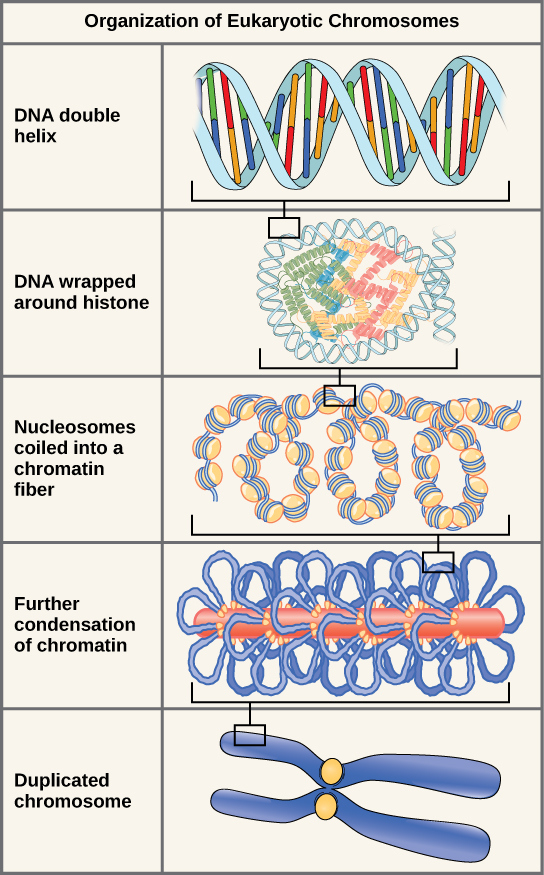

Figure 14.11図 14.11
These figures illustrate the compaction of the eukaryotic chromosome.
これらの図は、真核生物の染色体が密に折りたたまれる様子を示す。
Section Summary節のまとめ
The currently accepted model of the double-helix structure of DNA was proposed by Watson and Crick. Some of the salient features are that the two strands that make up the double helix have complementary base sequences and anti-parallel orientations. Alternating deoxyribose sugars and phosphates form the backbone of the structure, and the nitrogenous bases are stacked like rungs inside. The diameter of the double helix, 2 nm, is uniform throughout. A purine always pairs with a pyrimidine; A pairs with T, and G pairs with C. One turn of the helix has 10 base pairs. Prokaryotes are much simpler than eukaryotes in many of their features. Most prokaryotes contain a single, circular chromosome. In general, eukaryotic chromosomes contain a linear DNA molecule packaged into nucleosomes, and have two distinct regions that can be distinguished by staining, reflecting different states of packaging and compaction.
英語のヒント
現在受け入れられているDNA二重らせん構造のモデルは、ワトソンとクリックが提案したものである。その主な特徴として、二重らせんを構成する2本の鎖が相補的な塩基配列をもち、逆平行に並ぶことが挙げられる。デオキシリボース糖とリン酸が交互につながって構造の骨格を作り、含窒素塩基は内側にはしごの横木のように積み重なる。二重らせんの直径は2 nmで、全体を通して一定である。プリン塩基は常にピリミジン塩基と対を作り、AはTと、GはCと対になる。らせん1回転には10塩基対がある。原核生物は、多くの特徴において真核生物よりはるかに単純である。ほとんどの原核生物は1本の環状染色体をもつ。一般に、真核生物の染色体は、ヌクレオソームに収納された直鎖状のDNA分子を含む。染色によって区別できる2つの異なる領域があり、DNAの収納や凝縮の状態の違いを反映している。
Visual Connection Questions図を使った問題
Exercises 7練習問題 7
Exercise 7問題 7
Figure 14.10 In eukaryotic cells, DNA and RNA synthesis occur in a separate compartment from protein synthesis. In prokaryotic cells, both processes occur together. What advantages might there be to separating the processes? What advantages might there be to having them occur together?
図14.10 真核細胞では、DNAとRNAの合成は、タンパク質合成とは別の区画で行われる。原核細胞では、これらの過程は同じ場所で行われる。過程を分けることには、どのような利点が考えられるか。同じ場所で行うことには、どのような利点が考えられるか。
Solution解き方
Figure 14.10 Compartmentalization enables a eukaryotic cell to divide processes into discrete steps so it can build more complex protein and RNA products. But there is an advantage to having a single compartment as well: RNA and protein synthesis occurs much more quickly in a prokaryotic cell.
英語のヒント
図14.10 区画化によって、真核細胞は過程を個別の段階に分けることができるため、より複雑なタンパク質やRNAを作れる。ただし、1つの区画で行うことにも利点がある。原核細胞では、RNAとタンパク質の合成がはるかに速く進む。