第14章DNAの構造と機能
14.3 Basics of DNA Replication14.3 DNA複製の基礎
Learning Objectives学習目標
By the end of this section, you will be able to do the following:
この節を学ぶと、次のことができるようになる。
- Explain how the structure of DNA reveals the replication processDNAの構造から、複製の過程がどのように明らかになるかを説明する。
- Describe the Meselson and Stahl experimentsメセルソンとスタールの実験を説明する。
The elucidation of the structure of the double helix provided a hint as to how DNA divides and makes copies of itself. In their 1953 paper, Watson and Crick penned an incredible understatement: "It has not escaped our notice that the specific pairing we have postulated immediately suggests a possible copying mechanism for the genetic material." With specific base pairs, the sequence of one DNA strand can be predicted from its complement. The double-helix model suggests that the two strands of the double helix separate during replication, and each strand serves as a template from which the new complementary strand is copied. What was not clear was how the replication took place. There were three models suggested (Figure 14.12): conservative, semi-conservative, and dispersive.
英語のヒント
二重らせん構造の解明は、DNAがどのように分かれて自分自身のコピーを作るかを知る手がかりを与えた。1953年の論文で、ワトソンとクリックは驚くほど控えめに、こう書いている。「私たちが仮定した特異的な対形成が、遺伝物質の複製機構の可能性を直ちに示唆することを、私たちは見落としてはいない。」塩基が特定の相手と対を作るため、一方のDNA鎖の配列は、相補的な鎖から予測できる。二重らせんモデルからは、複製の際に二重らせんの2本の鎖が分かれ、それぞれが鋳型となって、新しい相補鎖がコピーされることが示唆される。明らかでなかったのは、どのような形で複製が起こるかだった。保存的、半保存的、分散的という3つのモデルが提案された(図14.12)。
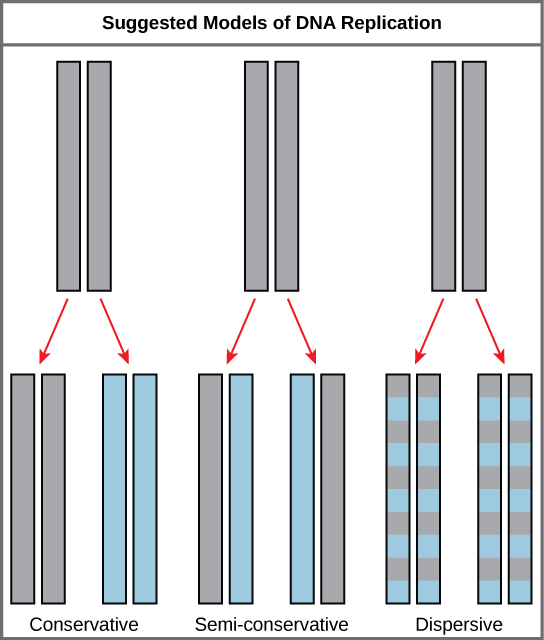

Figure 14.12図 14.12
The three suggested models of DNA replication. Gray indicates the original DNA strands, and blue indicates newly synthesized DNA.
DNA複製について提案された3つのモデル。灰色は元のDNA鎖、青色は新しく合成されたDNAを示す。
In conservative replication, the parental DNA remains together, and the newly formed daughter strands are together. The semi-conservative method suggests that each of the two parental DNA strands acts as a template for new DNA to be synthesized; after replication, each double-stranded DNA includes one parental or “old” strand and one “new” strand. In the dispersive model, both copies of DNA have double-stranded segments of parental DNA and newly synthesized DNA interspersed.
英語のヒント
保存的複製では、親DNAの2本の鎖は一緒のまま残り、新しくできた娘鎖どうしが一緒になる。半保存的複製では、親DNAの2本の鎖がそれぞれ、新しいDNAを合成するための鋳型として働く。複製後の各二本鎖DNAには、親由来の「古い」鎖が1本と「新しい」鎖が1本含まれる。分散的モデルでは、どちらのDNAコピーにも、親DNAの二本鎖部分と新しく合成されたDNAの二本鎖部分が入り交じる。
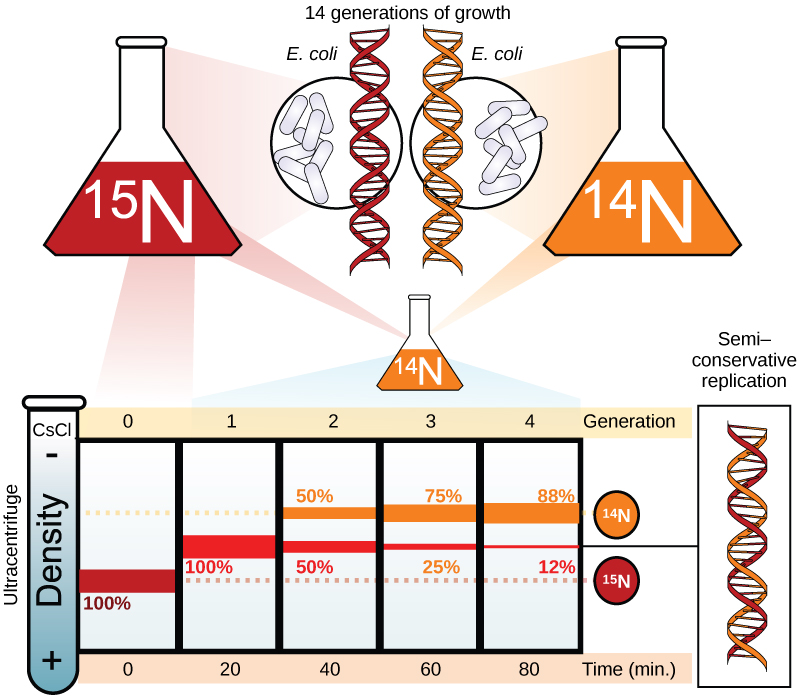
Meselson and Stahl were interested in understanding how DNA replicates. They grew E. coli for several generations in a medium containing a “heavy” isotope of nitrogen (15N), which gets incorporated into nitrogenous bases, and eventually into the DNA (Figure 14.13).
英語のヒント
メセルソンとスタールは、DNAがどのように複製されるのかに関心をもった。彼らは、窒素の「重い」同位体(15N)を含む培地で、大腸菌を何世代かにわたって増殖させた。この同位体は含窒素塩基に取り込まれ、最終的にDNAに組み込まれる(図14.13)。
OpenStax, Rice University; Biology 2e. (credit: modification of work by Mariana Ruiz Villareal) · CC BY 4.0 · Source出典

Figure 14.13図 14.13
Meselson and Stahl experimented with E. coli grown first in heavy nitrogen (15N) then in 14N. DNA grown in 15N (red band) is heavier than DNA grown in 14N (orange band), and sediments to a lower level in cesium chloride solution in an ultracentrifuge. When DNA grown in 15N is switched to media containing 14N, after one round of cell division the DNA sediments halfway between the 15N and 14N levels, indicating that it now contains fifty percent 14N. In subsequent cell divisions, an increasing amount of DNA contains 14N only. These data support the semi-conservative replication model. (credit: modification of work by Mariana Ruiz Villareal)
英語のヒント
メセルソンとスタールは、まず重窒素(15N)、次に14Nのもとで増殖させた大腸菌を使って実験した。15Nのもとで作られたDNA(赤いバンド)は、14Nのもとで作られたDNA(橙色のバンド)より重く、超遠心分離機で塩化セシウム溶液のより下の位置に沈降する。15Nで作られたDNAを、14Nを含む培地に移すと、1回の細胞分裂後、DNAは15Nと14Nの位置の中間に沈降する。このことは、DNAの窒素の50%が14Nになったことを示す。その後の細胞分裂では、14Nだけを含むDNAの量が増えていく。これらのデータは、半保存的複製モデルを支持している。(クレジット:Mariana Ruiz Villarealの作品を改変)
The E. coli culture was then placed into medium containing 14N and allowed to grow for several generations. After each of the first few generations, the cells were harvested and the DNA was isolated, then centrifuged at high speeds in an ultracentrifuge. During the centrifugation, the DNA was loaded into a gradient (typically a solution of salt such as cesium chloride or sucrose) and spun at high speeds of 50,000 to 60,000 rpm. Under these circumstances, the DNA will form a band according to its buoyant density: the density within the gradient at which it floats. DNA grown in 15N will form a band at a higher density position (i.e., farther down the centrifuge tube) than that grown in 14N. Meselson and Stahl noted that after one generation of growth in 14N after they had been shifted from 15N, the single band observed was intermediate in position in between DNA of cells grown exclusively in 15N and 14N. This suggested either a semi-conservative or dispersive mode of replication. The DNA harvested from cells grown for two generations in 14N formed two bands: one DNA band was at the intermediate position between 15N and 14N, and the other corresponded to the band of 14N DNA. These results could only be explained if DNA replicates in a semi-conservative manner. And for this reason, therefore, the other two models were ruled out.
英語のヒント
次に、大腸菌の培養物を14Nを含む培地へ移し、何世代か増殖させた。最初の数世代については、各世代が終わるたびに細胞を回収し、DNAを単離して超遠心分離機で高速遠心分離した。遠心分離では、DNAを密度勾配(通常は塩化セシウムなどの塩、またはスクロースの溶液)に載せ、毎分5万〜6万回転という高速で回転させた。この条件下では、DNAはその浮遊密度、すなわち密度勾配の中で浮かぶ位置の密度に応じてバンドを形成する。15Nのもとで作られたDNAは、14Nのもとで作られたDNAより高密度の位置、つまり遠心管のより下の位置にバンドを形成する。メセルソンとスタールは、15Nから14Nへ切り替えて1世代増殖させた後に観察されるバンドが1本であり、その位置が、 15Nだけで育てた細胞のDNAと14Nだけで育てた細胞のDNAの中間になることに気づいた。これは、半保存的か分散的のどちらかの複製様式を示唆していた。14Nのもとで2世代増殖させた細胞から回収したDNAは、2本のバンドを形成した。1本は15Nと14Nの中間の位置にあり、もう1本は14NのDNAのバンドに相当した。この結果は、DNAが半保存的に複製される場合にしか説明できない。そのため、残る2つのモデルは退けられた。
During DNA replication, each of the two strands that make up the double helix serves as a template from which new strands are copied. The new strands will be complementary to the parental or “old” strands. When two daughter DNA copies are formed, they have the same sequence and are divided equally into the two daughter cells.
英語のヒント
DNA複製では、二重らせんを構成する2本の鎖がそれぞれ、新しい鎖をコピーするための鋳型となる。新しい鎖は、親由来の「古い」鎖に相補的である。こうしてできた2つの娘DNAコピーは同じ配列をもち、2つの娘細胞に等しく分配される。