第21章失業
21.1 How Economists Define and Compute Unemployment Rate21.1 経済学者による失業率の定義と計算
Learning Objectives学習目標
Learning Objectives学習目標
By the end of this section, you will be able to:
英語のヒント
この節を学ぶと、次のことができるようになる。
- Calculate the labor force participation rate and the unemployment rate
英語のヒント
労働参加率と失業率を計算する - Explain hidden unemployment and what it means to be in or out of the labor force
英語のヒント
隠れた失業と、労働力人口に含まれること・含まれないことの意味を説明する - Evaluate the collection and interpretation of unemployment data
英語のヒント
失業データの収集と解釈を評価する
Newspaper or television reports typically describe unemployment as a percentage or a rate. A recent report might have said, for example, from September 2021 to October 2021, the U.S. unemployment rate declined from 4.8% to 4.6%. At a glance, the changes between the percentages may seem small. However, remember that the U.S. economy has about 162 million adults (as of the beginning of 2022) who either have jobs or are looking for them. A rise or fall of just 0.1% in the unemployment rate of 162 million potential workers translates into 160,000 people, which is roughly the total population of a city like Syracuse, New York, Brownsville, Texas, or Pasadena, California. Large rises in the unemployment rate mean large numbers of job losses. In April 2020, at the peak of the pandemic-induced recession, over 20 million people were out of work. Even with the unemployment rate at 4.2% in November 2021, about 7 million people who were looking for jobs were out of work.
英語のヒント
新聞やテレビの報道は、通常、失業を割合や率として説明する。たとえば最近の報道では、2021年9月から10月にかけて米国の失業率が4.8%から4.6%に低下したと伝えられたかもしれない。一見すると、割合の変化は小さくみえる。しかし、米国経済には、仕事を持つか仕事を探している成人が約1億6200万人いることを思い出そう(2022年初め時点)。1億6200万人の潜在的な労働者について、失業率がわずか0.1%上下するだけでも16万人に相当する。これはニューヨーク州シラキュース、テキサス州ブラウンズビル、カリフォルニア州パサデナのような都市の総人口にほぼ等しい。失業率の大幅な上昇は、多数の失職を意味する。パンデミックによる景気後退の頂点だった2020年4月には、2000万人以上が仕事を失っていた。2021年11月に失業率が4.2%になっても、仕事を探していた約700万人に仕事がなかった。
Additional Resources追加教材
Who’s In or Out of the Labor Force?誰が労働力人口に含まれ、誰が含まれないのか
Should we count everyone without a job as unemployed? Of course not. For example, we should not count children as unemployed. Surely, we should not count the retired as unemployed. Many full-time college students have only a part-time job, or no job at all, but it seems inappropriate to count them as suffering the pains of unemployment. Some people are not working because they are rearing children, ill, on vacation, or on parental leave.
英語のヒント
仕事のない人を全員、失業者として数えるべきだろうか。もちろん違う。たとえば、子どもを失業者として数えるべきではない。退職者も、当然、失業者として数えるべきではない。全日制の大学生の多くは、パートタイムの仕事しか持たないか、まったく仕事がないが、彼らを失業の苦しみを受けている人として数えるのは不適切に思われる。子育て、病気、休暇、育児休業のために働いていない人もいる。
The point is that we do not just divide the adult population into employed and unemployed. A third group exists: people who do not have a job, and for some reason—retirement, looking after children, taking a voluntary break before a new job—are not interested in having a job, either. It also includes those who do want a job but have quit looking, often due to discouragement due to their inability to find suitable employment. Economists refer to this third group of those who are not working and not looking for work as out of the labor force or not in the labor force.
英語のヒント
要点は、成人人口を就業者と失業者だけに分けるわけではない、ということである。第3の集団が存在する。仕事がなく、退職、子どもの世話、新しい仕事に就く前の自発的な休みなどの理由で、仕事に就くことにも関心がない人々である。仕事を望んでいても、適切な仕事が見つからないことに落胆して、求職活動をやめた人も含まれる。経済学者は、働いておらず仕事も探していないこの第3の集団を、労働力人口の外にいる、すなわち非労働力人口と呼ぶ。
The U.S. unemployment rate, which is based on a monthly survey carried out by the U.S. Bureau of the Census, asks a series of questions to divide the adult population into employed, unemployed, or not in the labor force. To be classified as unemployed, a person must be without a job, currently available to work, and actively looking for work in the previous four weeks. Thus, a person who does not have a job but who is not currently available to work or has not actively looked for work in the last four weeks is counted as out of the labor force.
英語のヒント
米国の失業率は、米国国勢調査局が毎月行う調査に基づいており、一連の質問によって成人人口を就業者、失業者、非労働力人口に分ける。失業者に分類されるには、仕事がなく、現在働くことができ、直近の4週間に積極的に仕事を探していなければならない。したがって、仕事がなくても、現在働けないか、過去4週間に積極的に仕事を探していない人は、非労働力人口として数えられる。
Employed: currently working for pay
英語のヒント
就業者:現在、報酬を得て働いている。
Unemployed: Out of work and actively looking for a job
英語のヒント
失業者:仕事がなく、積極的に仕事を探している。
Out of the labor force: Out of paid work and not actively looking for a job
英語のヒント
非労働力人口:有給の仕事がなく、積極的に仕事を探していない。
Labor force: the number of employed plus the unemployed
英語のヒント
労働力人口:就業者数と失業者数の合計。
Calculating the Unemployment Rate失業率の計算
Figure 21.2 shows the three-way division of the 16-and-over population. In November 2021, about 61.8% of the adult population was "in the labor force"; that is, people are either employed or without a job but looking for work. We can divide those in the labor force into the employed and the unemployed. Table 21.1 shows those values. The unemployment rate is not the percentage of the total adult population without jobs, but rather the percentage of adults who are in the labor force but who do not have jobs:
英語のヒント
Employed, Unemployed, and Out of the Labor Force Distribution of Adult Population (age 16 and older), November 2021成人人口(16歳以上)の就業者・失業者・非労働力人口への分布、2021年11月
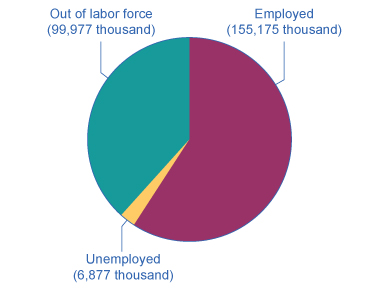

Figure 21.2図 21.2
The total adult, working-age population in November 2021 was 262.029 million. Out of this total population, 155.175 million were classified as employed, and 6.877 million were classified as unemployed. The remaining 99.977 million were classified as out of the labor force. As you will learn, however, this seemingly simple chart does not tell the whole story. As you will learn, however, this seemingly simple chart does not tell the whole story.
英語のヒント
2021年11月の成人の生産年齢人口は合計2億6202万9000人だった。そのうち1億5517万5000人が就業者、687万7000人が失業者に分類された。残る9997万7000人は非労働力人口に分類された。しかし、これから学ぶように、この一見単純な図だけでは全体像は分からない。しかし、これから学ぶように、この一見単純な図だけでは全体像は分からない。
Total adult population over the age of 16 16歳を超える成人人口の合計 |
262.029 million 2億6202万9000人 |
In the labor force 労働力人口 |
162.052 million (61.8%) 1億6205万2000人(61.8%) |
Employed 就業者 |
155.175 million 1億5517万5000人 |
Unemployed 失業者 |
6.877 million 687万7000人 |
Out of the labor force 非労働力人口 |
99.977 million (38.2%) 9997万7000人(38.2%) |
In this example, we can calculate the unemployment rate as 6.877 million unemployed people divided by 162.052 million people in the labor force, which works out to a 4.2% rate of unemployment. The following Work It Out feature will walk you through the steps of this calculation.
英語のヒント
この例では、失業者687万7000人を労働力人口1億6205万2000人で割ることで、失業率を計算できる。結果は4.2%である。次の「計算してみよう」では、この計算の手順を順に説明する。