第21章失業
21.3 What Causes Changes in Unemployment over the Short Run21.3 短期的な失業の変化を引き起こすもの
Learning Objectives学習目標
Learning Objectives学習目標
By the end of this section, you will be able to:
英語のヒント
この節を学ぶと、次のことができるようになる。
- Analyze cyclical unemployment
英語のヒント
循環的失業を分析する - Explain the relationship between sticky wages and employment using various economic arguments
英語のヒント
さまざまな経済学的議論を用いて、硬直的な賃金と雇用の関係を説明する - Apply supply and demand models to unemployment and wages
英語のヒント
需要・供給モデルを失業と賃金に適用する
We have seen that unemployment varies across times and places. What causes changes in unemployment? There are different answers in the short run and in the long run. Let's look at the short run first.
英語のヒント
失業が時期や場所によって異なることを見てきた。失業の変化を引き起こすのは何だろうか。短期と長期では答えが異なる。まず短期を見てみよう。
Cyclical Unemployment循環的失業
Let’s make the plausible assumption that in the short run, from a few months to a few years, the quantity of hours that the average person is willing to work for a given wage does not change much, so the labor supply curve does not shift much. In addition, make the standard ceteris paribus assumption that there is no substantial short-term change in the age structure of the labor force, institutions and laws affecting the labor market, or other possibly relevant factors.
英語のヒント
数か月から数年という短期には、平均的な人が一定の賃金で働こうとする時間数はあまり変わらず、そのため労働供給曲線も大きくはシフトしない、という妥当な仮定を置こう。さらに、労働力人口の年齢構成、労働市場に影響する制度や法律、その他の関係しうる要因には、短期に大きな変化がないという、標準的な「他の条件を一定とする」仮定を置く。
One primary determinant of the demand for labor from firms is how they perceive the state of the macro economy. If firms believe that business is expanding, then at any given wage they will desire to hire a greater quantity of labor, and the labor demand curve shifts to the right. Conversely, if firms perceive that the economy is slowing down or entering a recession, then they will wish to hire a lower quantity of labor at any given wage, and the labor demand curve will shift to the left. Economists call the variation in unemployment that the economy causes moving from expansion to recession or from recession to expansion (i.e. the business cycle) cyclical unemployment.
英語のヒント
企業の労働需要を決める主な要因の一つは、企業がマクロ経済の状態をどう認識するかである。企業が景気は拡大していると考えれば、どの賃金水準でもより多くの労働を雇いたいと考え、労働需要曲線は右へシフトする。逆に、経済が減速している、あるいは景気後退に入りつつあると認識すれば、どの賃金水準でも雇いたい労働量が減り、労働需要曲線は左へシフトする。景気拡大から景気後退へ、あるいは景気後退から景気拡大へという経済の移行(すなわち景気循環)によって生じる失業の変動を、経済学者は循環的失業と呼ぶ。
From the standpoint of the supply-and-demand model of competitive and flexible labor markets, unemployment represents something of a puzzle. In a supply-and-demand model of a labor market, as Figure 21.5 illustrates, the labor market should move toward an equilibrium wage and quantity. At the equilibrium wage (We), the equilibrium quantity (Qe) of labor supplied by workers should be equal to the quantity of labor demanded by employers.
英語のヒント
競争的で柔軟な労働市場の需要・供給モデルからみると、失業は一種の謎である。図21.5に示す労働市場の需要・供給モデルでは、労働市場は均衡賃金と均衡量に向かうはずである。均衡賃金(We)では、労働者が供給する労働の均衡量(Qe)は、雇用主が需要する労働量と等しくなるはずである。
The Unemployment and Equilibrium in the Labor Market労働市場の失業と均衡
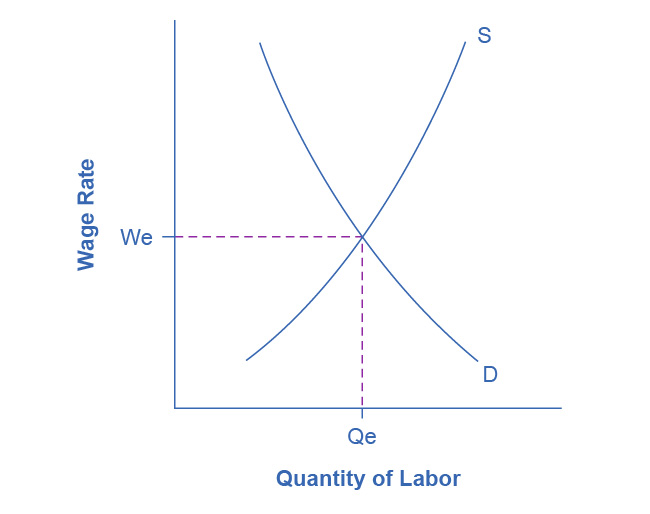
Figure 21.5図 21.5
In a labor market with flexible wages, the equilibrium will occur at wage We and quantity Qe, where the number of people who want jobs (shown by S) equals the number of jobs available (shown by D).
英語のヒント
賃金が柔軟な労働市場では、仕事を求める人数(Sで示す)が求人の数(Dで示す)に等しくなる、賃金We、量Qeで均衡が成立する。
One possibility for unemployment is that people who are unemployed are those who are not willing to work at the current equilibrium wage, say $10 an hour, but would be willing to work at a higher wage, like $20 per hour. The monthly Current Population Survey would count these people as unemployed, because they say they are ready and looking for work (at $20 per hour). However, from an economist’s perspective, these people are choosing to be unemployed.
英語のヒント
失業について考えられる一つの可能性は、失業者が、たとえば時給10ドルという現在の均衡賃金では働きたくないが、時給20ドルのように高い賃金なら働きたい人々だというものである。毎月の現況人口調査は、これらの人々を失業者として数える。本人が、(時給20ドルなら)働く用意があり、仕事を探していると答えるからである。しかし経済学者の観点からは、これらの人々は失業していることを選んでいる。
Probably a few people are unemployed because of unrealistic expectations about wages, but they do not represent the majority of the unemployed. Instead, unemployed people often have friends or acquaintances of similar skill levels who are employed, and the unemployed would be willing to work at the jobs and wages similar to what those people are receiving. However, the employers of their friends and acquaintances do not seem to be hiring. In other words, these people are involuntarily unemployed. What causes involuntary unemployment?
英語のヒント
賃金への非現実的な期待のために失業している人は、おそらく少数いるが、失業者の大半ではない。むしろ失業者には、同程度の技能を持ち、就業している友人や知人がいることが多い。失業者は、それらの人々と同じような仕事と賃金で働く意思を持つ。しかし友人や知人の雇用主は、採用をしていないようである。言い換えると、これらの人々は非自発的に失業している。何が非自発的失業を引き起こすのだろうか。
Why Wages Might Be Sticky Downward賃金が下方に硬直的でありうる理由
If a labor market model with flexible wages does not describe unemployment very well—because it predicts that anyone willing to work at the going wage can always find a job—then it may prove useful to consider economic models in which wages are not flexible or adjust only very slowly. In particular, even though wage increases may occur with relative ease, wage decreases are few and far between.
英語のヒント
賃金が柔軟な労働市場モデルは、現行賃金で働く意思がある人はいつでも仕事を見つけられると予測するため、失業をうまく説明できない。そうであれば、賃金が柔軟でない、あるいは非常に緩やかにしか調整されない経済モデルを考えると役立つかもしれない。特に、賃上げは比較的容易に起こることがあるのに、賃下げはめったに起こらない。
One set of reasons why wages may be “sticky downward,” as economists put it, involves economic laws and institutions. For low-skilled workers receiving minimum wage, it is illegal to reduce their wages. For union workers operating under a multiyear contract with a company, wage cuts might violate the contract and create a labor dispute or a strike. However, minimum wages and union contracts are not a sufficient reason why wages would be sticky downward for the U.S. economy as a whole. After all, out of the 73.3 million or so employed workers in the U.S. economy who earn wages by the hour, only about 1.1 million—less than 2% of the total—do not receive compensation above the minimum wage. Similarly, labor unions represent only about 12% of American wage and salary workers. In other high-income countries, more workers may have their wages determined by unions or the minimum wage may be set at a level that applies to a larger share of workers. However, for the United States, these two factors combined affect only about 15% or less of the labor force.
英語のヒント
経済学者の表現で、賃金が「下方に硬直的」になりうる理由の一群には、経済に関わる法律や制度がある。最低賃金を受け取る低技能労働者の賃金を下げることは違法である。企業との複数年契約のもとで働く組合員の場合、賃下げは契約違反となり、労働争議やストライキを引き起こすことがある。しかし、最低賃金や労働協約だけでは、米国経済全体で賃金が下方硬直的になる十分な理由にならない。米国経済で時給を得ている約7330万人の就業者のうち、最低賃金を超える報酬を受け取っていないのは、総数の2%未満に当たる約110万人にすぎない。同様に、労働組合が代表するのは米国の賃金・給与労働者の約12%にすぎない。他の高所得国では、組合が賃金を決める労働者がもっと多かったり、最低賃金がより多くの労働者に当てはまる水準に設定されていたりするかもしれない。しかし米国では、この二つの要因を合わせても、影響を受けるのは労働力人口の約15%以下である。
Economists looking for reasons why wages might be sticky downwards have focused on factors that may characterize most labor relationships in the economy, not just a few. Many have proposed a number of different theories, but they share a common tone.
英語のヒント
賃金が下方硬直的になりうる理由を探す経済学者は、ごく一部でなく、経済の大半の労働関係に当てはまりうる要因に注目してきた。さまざまな理論が提案されているが、それらには共通する基調がある。
One argument is that even employees who are not union members often work under an implicit contract, which is that the employer will try to keep wages from falling when the economy is weak or the business is having trouble, and the employee will not expect huge salary increases when the economy or the business is strong. This wage-setting behavior acts like a form of insurance: the employee has some protection against wage declines in bad times, but pays for that protection with lower wages in good times. Clearly, this sort of implicit contract means that firms will be hesitant to cut wages, lest workers feel betrayed and work less hard or even leave the firm.
英語のヒント
一つの議論は、組合員でない従業員でさえ、暗黙の契約のもとで働くことが多いというものである。その契約とは、経済が弱いときや企業が困難に陥ったとき、雇用主は賃金を下げないよう努め、経済や企業が好調なとき、従業員は大幅な賃上げを期待しない、というものである。この賃金決定の行動は、一種の保険として働く。従業員は不況時の賃下げからある程度守られるが、好況時の低めの賃金によって、その保護の代価を払う。明らかに、このような暗黙の契約は、企業が賃下げをためらうことを意味する。労働者が裏切られたと感じ、仕事への努力を減らし、さらには退職するおそれがあるからである。
Efficiency wage theory argues that workers' productivity depends on their pay, and so employers will often find it worthwhile to pay their employees somewhat more than market conditions might dictate. One reason is that employees who receive better pay than others will be more productive because they recognize that if they were to lose their current jobs, they would suffer a decline in salary. As a result, they are motivated to work harder and to stay with the current employer. In addition, employers know that it is costly and time-consuming to hire and train new employees, so they would prefer to pay workers a little extra now rather than to lose them and have to hire and train new workers. Thus, by avoiding wage cuts, the employer minimizes costs of training and hiring new workers, and reaps the benefits of well-motivated employees.
英語のヒント
効率賃金理論は、労働者の生産性が賃金に依存するため、雇用主は、市場の条件が示す水準よりやや多くの賃金を払う価値があると判断することが多いと主張する。一つの理由は、他の人より高い賃金を受け取る従業員は、現在の仕事を失えば給与が下がると認識するため、生産性が高くなるということである。その結果、より懸命に働き、現在の雇用主のもとにとどまろうとする。さらに雇用主は、新しい従業員の採用と訓練には費用と時間がかかると知っている。そのため、従業員を失って新しい労働者を採用・訓練するよりも、現在の労働者に少し多めに払うことを好む。したがって雇用主は、賃下げを避けることで新しい労働者の訓練・採用費用を最小にし、意欲の高い従業員から便益を得る。
The adverse selection of wage cuts argument points out that if an employer reacts to poor business conditions by reducing wages for all workers, then the best workers, those with the best employment alternatives at other firms, are the most likely to leave. The least attractive workers, with fewer employment alternatives, are more likely to stay. Consequently, firms are more likely to choose which workers should depart, through layoffs and firings, rather than trimming wages across the board. Sometimes companies that are experiencing difficult times can persuade workers to take a pay cut for the short term, and still retain most of the firm’s workers. However, it is far more typical for companies to lay off some workers, rather than to cut wages for everyone.
英語のヒント
賃下げの逆選択という議論は、雇用主が経営悪化に対応して全労働者の賃金を下げると、他社で最もよい雇用の選択肢を持つ、最も優れた労働者が最も離職しやすいと指摘する。雇用の選択肢が少ない、最も魅力の乏しい労働者は残りやすい。そのため企業は、賃金を一律に削るよりも、人員整理や解雇によって誰に去ってもらうかを選ぶ可能性が高い。苦境にある企業が、短期的な賃下げを受け入れるよう労働者を説得し、大半を維持できる場合もある。しかし、全員の賃金を下げるよりも、一部の労働者を解雇する方が、はるかに一般的である。
The insider-outsider model of the labor force, in simple terms, argues that those already working for firms are “insiders,” while new employees, at least for a time, are “outsiders.” A firm depends on its insiders to keep the organization running smoothly, to be familiar with routine procedures, and to train new employees. However, cutting wages will alienate the insiders and damage the firm’s productivity and prospects.
英語のヒント
労働力のインサイダー・アウトサイダー・モデルは、簡単にいえば、すでに企業で働く人を「内部者」、新しい従業員を少なくとも当面は「外部者」とみなす。企業は、組織を円滑に動かし、日常業務の手順を熟知し、新しい従業員を訓練するために、内部者に頼る。しかし、賃下げは内部者の心を離れさせ、企業の生産性と見通しを損なう。
Finally, the relative wage coordination argument points out that even if most workers were hypothetically willing to see a decline in their own wages in bad economic times as long as everyone else also experiences such a decline, there is no obvious way for a decentralized economy to implement such a plan. Instead, workers confronted with the possibility of a wage cut will worry that other workers will not have such a wage cut, and so a wage cut means being worse off both in absolute terms and relative to others. As a result, workers fight hard against wage cuts.
英語のヒント
最後に、相対賃金の調整という議論は、仮に大半の労働者が、他の全員も同様に賃下げを受けるなら不況時に自分の賃金が下がることを受け入れるとしても、分権的な経済には、その計画を実行する明確な方法がないと指摘する。むしろ、賃下げの可能性に直面する労働者は、他の労働者は賃下げされないのではないかと心配する。そのため賃下げは、絶対的にも他人との相対的な関係でも、生活が悪化することを意味する。その結果、労働者は賃下げに強く抵抗する。
These theories of why wages tend not to move downward differ in their logic and their implications, and figuring out the strengths and weaknesses of each theory is an ongoing subject of research and controversy among economists. All tend to imply that wages will decline only very slowly, if at all, even when the economy or a business is having tough times. When wages are inflexible and unlikely to fall, then either short-run or long-run unemployment can result. Figure 21.6 illustrates this.
英語のヒント
賃金が下がりにくい理由についてのこれらの理論は、論理と含意が異なる。それぞれの長所と短所を明らかにすることは、経済学者の間で研究と論争の継続的な課題となっている。どの理論も、経済や企業が苦境にあっても、賃金は下がるとしてもごく緩やかにしか下がらないことを示唆する傾向がある。賃金が柔軟でなく下がりにくいとき、短期または長期の失業が生じうる。図21.6はこれを示す。
Sticky Wages in the Labor Market労働市場の硬直的な賃金
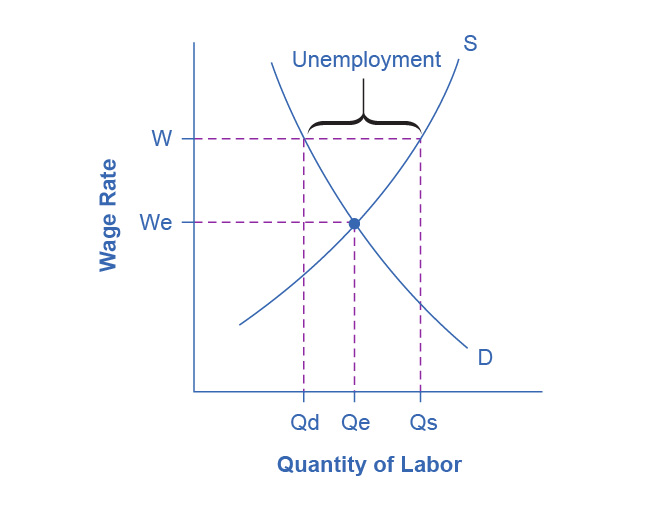


Figure 21.6図 21.6
Because the wage rate is stuck at W, above the equilibrium, the number of those who want jobs (Qs) is greater than the number of job openings (Qd). The result is unemployment, shown by the bracket in the figure.
英語のヒント
賃金率が均衡より高いWで固定されているため、仕事を求める人数(Qs)は求人数(Qd)を上回る。その結果、図の括弧で示す失業が生じる。