第21章失業
Figure 21.7 shows the interaction between shifts in labor demand and wages that are sticky downward. Figure 21.7 (a) illustrates the situation in which the demand for labor shifts to the right from D0 to D1. In this case, the equilibrium wage rises from W0 to W1 and the equilibrium quantity of labor hired increases from Q0 to Q1. It does not hurt employee morale at all for wages to rise.
英語のヒント
Figure 21.7 (b) shows the situation in which the demand for labor shifts to the left, from D0 to D1, as it would tend to do in a recession. Because wages are sticky downward, they do not adjust toward what would have been the new equilibrium wage (W1), at least not in the short run. Instead, after the shift in the labor demand curve, the same quantity of workers is willing to work at that wage as before; however, the quantity of workers demanded at that wage has declined from the original equilibrium (Q0) to Q2. The gap between the original equilibrium quantity (Q0) and the new quantity demanded of labor (Q2) represents workers who would be willing to work at the going wage but cannot find jobs. The gap represents the economic meaning of unemployment.
英語のヒント
図21.7(b)は、景気後退時に起こりやすいように、労働需要がD0からD1へ左にシフトする状況を示す。賃金は下方硬直的なので、少なくとも短期には、新しい均衡賃金となるはずのW1に向かって調整されない。代わりに、労働需要曲線のシフト後も、以前と同じ数の労働者がその賃金で働きたいと考える。しかし、その賃金で需要される労働者数は、元の均衡Q0からQ2へ減少している。元の均衡量Q0と新しい労働需要量Q2との差は、現行賃金で働きたいのに仕事が見つからない労働者を表す。この差が、経済学的な意味での失業を表す。
Rising Wage and Low Unemployment: Where Is the Unemployment in Supply and Demand?賃金上昇と低失業:需要と供給のどこに失業があるのか
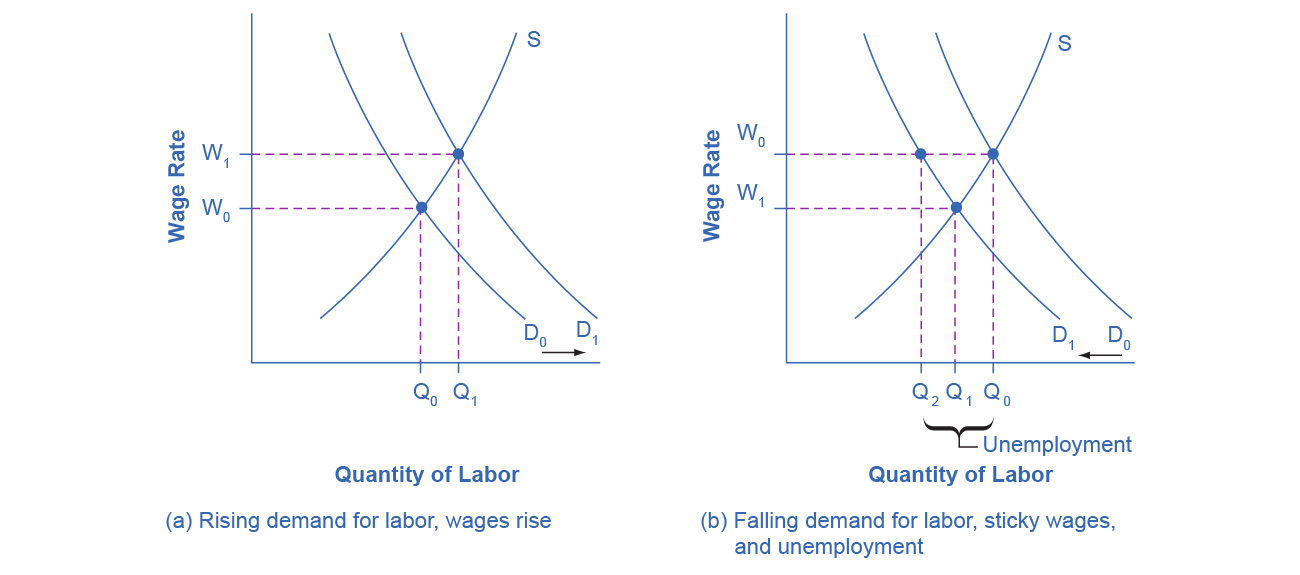
Figure 21.7図 21.7
(a) In a labor market where wages are able to rise, an increase in the demand for labor from D0 to D1 leads to an increase in equilibrium quantity of labor hired from Q0 to Q1 and a rise in the equilibrium wage from W0 to W1. (b) In a labor market where wages do not decline, a fall in the demand for labor from D0 to D1 leads to a decline in the quantity of labor demanded at the original wage (W0) from Q0 to Q2. These workers will want to work at the prevailing wage (W0), but will not be able to find jobs.
英語のヒント
(a)賃金が上がることのできる労働市場では、労働需要がD0からD1へ増加すると、雇用される労働の均衡量はQ0からQ1へ増え、均衡賃金はW0からW1へ上昇する。(b)賃金が下がらない労働市場では、労働需要がD0からD1へ減ると、元の賃金W0で需要される労働量はQ0からQ2へ減る。これらの労働者は現行賃金W0で働きたいと考えるが、仕事を見つけられない。
This analysis helps to explain the connection that we noted earlier: that unemployment tends to rise in recessions and to decline during expansions. The overall state of the economy shifts the labor demand curve and, combined with wages that are sticky downwards, unemployment changes. The rise in unemployment that occurs because of a recession is cyclical unemployment.
英語のヒント
この分析は、先ほど指摘した、失業は景気後退時に増え、景気拡大時に減る傾向があるという関係を説明するのに役立つ。経済全体の状態が労働需要曲線をシフトさせ、下方硬直的な賃金と組み合わさることで失業が変わる。景気後退によって生じる失業の増加が、循環的失業である。
Additional Resources追加教材
Key Concepts and Summary重要概念とまとめ
Cyclical unemployment rises and falls with the business cycle. In a labor market with flexible wages, wages will adjust in such a market so that quantity demanded of labor always equals the quantity supplied of labor at the equilibrium wage. Economists have proposed many theories for why wages might not be flexible, but instead may adjust only in a “sticky” way, especially when it comes to downward adjustments: implicit contracts, efficiency wage theory, adverse selection of wage cuts, insider-outsider model, and relative wage coordination.
英語のヒント
循環的失業は、景気循環に伴って増減する。賃金が柔軟な労働市場では、均衡賃金で労働需要量が常に労働供給量と等しくなるように賃金が調整される。経済学者は、賃金が柔軟でなく、特に下方調整において「硬直的」にしか調整されない理由について、多くの理論を提案してきた。暗黙の契約、効率賃金理論、賃下げの逆選択、インサイダー・アウトサイダー・モデル、相対賃金の調整がそれである。
Self-Check Questions理解度確認問題
Exercises 24練習問題 24
Exercise 24問題 24
Beginning in the 1970s and continuing for three decades, women entered the U.S. labor force in a big way. If we assume that wages are sticky in a downward direction, but that around 1970 the demand for labor equaled the supply of labor at the current wage rate, what do you imagine happened to the wage rate, employment, and unemployment as a result of increased labor force participation?
英語のヒント
1970年代に始まり、その後30年間にわたって、女性は米国の労働力人口に大規模に参入した。賃金は下方硬直的であり、1970年ごろには現行賃金率で労働需要と労働供給が等しかったと仮定すると、労働参加の増加によって、賃金率、雇用、失業はどうなったと考えられるか。
Solution解き方
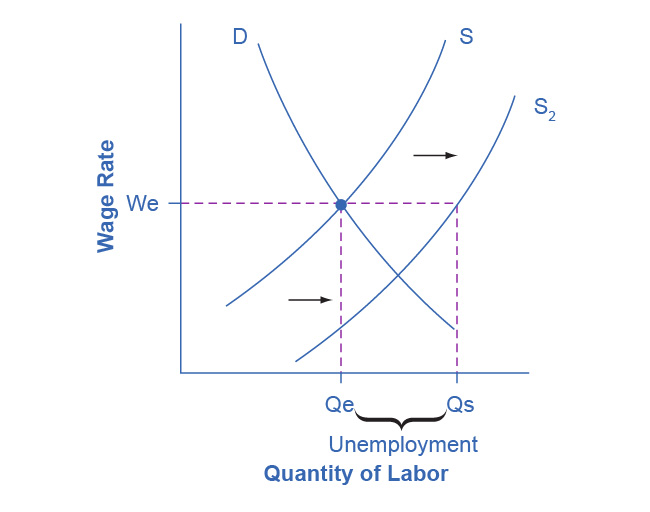
Because of the influx of women into the labor market, the supply of labor shifts to the right. Since wages are sticky downward, the increased supply of labor causes an increase in people looking for jobs (Qs), but no change in the number of jobs available (Qe). As a result, unemployment increases by the amount of the increase in the labor supply. This can be seen in the following figure.
英語のヒント
女性が労働市場に流入したため、労働供給は右へシフトする。賃金は下方硬直的なので、労働供給の増加は仕事を求める人数(Qs)を増やすが、求人の数(Qe)は変えない。その結果、労働供給の増加分だけ失業が増える。これは次の図で確認できる。
Over time, as labor demand grows, the unemployment will decline and eventually wages will begin to increase again. But this increase in labor demand goes beyond the scope of this problem.
英語のヒント
時間がたち、労働需要が増えると、失業は減り、やがて賃金が再び上がり始める。しかし、この労働需要の増加は、この問題の範囲を超えている。