第28章金融政策と銀行規制
Bank Runs銀行取り付け
Back in the nineteenth century and during the first few decades of the twentieth century (around and during the Great Depression), putting your money in a bank could be nerve-wracking. Imagine that the net worth of your bank became negative, so that the bank’s assets were not enough to cover its liabilities. In this situation, whoever withdrew their deposits first received all of their money, and those who did not rush to the bank quickly enough, lost their money. We call depositors racing to the bank to withdraw their deposits, as Figure 28.4 shows a bank run. In the movie It’s a Wonderful Life, the bank manager, played by Jimmy Stewart, faces a mob of worried bank depositors who want to withdraw their money, but manages to allay their fears by allowing some of them to withdraw a portion of their deposits—using the money from his own pocket that was supposed to pay for his honeymoon.
英語のヒント
19世紀から20世紀初めの数十年間、すなわち世界恐慌の前後や最中には、銀行に金を預けることは神経をすり減らすものだった。銀行の純資産が負となり、資産が負債を賄えなくなったと想像しよう。この状況では、先に引き出した人は全額を受け取るが、銀行に急ぐのが遅れた人は預金を失う。図28.4のように、預金者が引き出しのため銀行へ競って駆けつけることを、銀行取り付けと呼ぶ。映画『素晴らしき哉、人生!』では、ジミー・スチュワート演じる銀行経営者が、預金を引き出したいと不安に駆られた群衆に直面する。しかし、新婚旅行に使うはずだった自分の金で、一部の預金者に預金の一部を引き出させ、なんとか不安を和らげる。
A Run on the Bank銀行への取り付け
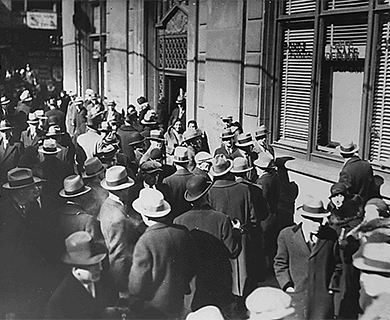
Bank runs during the Great Depression only served to worsen the economic situation. (Credit: “Depression: "Runs on Banks” by National Archives and Records Administration, Public Domain) · Public Domain · Source出典

Figure 28.4図 28.4
Bank runs during the Great Depression only served to worsen the economic situation. (Credit: “Depression: "Runs on Banks” by National Archives and Records Administration, Public Domain)
英語のヒント
世界恐慌中の銀行取り付けは、経済状況をさらに悪化させるだけだった。(出典:米国国立公文書記録管理局による「Depression: Runs on Banks」、パブリックドメイン)
The risk of bank runs created instability in the banking system. Even a rumor that a bank might experience negative net worth could trigger a bank run and, in a bank run, even healthy banks could be destroyed. Because a bank loans out most of the money it receives, and because it keeps only limited reserves on hand, a bank run of any size would quickly drain any of the bank’s available cash. When the bank had no cash remaining, it only intensified the fears of remaining depositors that they could lose their money. Moreover, a bank run at one bank often triggered a chain reaction of runs on other banks. In the late nineteenth and early twentieth century, bank runs were typically not the original cause of a recession—but they could make a recession much worse.
英語のヒント
銀行取り付けのリスクは、銀行制度を不安定にした。銀行の純資産が負になるかもしれないという噂だけでも取り付けを起こしうる。そして取り付けが起きれば、健全な銀行さえ破綻しうる。銀行は受け入れた資金の大部分を貸し出し、手元には限られた準備しか残さないため、取り付けが起きると、規模を問わず、利用可能な現金はすぐに流出する。現金がなくなると、まだ預金している人々の、金を失うかもしれないという恐れがいっそう強まるだけである。さらに、一つの銀行の取り付けは、しばしば他の銀行の取り付けを連鎖的に引き起こした。19世紀末から20世紀初頭にかけて、取り付けは通常、不況の最初の原因ではなかったが、不況をはるかに悪化させることがあった。
Deposit Insurance預金保険
To protect against bank runs, Congress has put two strategies into place: deposit insurance and the lender of last resort. Deposit insurance is an insurance system that makes sure depositors in a bank do not lose their money, even if the bank goes bankrupt. About 70 countries around the world, including all of the major economies, have deposit insurance programs. In the United States, the Federal Deposit Insurance Corporation (FDIC) is responsible for deposit insurance. Banks pay an insurance premium to the FDIC. The insurance premium is based on the bank’s level of deposits, and then adjusted according to the riskiness of a bank’s financial situation. In 2009, for example, a fairly safe bank with a high net worth might have paid 10–20 cents in insurance premiums for every $100 in bank deposits, while a risky bank with very low net worth might have paid 50–60 cents for every $100 in bank deposits.
英語のヒント
銀行取り付けを防ぐため、議会は二つの戦略を導入した。預金保険と最後の貸し手である。預金保険は、銀行が破綻しても預金者が金を失わないようにする保険制度である。主要な経済国のすべてを含め、世界の約70か国が預金保険制度をもつ。アメリカでは、連邦預金保険公社(FDIC)が預金保険を担当する。銀行はFDICに保険料を払う。保険料は預金額を基準に、銀行の財務状況のリスクに応じて調整される。たとえば2009年には、純資産が大きい比較的安全な銀行は、預金100ドルにつき10~20セントの保険料を払った可能性がある一方、純資産が非常に少ない危険な銀行は、100ドルにつき50~60セントを払った可能性がある。
Bank examiners from the FDIC evaluate the banks' balance sheets, looking at the asset and liability values to determine the risk level. The FDIC provides deposit insurance for about 4,914 banks (as of the third quarter of 2021). Even if a bank fails, the government guarantees that depositors will receive up to $250,000 of their money in each account, which is enough for almost all individuals, although not sufficient for many businesses. Since the United States enacted deposit insurance in the 1930s, no one has lost any of their insured deposits. Bank runs no longer happen at insured banks.
英語のヒント
FDICの銀行検査官は、銀行の貸借対照表を評価し、資産と負債の価値を見てリスク水準を決める。FDICは、2021年第3四半期時点で約4,914の銀行に預金保険を提供している。銀行が破綻しても、政府は預金者が各口座で25万ドルまで受け取れることを保証する。多くの企業には十分ではないが、ほとんどすべての個人には十分な額である。1930年代にアメリカが預金保険を導入して以来、付保された預金を失った人はいない。保険の対象となる銀行では、銀行取り付けはもはや起きない。
Lender of Last Resort最後の貸し手
The problem with bank runs is not that insolvent banks will fail; they are, after all, bankrupt and need to be shut down. The problem is that bank runs can cause solvent banks to fail and spread to the rest of the financial system. To prevent this, the Fed stands ready to lend to banks and other financial institutions when they cannot obtain funds from anywhere else. This is known as the lender of last resort role. For banks, the central bank acting as a lender of last resort helps to reinforce the effect of deposit insurance and to reassure bank customers that they will not lose their money.
英語のヒント
取り付けの問題は、支払い能力のない銀行が破綻することではない。そうした銀行はもともと破綻しており、閉鎖する必要がある。問題なのは、取り付けが支払い能力のある銀行まで破綻させ、金融制度のほかの部分へ広がりうることである。これを防ぐため、Fedは銀行などの金融機関が他のどこからも資金を得られないときに融資する用意をしている。これを「最後の貸し手」の役割と呼ぶ。中央銀行が最後の貸し手となることで、預金保険の効果が強まり、銀行の顧客は金を失わないと安心できる。
The lender of last resort task can arise in other financial crises, as well. During the 1987 stock market crash panic, when U.S. stock values fell by 25% in a single day, the Federal Reserve made a number of short-term emergency loans so that the financial system could keep functioning. During the 2008-2009 recession, we can interpret the Fed's “quantitative easing” policies (discussed below) as a willingness to make short-term credit available as needed in a time when the banking and financial system was under stress.
英語のヒント
最後の貸し手の仕事は、ほかの金融危機でも生じうる。アメリカの株価が一日で25%下落した1987年の株式市場暴落の恐慌では、連邦準備制度は金融制度の機能を維持するため、数多くの短期緊急融資を行った。2008~2009年の不況におけるFedの「量的緩和」政策(後述)も、銀行・金融制度が圧迫される中で、必要に応じて短期信用を供給する姿勢と解釈できる。