第28章金融政策と銀行規制
Unemployment and Inflation失業とインフレーション
If you were to survey central bankers around the world and ask them what they believe should be the primary task of monetary policy, the most popular answer by far would be fighting inflation. Most central bankers believe that the neoclassical model of economics accurately represents the economy over the medium to long term. Remember that in the neoclassical model of the economy, we draw the aggregate supply curve as a vertical line at the level of potential GDP, as Figure 28.10 shows. In the neoclassical model, economists determine the level of potential GDP (and the natural rate of unemployment that exists when the economy is producing at potential GDP) by real economic factors. If the original level of aggregate demand is AD0, then an expansionary monetary policy that shifts aggregate demand to AD1 only creates an inflationary increase in the price level, but it does not alter GDP or unemployment. From this perspective, all that monetary policy can do is to lead to low inflation or high inflation—and low inflation provides a better climate for a healthy and growing economy. After all, low inflation means that businesses making investments can focus on real economic issues, not on figuring out ways to protect themselves from the costs and risks of inflation. In this way, a consistent pattern of low inflation can contribute to long-term growth.
英語のヒント
世界中の中央銀行家に調査を行い、金融政策の主な仕事は何であるべきかと尋ねれば、圧倒的に多い答えはインフレとの闘いになるだろう。大半の中央銀行家は、新古典派の経済モデルが、中長期の経済を正確に表していると考えている。新古典派の経済モデルでは、図28.10に示すように、総供給曲線を潜在GDPの水準にある垂直線として描くことを思い出そう。新古典派モデルでは、経済学者は、潜在GDPの水準と、経済が潜在GDPで生産するときに存在する自然失業率を、実物的な経済要因によって決める。総需要のもとの水準がAD0なら、総需要をAD1へ移動させる拡張的金融政策は、物価水準のインフレ的上昇を起こすだけで、GDPも失業も変えない。この観点からは、金融政策にできることは、低いインフレか高いインフレをもたらすことだけであり、低いインフレは健全に成長する経済に、よりよい環境を与える。結局、インフレが低いとは、投資する企業が、インフレの費用や危険から身を守る方法の考案ではなく、実物的な経済問題に集中できるということである。このように、低いインフレが一貫して続くことは、長期成長に寄与しうる。
Monetary Policy in a Neoclassical Model新古典派モデルにおける金融政策
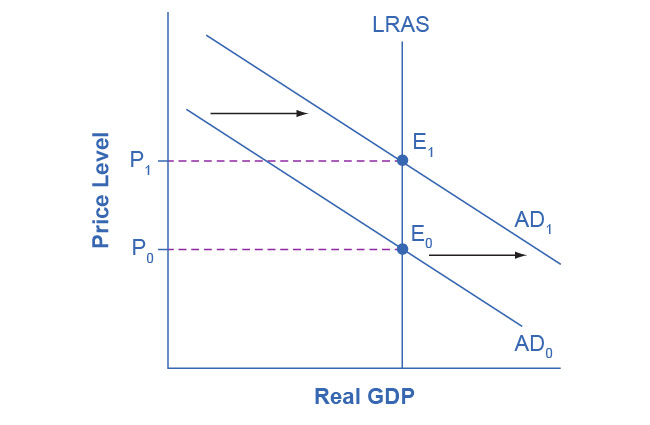

Figure 28.10図 28.10
In a neoclassical view, monetary policy affects only the price level, not the level of output in the economy. For example, an expansionary monetary policy causes aggregate demand to shift from the original AD0 to AD1. However, the adjustment of the economy from the original equilibrium (E0) to the new equilibrium (E1) represents an inflationary increase in the price level from P0 to P1, but has no effect in the long run on output or the unemployment rate. In fact, no shift in AD will affect the equilibrium quantity of output in this model.
英語のヒント
新古典派の見方では、金融政策が影響するのは物価水準だけであり、経済の生産水準ではない。たとえば、拡張的金融政策は総需要をもとのAD0からAD1へ移動させる。しかし、もとの均衡(E0)から新しい均衡(E1)への経済の調整は、物価水準がP0からP1へインフレ的に上昇することを表し、長期には生産量にも失業率にも影響しない。実際、このモデルでは、ADがどのように移動しても、均衡生産量には影響しない。
This vision of focusing monetary policy on a low rate of inflation is so attractive that many countries have rewritten their central banking laws since in the 1990s to have their bank practice inflation targeting, which means that the central bank is legally required to focus primarily on keeping inflation low. By 2014, central banks in 28 countries, including Austria, Brazil, Canada, Israel, Korea, Mexico, New Zealand, Spain, Sweden, Thailand, and the United Kingdom faced a legal requirement to target the inflation rate. A notable exception is the Federal Reserve in the United States, which does not practice inflation-targeting. Instead, the law governing the Federal Reserve requires it to take both unemployment and inflation into account.
英語のヒント
金融政策を低いインフレ率に集中させるという考えは非常に魅力的であり、多くの国は1990年代以降、中央銀行にインフレ目標政策を実施させるため、中央銀行法を書き換えた。インフレ目標政策とは、中央銀行が主としてインフレを低く保つことに注力するよう、法的に義務づけられることである。2014年までに、オーストリア、ブラジル、カナダ、イスラエル、韓国、メキシコ、ニュージーランド、スペイン、スウェーデン、タイ、イギリスを含む28か国の中央銀行は、インフレ率を目標とする法的義務を負っていた。目立つ例外がアメリカの連邦準備制度であり、インフレ目標政策を実施していない。その代わり、連邦準備制度を規定する法律は、失業とインフレの両方を考慮するよう求めている。
Economists have no final consensus on whether a central bank should be required to focus only on inflation or should have greater discretion. For those who subscribe to the inflation targeting philosophy, the fear is that politicians who are worried about slow economic growth and unemployment will constantly pressure the central bank to conduct a loose monetary policy—even if the economy is already producing at potential GDP. In some countries, the central bank may lack the political power to resist such pressures, with the result of higher inflation, but no long-term reduction in unemployment. The U.S. Federal Reserve has a tradition of independence, but central banks in other countries may be under greater political pressure. For all of these reasons—long and variable lags, excess reserves, unstable velocity, and controversy over economic goals—monetary policy in the real world is often difficult. The basic message remains, however, that central banks can affect aggregate demand through the conduct of monetary policy and in that way influence macroeconomic outcomes.
英語のヒント
中央銀行にインフレだけへの注力を義務づけるべきか、より大きな裁量を持たせるべきかについて、経済学者の間で最終的な合意はない。インフレ目標政策の考え方を支持する人々が恐れるのは、成長の鈍さと失業を懸念する政治家が、経済がすでに潜在GDPで生産していても、中央銀行に金融緩和政策を続けるよう絶えず圧力をかけることである。国によっては、中央銀行にその圧力へ抵抗する政治的な力がなく、インフレが上昇する一方で、失業は長期的には減らないという結果になりうる。アメリカの連邦準備制度には独立の伝統があるが、ほかの国の中央銀行は、より大きな政治的圧力にさらされているかもしれない。長く一定しない時間の遅れ、超過準備、不安定な流通速度、経済目標をめぐる論争という、これらすべての理由から、現実世界の金融政策はしばしば難しい。それでも基本的な要点は変わらない。中央銀行は金融政策の実施を通じて総需要に影響を与え、そのようにしてマクロ経済の結果に影響を及ぼせるのである。
Asset Bubbles and Leverage Cycles資産バブルとレバレッジ循環
One long-standing concern about having the central bank focus on inflation and unemployment is that it may be overlooking certain other economic problems that are coming in the future. For example, from 1994 to 2000 during what was known as the “dot-com” boom, the U.S. stock market, which the Dow Jones Industrial Index measures (which includes 30 very large companies from across the U.S. economy), nearly tripled in value. The Nasdaq index, which includes many smaller technology companies, increased in value by a multiple of five from 1994 to 2000. These rates of increase were clearly not sustainable. Stock values as measured by the Dow Jones were almost 20% lower in 2009 than they had been in 2000. Stock values in the Nasdaq index were 50% lower in 2009 than they had been in 2000. The drop-off in stock market values contributed to the 2001 recession and the higher unemployment that followed.
英語のヒント
中央銀行がインフレと失業に集中することについて、長年にわたる懸念の一つは、将来生じるほかの経済問題を見落としかねないということである。たとえば、いわゆる「ドットコム」ブームの1994~2000年、アメリカの株式市場は、ダウ・ジョーンズ工業株価指数で測ると、価値がほぼ3倍になった。この指数には、アメリカ経済全体から選ばれた30の巨大企業が含まれる。多数の小規模な技術企業を含むナスダック指数は、1994年から2000年までに5倍となった。このような上昇率が持続不可能であることは明らかだった。2009年の株価は、ダウ・ジョーンズで測ると、2000年よりもほぼ20%低かった。ナスダック指数の株価は、2009年には2000年より50%低かった。株式市場の価値の下落は、2001年の景気後退と、その後の失業増加の一因となった。
We can tell a similar story about housing prices in the mid-2000s. During the 1970s, 1980s, and 1990s, housing prices increased at about 6% per year on average. During what came to be known as the “housing bubble” from 2003 to 2005, housing prices increased at almost double this annual rate. These rates of increase were clearly not sustainable. When housing prices fell in 2007 and 2008, many banks and households found that their assets were worth less than they expected, which contributed to the recession that started in 2007.
英語のヒント
2000年代半ばの住宅価格にも、似た話が当てはまる。1970年代、1980年代、1990年代には、住宅価格は年平均約6%で上昇していた。後に「住宅バブル」と呼ばれるようになった2003~2005年には、住宅価格の年上昇率はそのほぼ2倍になった。このような上昇率が持続不可能であることは明らかだった。2007年と2008年に住宅価格が下落すると、多くの銀行や家計は、自分たちの資産の価値が予想より低いと気づいた。これが、2007年に始まった景気後退の一因となった。
At a broader level, some economists worry about a leverage cycle, where “leverage” is a term financial economists use to mean “borrowing.” When economic times are good, banks and the financial sector are eager to lend, and people and firms are eager to borrow. Remember that a money multiplier determines the amount of money and credit in an economy —a process of loans made, money deposited, and more loans made. In good economic times, this surge of lending exaggerates the episode of economic growth. It can even be part of what lead prices of certain assets—like stock prices or housing prices—to rise at unsustainably high annual rates. At some point, when economic times turn bad, banks and the financial sector become much less willing to lend, and credit becomes expensive or unavailable to many potential borrowers. The sharp reduction in credit, perhaps combined with the deflating prices of a dot-com stock price bubble or a housing bubble, makes the economic downturn worse than it would otherwise be.
英語のヒント
より広い観点では、レバレッジ循環を懸念する経済学者もいる。ここで「レバレッジ」とは、金融の経済学者が「借入れ」という意味で使う言葉である。景気がよいときには、銀行や金融部門は貸すことに積極的で、人々や企業は借りることに積極的である。経済の貨幣量と信用量は、融資が行われ、その資金が預金され、さらに融資が行われるという過程である、貨幣乗数によって決まることを思い出そう。景気がよい時期には、この貸出しの急増が経済成長の局面を増幅する。それは、株価や住宅価格など特定の資産価格を、持続不能な高い年率で上昇させる要因にもなりうる。やがて景気が悪くなると、銀行や金融部門は貸出しに著しく消極的になり、多くの潜在的な借り手にとって、信用は高価になるか利用できなくなる。信用の急減が、場合によってはドットコム株価バブルや住宅バブルの価格下落と重なり、景気の下降を、本来よりも悪化させる。
Thus, some economists have suggested that the central bank should not just look at economic growth, inflation, and unemployment rates, but should also keep an eye on asset prices and leverage cycles. Such proposals are quite controversial. If a central bank had announced in 1997 that stock prices were rising “too fast” or in 2004 that housing prices were rising “too fast,” and then taken action to hold down price increases, many people and their elected political representatives would have been outraged. Neither the Federal Reserve nor any other central banks want to take the responsibility of deciding when stock prices and housing prices are too high, too low, or just right. As further research explores how asset price bubbles and leverage cycles can affect an economy, central banks may need to think about whether they should conduct monetary policy in a way that would seek to moderate these effects.
英語のヒント
そこで一部の経済学者は、中央銀行は経済成長、インフレ、失業率だけでなく、資産価格やレバレッジ循環にも目を向けるべきだと提案している。こうした提案には大きな論争がある。仮に中央銀行が1997年に株価の上昇は「速すぎる」、または2004年に住宅価格の上昇は「速すぎる」と発表し、その上昇を抑える行動を取っていたら、多くの人々と、彼らが選んだ政治的代表は激怒しただろう。連邦準備制度もほかの中央銀行も、株価や住宅価格が高すぎるのか、低すぎるのか、それともちょうどよいのかを判断する責任を引き受けたくはない。資産価格バブルやレバレッジ循環が経済にどのように影響しうるかを、今後の研究が明らかにするにつれて、中央銀行は、それらの影響を穏やかにするような金融政策を行うべきかどうか、考える必要があるかもしれない。
Let’s end this chapter with a Work it Out exercise in how the Fed—or any central bank—would stir up the economy by increasing the money supply.
英語のヒント
Fed、あるいはどの中央銀行でも、貨幣供給を増やすことで経済をどのように活性化するかを、「解いてみよう」の演習で考え、この章を終えよう。
The discussion in this chapter has focused on domestic monetary policy; that is, the view of monetary policy within an economy. Exchange Rates and International Capital Flows explores the international dimension of monetary policy, and how monetary policy becomes involved with exchange rates and international flows of financial capital.
英語のヒント
この章では、国内の金融政策、つまり一つの経済の内部から見た金融政策を中心に論じてきた。「為替レートと国際資本移動」では、金融政策の国際的側面、そして金融政策が為替レートや金融資本の国際移動にどのように関わるかを探る。