第28章金融政策と銀行規制
28.1 The Federal Reserve Banking System and Central Banks28.1 連邦準備銀行制度と中央銀行
Learning Objectives学習目標
Learning Objectives学習目標
By the end of this section, you will be able to:
英語のヒント
この節を学ぶと、次のことができるようになる。
- Explain the structure and organization of the U.S. Federal Reserve
英語のヒント
アメリカの連邦準備制度の構造と組織を説明する - Discuss how central banks impact monetary policy, promote financial stability, and provide banking services
英語のヒント
中央銀行が金融政策に影響し、金融の安定を促進し、銀行サービスを提供する仕組みを論じる
In making decisions about the money supply, a central bank decides whether to raise or lower interest rates and, in this way, to influence macroeconomic policy, whose goal is low unemployment and low inflation. The central bank is also responsible for regulating all or part of the nation’s banking system to protect bank depositors and insure the health of the bank’s balance sheet.
英語のヒント
中央銀行は貨幣供給について意思決定する際、金利を上げるか下げるかを決め、それによって低失業と低インフレを目標とするマクロ経済政策に影響を与える。中央銀行はまた、預金者を保護し、銀行の貸借対照表の健全性を確保するため、国内の銀行制度の全部または一部を規制する責任を負う。
We call the organization responsible for conducting monetary policy and ensuring that a nation’s financial system operates smoothly the central bank. Most nations have central banks or currency boards. Some prominent central banks around the world include the European Central Bank, the Bank of Japan, and the Bank of England. In the United States, we call the central bank the Federal Reserve—often abbreviated as just “the Fed.” This section explains the U.S. Federal Reserve's organization and identifies the major central bank's responsibilities.
英語のヒント
金融政策を実施し、一国の金融制度が円滑に機能するよう確保する組織を中央銀行と呼ぶ。ほとんどの国には中央銀行または通貨委員会がある。世界の主要な中央銀行には、欧州中央銀行、日本銀行、イングランド銀行などがある。アメリカの中央銀行は連邦準備制度と呼ばれ、しばしば単に「Fed」と略される。この節では、アメリカの連邦準備制度の組織を説明し、中央銀行の主な責任を明らかにする。
Structure/Organization of the Federal Reserve連邦準備制度の構造と組織
Unlike most central banks, the Federal Reserve is semi-decentralized, mixing government appointees with representation from private-sector banks. At the national level, it is run by a Board of Governors, consisting of seven members appointed by the President of the United States and confirmed by the Senate. Appointments are for 14-year terms and they are arranged so that one term expires January 31 of every even-numbered year. The purpose of the long and staggered terms is to insulate the Board of Governors as much as possible from political pressure so that governors can make policy decisions based only on their economic merits. Additionally, except when filling an unfinished term, each member only serves one term, further insulating decision-making from politics. The Fed's policy decisions do not require congressional approval, and the President cannot ask for a Federal Reserve Governor to resign as the President can with cabinet positions.
英語のヒント
多くの中央銀行とは異なり、連邦準備制度は半ば分権化されており、政府が任命する人々と民間銀行の代表が混在する。全国レベルでは、アメリカ大統領が任命し、上院が承認する7人からなる理事会が運営する。任期は14年で、偶数年の1月31日に一人ずつ任期が切れるよう調整されている。任期を長くし、満了時期をずらす目的は、理事会を政治的圧力から可能な限り切り離し、理事が経済上の利点だけに基づいて政策を決められるようにすることである。また、未完了の任期を埋める場合を除き、各理事は一期しか務められず、これも意思決定を政治から遠ざける。Fedの政策決定には議会の承認を必要とせず、大統領も閣僚に対するように連邦準備制度の理事へ辞任を求めることはできない。
One member of the Board of Governors is designated as the Chair. For example, from 1987 until early 2006, the Chair was Alan Greenspan. From 2006 until 2014, Ben Bernanke held the post. From 2014 to 2018, Janet Yellen was the Chair. The current Chair is Jerome Powell. See the following Clear It Up feature to find out more about the former and current Chair.
英語のヒント
理事会の一人が議長に指名される。たとえば、1987年から2006年初めまでの議長はアラン・グリーンスパンだった。2006~2014年にはベン・バーナンキ、2014~2018年にはジャネット・イエレンがその職を務めた。現在の議長はジェローム・パウエルである。前任と現任の議長について詳しく知るには、次の「疑問を解く」のコーナーを見てみよう。
The Fed Chair is first among equals on the Board of Governors. While they have only one vote, the Chair controls the agenda, and is the Fed's public voice, so they have more power and influence than one might expect.
英語のヒント
Fed議長は理事会の「同輩中の首席」である。票は一票しかもたないが、議題を掌握し、Fedの対外的な声となるため、予想される以上の権力と影響力をもつ。
Additional Resources追加教材
The Federal Reserve is more than the Board of Governors. The Fed also includes 12 regional Federal Reserve banks, each of which is responsible for supporting the commercial banks and economy generally in its district. Figure 28.3 shows the Federal Reserve districts and the cities where their regional headquarters are located. The commercial banks in each district elect a Board of Directors for each regional Federal Reserve bank, and that board chooses a president for each regional Federal Reserve district. Thus, the Federal Reserve System includes both federally and private-sector appointed leaders.
英語のヒント
連邦準備制度は理事会だけではない。12の地区連邦準備銀行も含まれ、それぞれが管轄地区の商業銀行と経済全般を支える責任を負う。図28.3は、連邦準備地区と、各地区の本部が置かれる都市を示す。各地区の商業銀行が地区連邦準備銀行の取締役会を選び、その取締役会が地区連邦準備銀行の総裁を選ぶ。したがって、連邦準備制度には、連邦政府が任命する指導者と民間が任命する指導者の両方が含まれる。
The Twelve Federal Reserve Districts12の連邦準備地区
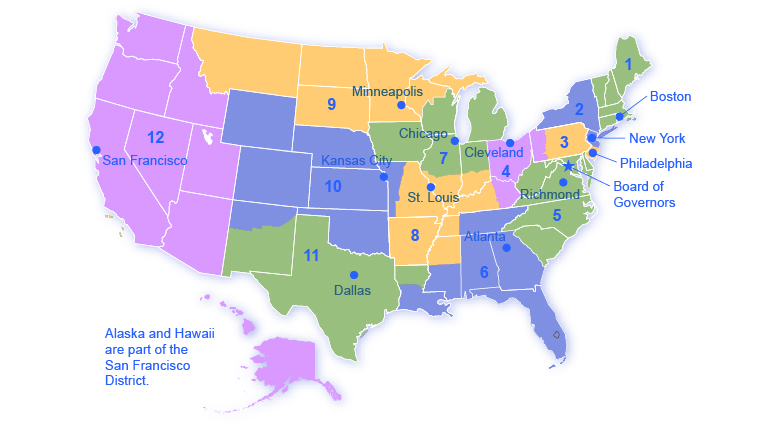

Figure 28.3図 28.3
There are twelve regional Federal Reserve banks, each with its district.
英語のヒント
12の地区連邦準備銀行があり、それぞれに管轄地区がある。