第28章金融政策と銀行規制
Federal Reserve Actions Over Last Four Decades過去40年間の連邦準備制度の行動
For the period from 1970 through 2020, we can summarize Federal Reserve monetary policy by looking at how it targeted the federal funds interest rate using open market operations.
英語のヒント
1970年から2020年までの連邦準備制度の金融政策は、公開市場操作を用いてフェデラル・ファンド金利をどのように目標に導いたかを見ることで、概観できる。
Of course, telling the story of the U.S. economy since 1970 in terms of Federal Reserve actions leaves out many other macroeconomic factors that were influencing unemployment, recession, economic growth, and inflation over this time. The ten episodes of Federal Reserve action outlined in the sections below also demonstrate that we should consider the central bank as one of the leading actors influencing the macro economy. As we noted earlier, the single person with the greatest power to influence the U.S. economy is probably the Federal Reserve chairperson.
英語のヒント
もちろん、1970年以降のアメリカ経済を連邦準備制度の行動から語ると、その間の失業、景気後退、経済成長、インフレに影響していた、ほかの多くのマクロ経済要因が抜け落ちる。以下で概説する連邦準備制度の行動の10の局面もまた、中央銀行を、マクロ経済に影響を与える主要な行為者の一つと考えるべきことを示している。すでに述べたように、アメリカ経済に影響を与える最大の力を持つ個人は、おそらく連邦準備制度の議長である。
Figure 28.8 shows how the Federal Reserve has carried out monetary policy by targeting the federal funds interest rate in the last few decades. The graph shows the federal funds interest rate (remember, this interest rate is set through open market operations), the unemployment rate, and the inflation rate since 1970. Different episodes of monetary policy during this period are indicated in the figure.
英語のヒント
図28.8は、ここ数十年間、連邦準備制度がフェデラル・ファンド金利を目標とすることで金融政策をどのように実施してきたかを示す。グラフには1970年以降のフェデラル・ファンド金利、失業率、インフレ率が示されている。この金利は公開市場操作によって設定されることを思い出そう。この期間の金融政策の異なる局面が図に示されている。
Monetary Policy, Unemployment, and Inflation金融政策、失業、インフレーション
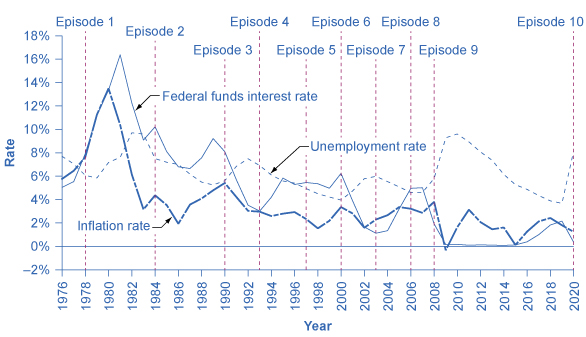

Figure 28.8図 28.8
Through the episodes here, the Federal Reserve typically reacted to higher inflation with a contractionary monetary policy and a higher interest rate, and reacted to higher unemployment with an expansionary monetary policy and a lower interest rate.
英語のヒント
ここに示した各局面で、連邦準備制度は通常、インフレの上昇に対しては引締め的金融政策と金利の引上げで対応し、失業の増加に対しては拡張的金融政策と金利の引下げで対応した。
Episode 1
英語のヒント
局面1
Consider Episode 1 in the late 1970s. The rate of inflation was very high, exceeding 10% in 1979 and 1980, so the Federal Reserve used tight monetary policy to raise interest rates, with the federal funds rate rising from 5.5% in 1977 to 16.4% in 1981. By 1983, inflation was down to 3.2%, but aggregate demand contracted sharply enough that back-to-back recessions occurred in 1980 and in 1981–1982, and the unemployment rate rose from 5.8% in 1979 to 9.7% in 1982.
英語のヒント
1970年代後半の局面1を考えよう。インフレ率は非常に高く、1979年と1980年には10%を超えた。そのため、連邦準備制度は金融引締め政策を用いて金利を上げ、フェデラル・ファンド金利は1977年の5.5%から1981年の16.4%へ上昇した。1983年までにインフレ率は3.2%へ下がったが、総需要が大きく縮小したため、1980年と1981~1982年には立て続けに景気後退が起こり、失業率は1979年の5.8%から1982年の9.7%へ上昇した。
Episode 2
英語のヒント
局面2
In Episode 2, when economists persuaded the Federal Reserve in the early 1980s that inflation was declining, the Fed began slashing interest rates to reduce unemployment. The federal funds interest rate fell from 16.4% in 1981 to 6.8% in 1986. By 1986 or so, inflation had fallen to about 2% and the unemployment rate had come down to 7%, and was still falling.
英語のヒント
局面2では、1980年代初頭に経済学者がインフレは低下していると連邦準備制度を説得すると、Fedは失業を減らすために金利を大幅に引き下げ始めた。フェデラル・ファンド金利は1981年の16.4%から1986年の6.8%へ下がった。1986年ごろまでにインフレ率は約2%へ下がり、失業率も7%へ低下し、なお下がり続けていた。
Episode 3
英語のヒント
局面3
However, in Episode 3 in the late 1980s, inflation appeared to be creeping up again, rising from 2% in 1986 up toward 5% by 1989. In response, the Federal Reserve used contractionary monetary policy to raise the federal funds rates from 6.6% in 1987 to 9.2% in 1989. The tighter monetary policy stopped inflation, which fell from above 5% in 1990 to under 3% in 1992, but it also helped to cause the 1990-1991 recession, and the unemployment rate rose from 5.3% in 1989 to 7.5% by 1992.
英語のヒント
しかし、1980年代後半の局面3では、インフレが再びじわじわと上がっているように見えた。インフレ率は1986年の2%から、1989年には5%に近づいた。これを受け、連邦準備制度は引締め的金融政策を用い、フェデラル・ファンド金利を1987年の6.6%から1989年の9.2%へ引き上げた。金融引締めはインフレを止め、インフレ率は1990年の5%超から1992年の3%未満へ下がった。しかしそれは1990~1991年の景気後退の一因にもなり、失業率は1989年の5.3%から1992年の7.5%へ上がった。
Episode 4
英語のヒント
局面4
In Episode 4, in the early 1990s, when the Federal Reserve was confident that inflation was back under control, it reduced interest rates, with the federal funds interest rate falling from 8.1% in 1990 to 3.5% in 1992. As the economy expanded, the unemployment rate declined from 7.5% in 1992 to less than 5% by 1997.
英語のヒント
1990年代初頭の局面4では、連邦準備制度は、インフレが再び制御下に入ったと確信すると、金利を引き下げた。フェデラル・ファンド金利は1990年の8.1%から1992年の3.5%へ下がった。経済が拡大するにつれて、失業率は1992年の7.5%から1997年には5%未満へ低下した。
Episodes 5 and 6
英語のヒント
局面5と6
In Episodes 5 and 6, the Federal Reserve perceived a risk of inflation and raised the federal funds rate from 3% to 5.8% from 1993 to 1995. Inflation did not rise, and the period of economic growth during the 1990s continued. Then in 1999 and 2000, the Fed was concerned that inflation seemed to be creeping up so it raised the federal funds interest rate from 4.6% in December 1998 to 6.5% in June 2000. By early 2001, inflation was declining again, but a recession occurred in 2001. Between 2000 and 2002, the unemployment rate rose from 4.0% to 5.8%.
英語のヒント
局面5と6では、連邦準備制度はインフレの危険を認識し、1993年から1995年にかけてフェデラル・ファンド金利を3%から5.8%へ引き上げた。インフレ率は上昇せず、1990年代の経済成長期は続いた。その後、1999年と2000年には、インフレがじわじわと上がっているように見えたため、Fedは懸念を抱き、フェデラル・ファンド金利を1998年12月の4.6%から2000年6月の6.5%へ引き上げた。2001年初頭までにインフレ率は再び低下していたが、2001年には景気後退が起きた。2000年から2002年の間に、失業率は4.0%から5.8%へ上昇した。
Episodes 7 and 8
英語のヒント
局面7と8
In Episodes 7 and 8, the Federal Reserve conducted a loose monetary policy and slashed the federal funds rate from 6.2% in 2000 to just 1.7% in 2002, and then again to 1% in 2003. They actually did this because of fear of Japan-style deflation. This persuaded them to lower the Fed funds further than they otherwise would have. The recession ended, but, unemployment rates were slow to decline in the early 2000s. Finally, in 2004, the unemployment rate declined and the Federal Reserve began to raise the federal funds rate until it reached 5% by 2007.
英語のヒント
局面7と8では、連邦準備制度は金融緩和政策を実施し、フェデラル・ファンド金利を2000年の6.2%から2002年にはわずか1.7%へ大幅に下げ、さらに2003年には1%へ引き下げた。実際にこのようにしたのは、日本型のデフレを恐れたためだった。この恐れにより、そうでなければ行ったであろう水準よりも、フェデラル・ファンド金利をさらに下げることになった。景気後退は終わったが、2000年代初頭の失業率の低下は緩慢だった。ようやく2004年に失業率が低下し、連邦準備制度はフェデラル・ファンド金利を引き上げ始め、2007年までに5%へ達した。
Episode 9
英語のヒント
局面9
In Episode 9, as the Great Recession took hold in 2008, the Federal Reserve was quick to slash interest rates, taking them down to 2% in 2008 and to nearly 0% in 2009. When the Fed had taken interest rates down to near-zero, the economy was still deep in recession. Open market operations could not make the interest rate turn negative. The Federal Reserve had to think “outside the box.”
英語のヒント
局面9では、2008年に大不況が本格化すると、連邦準備制度は素早く金利を大幅に引き下げ、2008年には2%、2009年にはほぼ0%とした。Fedが金利をゼロ近くまで下げても、経済はなお深い景気後退の中にあった。公開市場操作では、金利をマイナスにすることはできなかった。連邦準備制度は「従来の枠を超えて」考える必要があった。
Episode 10
英語のヒント
局面10
In Episode 10, which started in March 2020, the Fed cut interest rates again, reducing the target federal funds rate from 2% to between 0–1/4% in a matter of weeks. Limited by the zero lower bound, the Fed once again had to think “outside the box” in order to further support the financial system.
英語のヒント
2020年3月に始まった局面10では、Fedは再び金利を引き下げ、わずか数週間で、目標フェデラル・ファンド金利を2%から0~1/4%へ下げた。ゼロ下限制約に直面したFedは、金融システムをさらに支えるため、再び「従来の枠を超えて」考える必要があった。