第28章金融政策と銀行規制
Unpredictable Movements of Velocity予測できない貨幣流通速度の動き
Velocity is a term that economists use to describe how quickly money circulates through the economy. We define the velocity of money in a year as:
英語のヒント
流通速度とは、貨幣が経済をどれほど速く循環するかを表すために経済学者が使う用語である。1年間の貨幣の流通速度を、次のように定義する。
Specific measurements of velocity depend on the definition of the money supply used. Consider the velocity of M1, the total amount of currency in circulation and checking account balances. In 2009, for example, M1 was $1.7 trillion and nominal GDP was $14.3 trillion, so the velocity of M1 was 8.4 (which is $14.3 trillion/$1.7 trillion). A higher velocity of money means that the average dollar circulates more times in a year. A lower velocity means that the average dollar circulates fewer times in a year.
英語のヒント
流通速度の具体的な測定値は、用いる貨幣供給量の定義によって異なる。流通中の現金通貨と当座預金残高の総額であるM1の流通速度を考えよう。たとえば2009年、M1は1.7兆ドル、名目GDPは14.3兆ドルだったので、M1の流通速度は8.4だった(14.3兆ドル÷1.7兆ドル)。貨幣流通速度が高いとは、平均的な1ドルが1年間に循環する回数が多いことを意味する。流通速度が低いとは、平均的な1ドルが1年間に循環する回数が少ないことを意味する。
See the following Clear It Up feature for a discussion of how deflation could affect monetary policy.
英語のヒント
デフレが金融政策にどのような影響を及ぼしうるかについては、次の「疑問を解く」を参照してほしい。
Changes in velocity can cause problems for monetary policy. To understand why, rewrite the definition of velocity so that the money supply is on the left-hand side of the equation. That is:
英語のヒント
流通速度の変化は、金融政策に問題を生じさせうる。その理由を理解するため、貨幣供給量が等式の左辺に来るように、流通速度の定義を書き換えよう。つまり、次のようになる。
Therefore,
英語のヒント
したがって、
We sometimes call this equation the basic quantity equation of money but, as you can see, it is just the definition of velocity written in a different form. This equation must hold true, by definition.
英語のヒント
この等式を貨幣の基本数量方程式と呼ぶことがある。しかし、見てわかるように、これは流通速度の定義を別の形に書いただけである。この等式は、定義により必ず成立する。
If velocity is constant over time, then a certain percentage rise in the money supply on the left-hand side of the basic quantity equation of money will inevitably lead to the same percentage rise in nominal GDP—although this change could happen through an increase in inflation, or an increase in real GDP, or some combination of the two. If velocity is changing over time but in a constant and predictable way, then changes in the money supply will continue to have a predictable effect on nominal GDP. If velocity changes unpredictably over time, however, then the effect of changes in the money supply on nominal GDP becomes unpredictable.
英語のヒント
流通速度が時間とともに変わらないなら、貨幣の基本数量方程式の左辺にある貨幣供給量がある割合で増えると、名目GDPも必然的に同じ割合で増える。ただし、その変化は、インフレの上昇、実質GDPの増加、あるいは両者の組合せによって起こりうる。流通速度が時間とともに変わっても、その変わり方が一定で予測可能なら、貨幣供給量の変化は引き続き、名目GDPに予測可能な影響を与える。しかし、流通速度が時間とともに予測不能な形で変われば、貨幣供給量の変化が名目GDPに与える影響も予測不能になる。
Figure 28.9 illustrates the actual velocity of money in the U.S. economy as measured by using M1, the most common definition of the money supply. From 1960 up to about 1980, velocity appears fairly predictable; that is, it is increasing at a fairly constant rate. In the early 1980s, however, velocity as calculated with M1 becomes more variable. The reasons for these sharp changes in velocity remain a puzzle. Economists suspect that the changes in velocity are related to innovations in banking and finance which have changed how we are using money in making economic transactions: for example, the growth of electronic payments; a rise in personal borrowing and credit card usage; and accounts that make it easier for people to hold money in savings accounts, where it is counted as M2, right up to the moment that they want to write a check on the money and transfer it to M1. So far at least, it has proven difficult to draw clear links between these kinds of factors and the specific up-and-down fluctuations in M1. Given many changes in banking and the prevalence of electronic banking, economists now favor M2 as a measure of money rather than the narrower M1.
英語のヒント
図28.9は、最も一般的な貨幣供給量の定義であるM1を用いて測定した、アメリカ経済における実際の貨幣流通速度を示す。1960年から1980年ごろまでは、流通速度はかなり予測可能に見える。つまり、ほぼ一定の率で上昇している。しかし1980年代初頭になると、M1で計算した流通速度の変動が大きくなる。流通速度がこのように急変した理由は、依然として謎である。経済学者は、その変化が、経済取引での貨幣の使い方を変えた銀行業や金融の革新に関係していると考えている。たとえば、電子決済の増加、個人の借入れとクレジットカード利用の増加、そして、小切手を振り出してM1へ移す直前まで、M2に数えられる貯蓄預金口座にお金を置きやすくする口座などである。少なくともこれまでのところ、こうした要因とM1の具体的な上下変動との間に、明確な結びつきを見いだすのは難しかった。銀行業の多くの変化や電子バンキングの普及を受けて、経済学者は現在、より狭いM1よりもM2を貨幣の尺度として好んでいる。
Velocity Calculated Using M1M1を用いて計算した流通速度
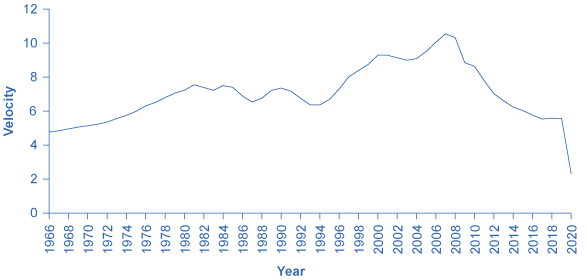
OpenStax artwork, CC BY 4.0. Data: Federal Reserve Bank of St. Louis, Velocity of M1 Money Stock [M1V], via FRED; https://fred.stlouisfed.org/series/M1V. Original 1966–2020 series as plotted in the fixed OpenStax source. · CC BY 4.0 artwork; FRED data with required citation · Source出典
Figure 28.9図 28.9
Velocity is the nominal GDP divided by the money supply for a given year. We can calculate different measures of velocity by using different measures of the money supply. Velocity, as calculated by using M1, has lacked a steady trend since the 1980s, instead bouncing up and down. Note also that the redefinition of M1 to include savings deposits in 2020 (see Money and Banking) drastically increased M1 in 2020, causing velocity to plummet. (credit: Federal Reserve Bank of St. Louis)
英語のヒント
流通速度は、ある年の名目GDPを貨幣供給量で割ったものである。貨幣供給量の異なる尺度を使えば、流通速度の異なる尺度を計算できる。M1を用いて計算した流通速度は、1980年代以降、安定した傾向を欠き、上下に変動してきた。2020年に貯蓄預金を含めるようM1が再定義されたこと(「貨幣と銀行」を参照)によって、2020年のM1が劇的に増加し、流通速度が急落したことにも注意しよう。(クレジット:セントルイス連邦準備銀行)
Velocity Calculated Using M1
英語のヒント
M1を用いて計算した流通速度
In the 1970s, when velocity as measured by M1 seemed predictable, a number of economists, led by Nobel laureate Milton Friedman (1912–2006), argued that the best monetary policy was for the central bank to increase the money supply at a constant growth rate. These economists argued that with the long and variable lags of monetary policy, and the political pressures on central bankers, central bank monetary policies were as likely to have undesirable as to have desirable effects. Thus, these economists believed that the monetary policy should seek steady growth in the money supply of 3% per year. They argued that a steady monetary growth rate would be correct over longer time periods, since it would roughly match the growth of the real economy. In addition, they argued that giving the central bank less discretion to conduct monetary policy would prevent an overly activist central bank from becoming a source of economic instability and uncertainty. In this spirit, Friedman wrote in 1967: “The first and most important lesson that history teaches about what monetary policy can do—and it is a lesson of the most profound importance—is that monetary policy can prevent money itself from being a major source of economic disturbance.”
英語のヒント
M1で測定した流通速度が予測可能に見えた1970年代、ノーベル賞受賞者ミルトン・フリードマン(1912~2006年)を中心とする多くの経済学者は、中央銀行が貨幣供給量を一定の増加率で増やすことが、最良の金融政策だと主張した。これらの経済学者は、金融政策の効果には長く一定しない遅れがあり、中央銀行家には政治的圧力がかかるため、中央銀行の金融政策は、望ましい効果と同じくらいの確率で、望ましくない効果も持つと論じた。そこで、金融政策は年率3%という安定した貨幣供給の増加を目指すべきだと考えた。一定の貨幣増加率は実体経済の成長率とおおむね一致するので、長い期間で見れば正しいと論じたのである。さらに、金融政策を実施する中央銀行の裁量を小さくすれば、過度に積極的な中央銀行が、経済の不安定や不確実性の原因になるのを防げると主張した。こうした考えから、フリードマンは1967年に次のように書いた。「金融政策に何ができるかについて歴史が教える第一の、そして最も重要な教訓は――しかもこれは、きわめて深い重要性を持つ教訓である――金融政策は、貨幣そのものが経済的混乱の大きな原因になることを防げる、ということである。」
As the velocity of M1 began to fluctuate in the 1980s, having the money supply grow at a predetermined and unchanging rate seemed less desirable, because as the quantity theory of money shows, the combination of constant growth in the money supply and fluctuating velocity would cause nominal GDP to rise and fall in unpredictable ways. The jumpiness of velocity in the 1980s caused many central banks to focus less on the rate at which the quantity of money in the economy was increasing, and instead to set monetary policy by reacting to whether the economy was experiencing or in danger of higher inflation or unemployment.
英語のヒント
1980年代にM1の流通速度が変動し始めると、貨幣供給量をあらかじめ決めた不変の率で増やすことは、あまり望ましくないと思われるようになった。貨幣数量説が示すように、貨幣供給の一定の増加と、流通速度の変動が組み合わさると、名目GDPが予測不能な形で上下するからである。1980年代の流通速度の不安定さを受けて、多くの中央銀行は、経済における貨幣量の増加率への重点を弱めた。その代わり、インフレや失業の上昇を経済が経験しているか、その危険があるかに応じて、金融政策を決めるようになった。