第28章金融政策と銀行規制
28.4 Monetary Policy and Economic Outcomes28.4 金融政策と経済の結果
Learning Objectives学習目標
Learning Objectives学習目標
By the end of this section, you will be able to:
英語のヒント
この節を学ぶと、次のことができるようになる。
- Contrast expansionary monetary policy and contractionary monetary policy
英語のヒント
拡張的金融政策と引締め的金融政策を対比する - Explain how monetary policy impacts interest rates and aggregate demand
英語のヒント
金融政策が金利と総需要に及ぼす影響を説明する - Evaluate Federal Reserve decisions over the last forty years
英語のヒント
過去40年間の連邦準備制度の決定を評価する - Explain the significance of quantitative easing (QE)
英語のヒント
量的緩和(QE)の意義を説明する
A monetary policy that lowers interest rates and stimulates borrowing is an expansionary monetary policy or loose monetary policy. Conversely, a monetary policy that raises interest rates and reduces borrowing in the economy is a contractionary monetary policy or tight monetary policy. This module will discuss how expansionary and contractionary monetary policies affect interest rates and aggregate demand, and how such policies will affect macroeconomic goals like unemployment and inflation. We will conclude with a look at the Fed’s monetary policy practice in recent decades.
英語のヒント
金利を下げ、借入れを刺激する金融政策を、拡張的金融政策、または金融緩和政策という。逆に、金利を上げ、経済における借入れを減らす金融政策を、引締め的金融政策、または金融引締め政策という。この節では、拡張的金融政策と引締め的金融政策が金利と総需要にどのように影響するか、さらに失業やインフレなどのマクロ経済目標にどう影響するかを検討する。最後に、ここ数十年間のFedの金融政策の実施状況を見る。
The Effect of Monetary Policy on Interest Rates金融政策が金利に及ぼす効果
Consider the market for loanable bank funds in Figure 28.5. The original equilibrium (E0) occurs at an 8% interest rate and a quantity of funds loaned and borrowed of $10 billion. An expansionary monetary policy will shift the supply of loanable funds to the right from the original supply curve (S0) to S1, leading to an equilibrium (E1) with a lower 6% interest rate and a quantity $14 billion in loaned funds. Conversely, a contractionary monetary policy will shift the supply of loanable funds to the left from the original supply curve (S0) to S2, leading to an equilibrium (E2) with a higher 10% interest rate and a quantity of $8 billion in loaned funds.
英語のヒント
図28.5の銀行の貸付資金市場を考えよう。もとの均衡(E0)は、金利8%、貸し借りされる資金量100億ドルのところにある。拡張的金融政策は、貸付資金の供給をもとの供給曲線(S0)からS1へ右に移動させ、金利が6%に下がり、貸付資金量が140億ドルとなる均衡(E1)をもたらす。逆に、引締め的金融政策は、貸付資金の供給をもとの供給曲線(S0)からS2へ左に移動させ、金利が10%に上がり、貸付資金量が80億ドルとなる均衡(E2)をもたらす。
Monetary Policy and Interest Rates金融政策と金利
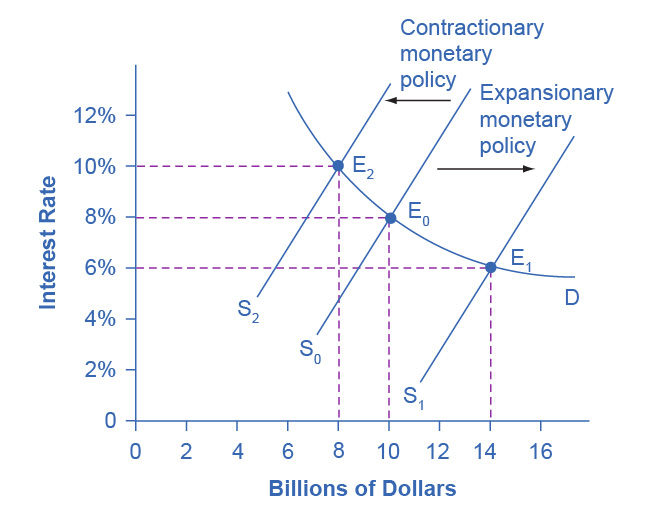
Figure 28.5図 28.5
The original equilibrium occurs at E0. An expansionary monetary policy will shift the supply of loanable funds to the right from the original supply curve (S0) to the new supply curve (S1) and to a new equilibrium of E1, reducing the interest rate from 8% to 6%. A contractionary monetary policy will shift the supply of loanable funds to the left from the original supply curve (S0) to the new supply (S2), and raise the interest rate from 8% to 10%.
英語のヒント
もとの均衡はE0にある。拡張的金融政策は、貸付資金の供給をもとの供給曲線(S0)から新しい供給曲線(S1)へ右に移動させ、新しい均衡E1へ導き、金利を8%から6%へ下げる。引締め的金融政策は、貸付資金の供給をもとの供給曲線(S0)から新しい供給(S2)へ左に移動させ、金利を8%から10%へ上げる。
How does a central bank “raise” interest rates? When describing the central bank's monetary policy actions, it is common to hear that the central bank “raised interest rates” or “lowered interest rates.” We need to be clear about this: more precisely, through open market operations the central bank changes bank reserves in a way which affects the supply curve of loanable funds. As a result, Figure 28.5 shows that interest rates change. If they do not meet the Fed’s target, the Fed can supply more or less reserves until interest rates do.
英語のヒント
中央銀行はどのように金利を「引き上げる」のだろうか。中央銀行の金融政策上の行動を説明する際、中央銀行が「金利を上げた」「金利を下げた」という表現をよく耳にする。この点を明確にしておこう。より正確には、中央銀行は公開市場操作によって銀行準備を変化させ、貸付資金の供給曲線に影響を与える。その結果、図28.5に示すように金利が変わる。金利がFedの目標に達しなければ、Fedは金利が目標に達するまで、供給する準備を増減できる。
Recall that the specific interest rate the Fed targets is the federal funds rate. The Federal Reserve has, since 1995, established its target federal funds rate in advance of any open market operations.
英語のヒント
Fedが目標とする特定の金利は、フェデラル・ファンド金利であることを思い出そう。連邦準備制度は1995年以降、公開市場操作に先立って、目標フェデラル・ファンド金利を設定している。
Of course, financial markets display a wide range of interest rates, representing borrowers with different risk premiums and loans that they must repay over different periods of time. In general, when the federal funds rate drops substantially, other interest rates drop, too, and when the federal funds rate rises, other interest rates rise. However, a fall or rise of one percentage point in the federal funds rate—which remember is for borrowing overnight—will typically have an effect of less than one percentage point on a 30-year loan to purchase a house or a three-year loan to purchase a car. Monetary policy can push the entire spectrum of interest rates higher or lower, but the forces of supply and demand in those specific markets for lending and borrowing set the specific interest rates.
英語のヒント
もちろん、金融市場には幅広い金利がある。それは、借り手ごとにリスク・プレミアムが異なり、融資の返済期間も異なるためである。一般に、フェデラル・ファンド金利が大幅に低下すると、ほかの金利も低下し、フェデラル・ファンド金利が上昇すると、ほかの金利も上昇する。しかし、フェデラル・ファンド金利は翌日物の借入れに対する金利であることを思い出してほしい。その金利が1パーセント・ポイント下落または上昇しても、住宅購入のための30年ローンや、自動車購入のための3年ローンへの影響は、通常1パーセント・ポイントより小さい。金融政策は金利全体を高くも低くもできるが、個別の金利を決めるのは、それぞれの貸借市場における需要と供給の力である。
The Effect of Monetary Policy on Aggregate Demand金融政策が総需要に及ぼす効果
Monetary policy affects interest rates and the available quantity of loanable funds, which in turn affects several components of aggregate demand. Tight or contractionary monetary policy that leads to higher interest rates and a reduced quantity of loanable funds will reduce two components of aggregate demand. Business investment will decline because it is less attractive for firms to borrow money, and even firms that have money will notice that, with higher interest rates, it is relatively more attractive to put those funds in a financial investment than to make an investment in physical capital. In addition, higher interest rates will discourage consumer borrowing for big-ticket items like houses and cars. Conversely, loose or expansionary monetary policy that leads to lower interest rates and a higher quantity of loanable funds will tend to increase business investment and consumer borrowing for big-ticket items.
英語のヒント
金融政策は金利と利用可能な貸付資金量に影響し、それがさらに総需要のいくつかの構成要素に影響する。金利の上昇と貸付資金量の減少をもたらす金融引締め政策、すなわち引締め的金融政策は、総需要の二つの構成要素を減少させる。企業にとって資金を借りる魅力が低下するため、企業投資は減少する。資金を持っている企業でさえ、金利が上がれば、実物資本への投資よりも、その資金を金融投資に回す方が相対的に魅力的だと気づくだろう。また、金利が高くなると、住宅や自動車など高額商品のための消費者の借入れが抑制される。逆に、金利の低下と貸付資金量の増加をもたらす金融緩和政策、すなわち拡張的金融政策は、企業投資と、高額商品のための消費者の借入れを増加させる傾向がある。
If the economy is suffering a recession and high unemployment, with output below potential GDP, expansionary monetary policy can help the economy return to potential GDP. Figure 28.6 (a) illustrates this situation. This example uses a short-run upward-sloping Keynesian aggregate supply curve (SRAS). The original equilibrium during a recession of E0 occurs at an output level of 600. An expansionary monetary policy will reduce interest rates and stimulate investment and consumption spending, causing the original aggregate demand curve (AD0) to shift right to AD1, so that the new equilibrium (E1) occurs at the potential GDP level of 700.
英語のヒント
経済が景気後退と高失業に苦しみ、生産量が潜在GDPを下回っているなら、拡張的金融政策は、経済が潜在GDPへ戻るのを助けられる。図28.6(a)はこの状況を示している。この例では、短期の右上がりのケインズ派総供給曲線(SRAS)を用いる。景気後退期のもとの均衡E0は、生産水準600のところにある。拡張的金融政策は金利を下げ、投資支出と消費支出を刺激し、もとの総需要曲線(AD0)をAD1へ右に移動させる。そのため、新しい均衡(E1)は潜在GDP水準の700のところに生じる。
Expansionary or Contractionary Monetary Policy拡張的金融政策と引締め的金融政策
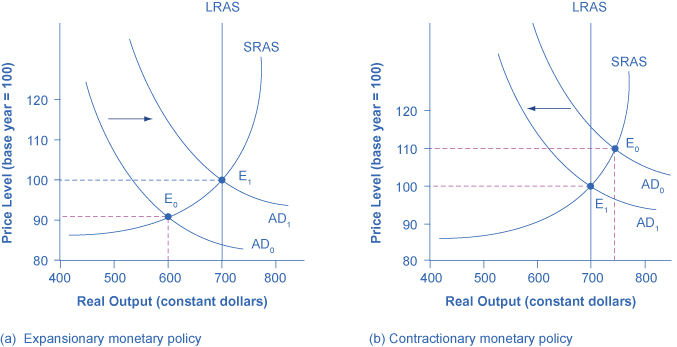
Figure 28.6図 28.6
(a) The economy is originally in a recession with the equilibrium output and price shown at E0. Expansionary monetary policy will reduce interest rates and shift aggregate demand to the right from AD0 to AD1, leading to the new equilibrium (E1) at the potential GDP level of output with a relatively small rise in the price level. (b) The economy is originally producing above the potential GDP level of output at the equilibrium E0 and is experiencing pressures for an inflationary rise in the price level. Contractionary monetary policy will shift aggregate demand to the left from AD0 to AD1, thus leading to a new equilibrium (E1) at the potential GDP level of output.
英語のヒント
(a)経済は当初、景気後退にあり、均衡生産量と物価はE0で示される。拡張的金融政策は金利を下げ、総需要をAD0からAD1へ右に移動させる。その結果、物価水準の上昇を比較的小さく抑えながら、潜在GDPの生産水準にある新しい均衡(E1)へ至る。(b)経済は当初、均衡E0で潜在GDPを上回る生産をしており、物価水準を上昇させるインフレ圧力にさらされている。引締め的金融政策は総需要をAD0からAD1へ左に移動させ、潜在GDPの生産水準にある新しい均衡(E1)へ至る。
Conversely, if an economy is producing at a quantity of output above its potential GDP, a contractionary monetary policy can reduce the inflationary pressures for a rising price level. In Figure 28.6 (b), the original equilibrium (E0) occurs at an output of 750, which is above potential GDP. A contractionary monetary policy will raise interest rates, discourage borrowing for investment and consumption spending, and cause the original demand curve (AD0) to shift left to AD1, so that the new equilibrium (E1) occurs at the potential GDP level of 700.
英語のヒント
逆に、経済の生産量が潜在GDPを上回っているなら、引締め的金融政策は、物価水準の上昇を促すインフレ圧力を弱められる。図28.6(b)では、もとの均衡(E0)は、潜在GDPを上回る生産量750のところにある。引締め的金融政策は金利を上げ、投資支出と消費支出のための借入れを抑え、もとの需要曲線(AD0)をAD1へ左に移動させる。その結果、新しい均衡(E1)は潜在GDP水準700のところに生じる。
These examples suggest that monetary policy should be countercyclical; that is, it should act to counterbalance the business cycles of economic downturns and upswings. The Fed should loosen monetary policy when a recession has caused unemployment to increase and tighten it when inflation threatens. Of course, countercyclical policy does pose a danger of overreaction. If loose monetary policy seeking to end a recession goes too far, it may push aggregate demand so far to the right that it triggers inflation. If tight monetary policy seeking to reduce inflation goes too far, it may push aggregate demand so far to the left that a recession begins. Figure 28.7 (a) summarizes the chain of effects that connect loose and tight monetary policy to changes in output and the price level.
英語のヒント
これらの例は、金融政策が反循環的であるべきことを示している。つまり、経済の下降と上昇という景気循環を相殺するように作用すべきだということである。景気後退によって失業が増えたときは、Fedは金融政策を緩和し、インフレのおそれがあるときは引き締めるべきである。もちろん、反循環的政策には過剰反応の危険もある。景気後退を終わらせようとする金融緩和政策が行き過ぎると、総需要を右へ動かしすぎて、インフレを引き起こしかねない。インフレを抑えようとする金融引締め政策が行き過ぎると、総需要を左へ動かしすぎて、景気後退が始まりかねない。図28.7(a)は、金融緩和政策および金融引締め政策と、生産量および物価水準の変化をつなぐ効果の連鎖をまとめている。
The Pathways of Monetary Policy金融政策の波及経路
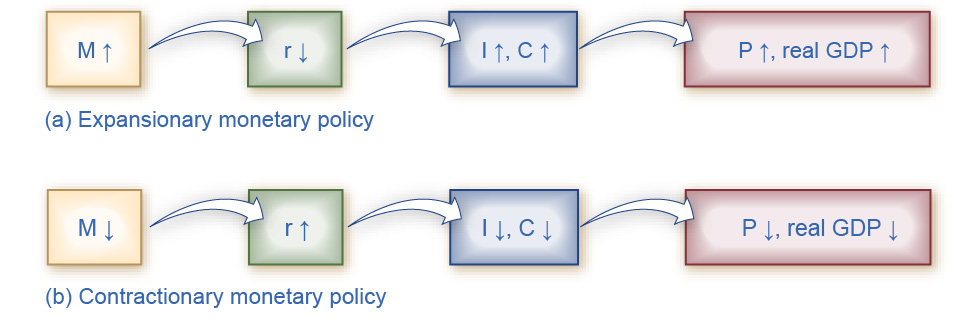


Figure 28.7図 28.7
(a) In expansionary monetary policy the central bank causes the supply of money and loanable funds to increase, which lowers the interest rate, stimulating additional borrowing for investment and consumption, and shifting aggregate demand right. The result is a higher price level and, at least in the short run, higher real GDP. (b) In contractionary monetary policy, the central bank causes the supply of money and credit in the economy to decrease, which raises the interest rate, discouraging borrowing for investment and consumption, and shifting aggregate demand left. The result is a lower price level and, at least in the short run, lower real GDP.
英語のヒント
(a)拡張的金融政策では、中央銀行は貨幣と貸付資金の供給を増やす。それにより金利が下がり、投資と消費のための追加借入れが刺激され、総需要が右に移動する。その結果、物価水準は上がり、少なくとも短期的には、実質GDPも増加する。(b)引締め的金融政策では、中央銀行は経済における貨幣と信用の供給を減らす。それにより金利が上がり、投資と消費のための借入れが抑えられ、総需要が左に移動する。その結果、物価水準は下がり、少なくとも短期的には、実質GDPも減少する。