第13章遺伝についての現代的理解
Chromosome Inversions染色体逆位
A chromosome inversion is the detachment, 180° rotation, and reinsertion of part of a chromosome. Inversions may occur in nature as a result of mechanical shear, or from transposable elements' action (special DNA sequences capable of facilitating rearranging chromosome segments with the help of enzymes that cut and paste DNA sequences). Unless they disrupt a gene sequence, inversions only change gene orientation and are likely to have more mild effects than aneuploid errors. However, altered gene orientation can result in functional changes because regulators of gene expression could move out of position with respect to their targets, causing aberrant levels of gene products.
英語のヒント
染色体逆位は、一部分が切り離され、180度回転して再挿入されることである。自然には機械的な剪断や、転移因子の作用で起こりうる。転移因子は、DNAを切り貼りする酵素の助けで染色体部分の再編成を促す、特殊なDNA配列である。遺伝子配列を壊さなければ、逆位は遺伝子の向きだけを変えるため、異数性より影響が軽い傾向がある。しかし発現の調節因子が標的との位置関係を変え、産物量が異常になることで、向きの変化が機能の変化を引き起こすこともある。
An inversion can be pericentric and include the centromere, or paracentric and occur outside the centromere (Figure 13.11). A pericentric inversion that is asymmetric about the centromere can change the chromosome arms' relative lengths, making these inversions easily identifiable.
英語のヒント
逆位には、セントロメアを含む腕間逆位と、セントロメアの外側で起こる腕内逆位がある(図13.11)。セントロメアに対して非対称な腕間逆位は、染色体の腕の相対的な長さを変えるため、見つけやすい。
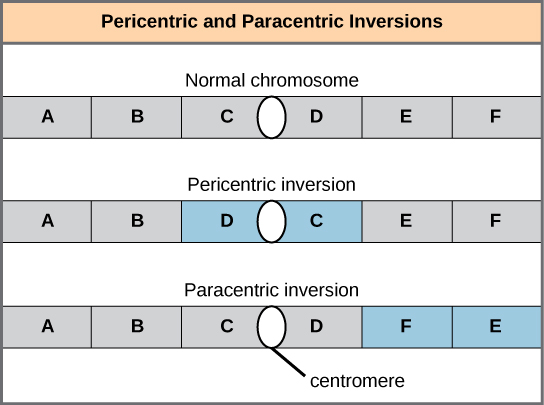
Figure 13.11図 13.11
Pericentric inversions include the centromere, and paracentric inversions do not. A pericentric inversion can change the chromosome arms' relative lengths. A paracentric inversion cannot.
腕間逆位はセントロメアを含み、腕内逆位は含まない。腕間逆位は腕の相対的な長さを変えうるが、腕内逆位にはできない。
When one homologous chromosome undergoes an inversion but the other does not, the individual is an inversion heterozygote. To maintain point-for-point synapsis during meiosis, one homolog must form a loop, and the other homolog must mold around it. Although this topology can ensure that the genes correctly align, it also forces the homologs to stretch and can occur with imprecise synapsis regions (Figure 13.12).
英語のヒント
一方の相同染色体だけに逆位がある個体を、逆位ヘテロ接合体という。減数分裂で各位置を一対一に対応させて対合するには、一方がループを作り、他方がその周囲に沿う必要がある。この形は遺伝子を正しく並べる一方、相同染色体を引き伸ばすことにもなり、対合が不正確な領域を伴うことがある(図13.12)。
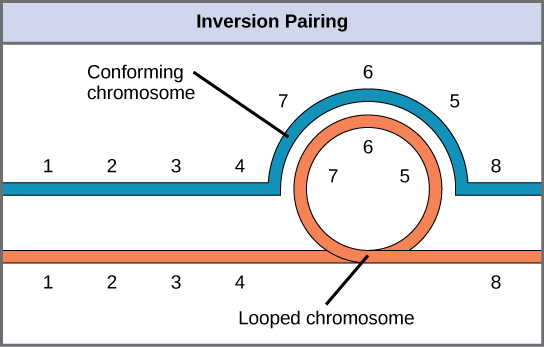


Figure 13.12図 13.12
When one chromosome undergoes an inversion but the other does not, one chromosome must form an inverted loop to retain point-for-point interaction during synapsis. This inversion pairing is essential to maintaining gene alignment during meiosis and to allow for recombination.
一方の染色体だけが逆位を起こすと、対合時に各位置の対応を保つため、片方が逆位ループを形成しなければならない。この逆位対合は、減数分裂中の遺伝子の対応を保ち、組換えを可能にするために不可欠である。
Translocations転座
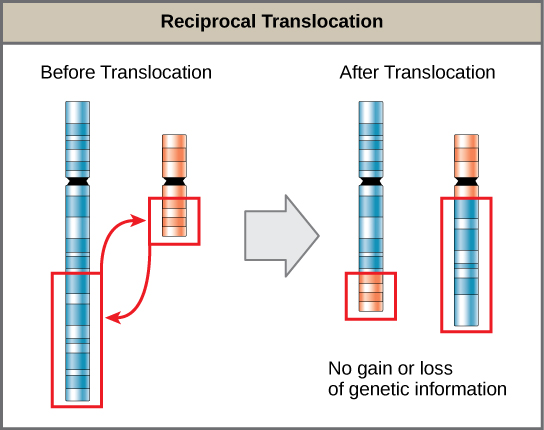
A translocation occurs when a chromosome segment dissociates and reattaches to a different, nonhomologous chromosome. Translocations can be benign or have devastating effects depending on how the positions of genes are altered with respect to regulatory sequences. Notably, specific translocations have occurred with several cancers and with schizophrenia. Reciprocal translocations result from exchanging chromosome segments between two nonhomologous chromosomes such that there is no genetic information gain or loss (Figure 13.13).
英語のヒント
転座は染色体の一部分が離れ、別の非相同染色体に再付着すると起こる。調節配列に対して遺伝子の位置がどう変わるかによって、無害な場合も壊滅的な影響を持つ場合もある。特定の転座はいくつかのがんや統合失調症で見つかっている。相互転座は二つの非相同染色体の部分を交換し、遺伝情報の増減を伴わないものである(図13.13)。
OpenStax, Rice University; Biology 2e. (credit: modification of work by National Human Genome Research/USA) · CC BY 4.0 · Source出典

Figure 13.13図 13.13
A reciprocal translocation occurs when a DNA segment transfers from one chromosome to another, nonhomologous chromosome. (credit: modification of work by National Human Genome Research/USA)
相互転座は、DNAの一部分が一方の染色体から別の非相同染色体へ移るときに起こる。(出典:米国国立ヒトゲノム研究機関の作品を改変)