第13章遺伝についての現代的理解
Chromosome Number Disorders染色体数の異常
Of all of the chromosomal disorders, chromosome number abnormalities are the most obviously identifiable from a karyogram. Chromosome number disorders include duplicating or losing entire chromosomes, as well as changes in the number of complete sets of chromosomes. They are caused by nondisjunction, which occurs when homologous chromosome pairs or sister chromatids fail to separate during meiosis. Misaligned or incomplete synapsis, or a spindle apparatus dysfunction that facilitates chromosome migration, can cause nondisjunction. The risk of nondisjunction occurring increases with the parents' age.
英語のヒント
染色体異常のうち、数の異常は核型図から最も分かりやすい。染色体全体の重複や喪失、染色体の完全な組の数の変化などが含まれる。原因は不分離で、減数分裂中に相同染色体対や姉妹染色分体が分離しないと起こる。対合のずれや不完全さ、染色体の移動を助ける紡錘体装置の機能不全が原因になりうる。不分離の危険は親の年齢とともに増える。
Nondisjunction can occur during either meiosis I or II, with differing results (Figure 13.6). If homologous chromosomes fail to separate during meiosis I, the result is two gametes that lack that particular chromosome and two gametes with two chromosome copies. If sister chromatids fail to separate during meiosis II, the result is one gamete that lacks that chromosome, two normal gametes with one chromosome copy, and one gamete with two chromosome copies.
英語のヒント
不分離は減数第一分裂でも第二分裂でも起こり、結果は異なる(図13.6)。第一分裂で相同染色体が分離しないと、その染色体を欠く配偶子が二つ、2コピー持つ配偶子が二つできる。第二分裂で姉妹染色分体が分離しないと、欠く配偶子が一つ、1コピー持つ正常配偶子が二つ、2コピー持つ配偶子が一つできる。
Aneuploidy異数性
Scientists call an individual with the appropriate number of chromosomes for their species euploid. In humans, euploidy corresponds to 22 pairs of autosomes and one pair of sex chromosomes. An individual with an error in chromosome number is described as aneuploid, a term that includes monosomy (losing one chromosome) or trisomy (gaining an extraneous chromosome). Monosomic human zygotes missing any one copy of an autosome invariably fail to develop to birth because they lack essential genes. This underscores the importance of “gene dosage” in humans. Most autosomal trisomies also fail to develop to birth; however, duplications of some smaller chromosomes (13, 15, 18, 21, or 22) can result in offspring that survive for several weeks to many years. Trisomic individuals suffer from a different type of genetic imbalance: an excess in gene dose. Individuals with an extra chromosome may synthesize an abundance of the gene products, which that chromosome encodes. This extra dose (150 percent) of specific genes can lead to a number of functional challenges and often precludes development. The most common trisomy among viable births is that of chromosome 21, which corresponds to Down Syndrome. Short stature and stunted digits, facial distinctions that include a broad skull and large tongue, and significant developmental delays characterize individuals with this inherited disorder. We can correlate the incidence of Down syndrome with maternal age. Older people are more likely to become pregnant with fetuses carrying the trisomy 21 genotype (Figure 13.7).
英語のヒント
その種に適した染色体数を持つ個体を正倍数体という。ヒトでは22対の常染色体と1対の性染色体に対応する。染色体数に誤りがある個体は異数体といい、1本失うモノソミーや、余分な1本を持つトリソミーを含む。ヒトで常染色体のいずれかを1コピー欠くモノソミーの接合子は、必須遺伝子を欠くため必ず出生まで発生できない。これはヒトにおける「遺伝子量」の重要性を示す。常染色体トリソミーの多くも出生まで発生できないが、小さい染色体の一部(13、15、18、21、22)の重複では、数週間から何年も生存する子ができることがある。トリソミーの個体では、遺伝子量が過剰という別の不均衡が生じる。余分な染色体のコードする遺伝子産物を大量に合成する可能性があり、特定の遺伝子が150%の量になると、多くの機能的問題を生み、しばしば発生を妨げる。生存して出生する中で最も普通のトリソミーは第21染色体のもので、ダウン症候群に対応する。低身長、短い指、幅広い頭蓋骨や大きい舌などの顔貌の特徴、顕著な発達の遅れを伴う。発生率は母親の年齢と相関し、高齢ほど21トリソミーの胎児を妊娠する可能性が高い(図13.7)。
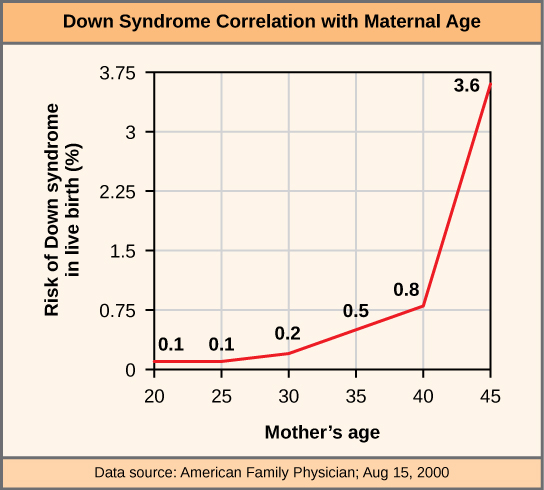
Figure 13.7図 13.7
The incidence of having a fetus with trisomy 21 increases dramatically with maternal age.
21トリソミーの胎児を妊娠する割合は、母親の年齢とともに大きく増える。
Polyploidy倍数性
We call an individual with more than the correct number of chromosome sets (two for diploid species) polyploid. For instance, fertilizing an abnormal diploid egg with a normal haploid sperm would yield a triploid zygote. Polyploid animals are extremely rare, with only a few examples among the flatworms, crustaceans, amphibians, fish, and lizards. Polyploid animals are sterile because meiosis cannot proceed normally and instead produces mostly aneuploid daughter cells that cannot yield viable zygotes. Rarely, polyploid animals can reproduce asexually by haplodiploidy, in which an unfertilized egg divides mitotically to produce offspring. In contrast, polyploidy is very common in the plant kingdom, and polyploid plants tend to be larger and more robust than euploids of their species (Figure 13.8).
英語のヒント
正しい数(二倍体種なら2組)より多い染色体の組を持つ個体を倍数体という。例えば異常な二倍体の卵に正常な半数体の精子が受精すると、三倍体の接合子になる。倍数体の動物は非常にまれで、扁形動物、甲殻類、両生類、魚類、トカゲに少数の例がある。倍数体動物では減数分裂が正常に進まず、生存可能な接合子を作れない異数性の娘細胞が大部分となるため、不妊である。まれには、未受精卵が有糸分裂して子を作る半数倍数性によって、無性生殖できる。対して植物界では倍数性が非常に普通で、倍数体植物は同種の正倍数体より大きく頑丈になる傾向がある(図13.8)。
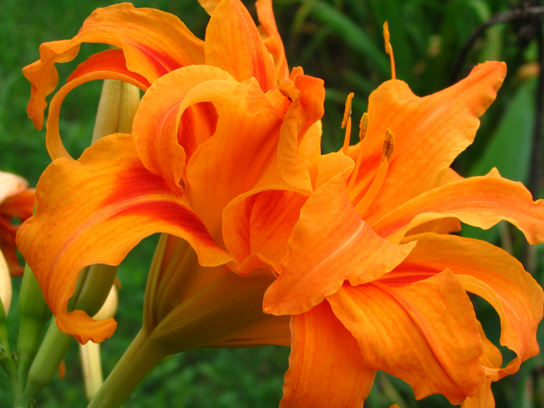


Figure 13.8図 13.8
As with many polyploid plants, this triploid orange daylily (Hemerocallis fulva) is particularly large and robust, and grows flowers with triple the number of petals of its diploid counterparts. (credit: Steve Karg)
多くの倍数体植物と同様、この三倍体のヤブカンゾウ(Hemerocallis fulva)はとくに大きく頑丈で、二倍体の3倍の数の花弁を持つ花を付ける。(出典:Steve Karg)