第13章遺伝についての現代的理解
Sex Chromosome Nondisjunction in Humansヒトの性染色体の不分離
Humans display dramatic deleterious effects with autosomal trisomies and monosomies. Therefore, it may seem counterintuitive that human females and males can function normally, despite carrying different numbers of the X chromosome. Rather than a gain or loss of autosomes, variations in the number of sex chromosomes occur with relatively mild effects. In part, this happens because of the molecular process X inactivation. Early in development, when female mammalian embryos consist of just a few thousand cells (relative to trillions in the newborn), one X chromosome in each cell inactivates by tightly condensing into a quiescent (dormant) structure, or a Barr body. The chance that an X chromosome (maternally or paternally derived) inactivates in each cell is random, but once this occurs, all cells derived from that one will have the same inactive X chromosome or Barr body. By this process, females compensate for their double genetic dose of X chromosome. In so-called “tortoiseshell” cats, we observe embryonic X inactivation as color variegation (Figure 13.9). Females that are heterozygous for an X-linked coat color gene will express one of two different coat colors over different regions of their body, corresponding to whichever X chromosome inactivates in that region's embryonic cell progenitor.
英語のヒント
ヒトでは常染色体のトリソミーやモノソミーが著しい有害な影響を示す。そのため、女性と男性が異なる数のX染色体を持ちながら正常に機能できることは、直感に反するかもしれない。常染色体の増減に比べ、性染色体数の変化の影響は比較的軽い。その一因はX染色体の不活性化という分子過程である。哺乳類の雌の胚がまだ数千細胞(新生児では数兆)しかない発生初期に、各細胞の一方のX染色体が強く凝縮し、休眠した構造であるバー小体となって不活性化する。母由来と父由来のどちらが不活性化するかは無作為だが、いったん決まると、その細胞から生じるすべての細胞が同じ不活性X染色体、すなわちバー小体を持つ。こうして雌は二重のX染色体遺伝子量を補正する。いわゆるサビ猫では、この胚のX不活性化が毛色のまだら模様として見える(図13.9)。X連鎖の毛色遺伝子についてヘテロ接合の雌は、部位ごとの胚の祖先細胞でどちらのXが不活性化したかに応じ、体の異なる領域に二つの毛色の片方を示す。
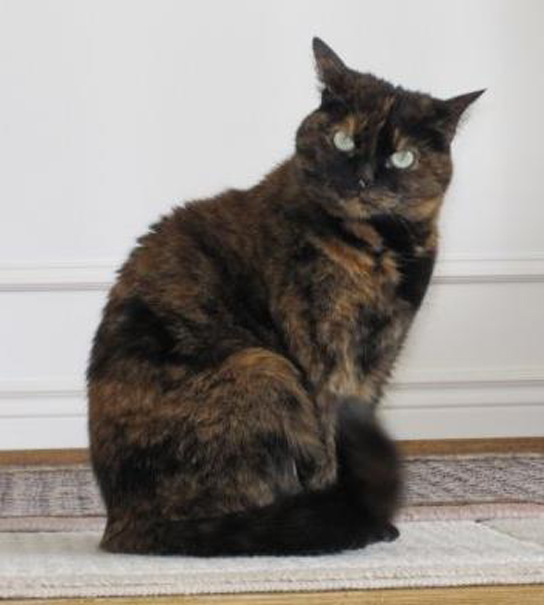
Figure 13.9図 13.9
In cats, the gene for coat color is located on the X chromosome. In female cats' embryonic development, one of the two X chromosomes randomly inactivates in each cell, resulting in a tortoiseshell pattern if the cat has two different alleles for coat color. Male cats, having only one X chromosome, never exhibit a tortoiseshell coat color. (credit: Michael Bodega)
ネコの毛色遺伝子はX染色体上にある。雌の胚発生中に、各細胞の二つのXの片方が無作為に不活性化するため、毛色の対立遺伝子が異なればサビ模様になる。Xを一つしか持たない雄は、サビの毛色を決して示さない。(出典:Michael Bodega)
An individual carrying an abnormal number of X chromosomes will inactivate all but one X chromosome in each of her cells. However, even inactivated X chromosomes continue to express a few genes, and X chromosomes must reactivate for the proper maturation of female ovaries. As a result, X-chromosomal abnormalities typically occur with mild intellectual and physical disorders or disabilities, as well as sterility. If the X chromosome is absent altogether, the individual will not develop in utero.
英語のヒント
異常な数のX染色体を持つ個体は、各細胞で一つを除くすべてのXを不活性化する。しかし不活性Xも少数の遺伝子を発現し続け、卵巣が正常に成熟するにはXの再活性化が必要である。そのためX染色体の異常は、通常、軽い知的・身体的な障害や不妊を伴う。X染色体が全くない場合、子宮内で発生できない。
Scientists have identified and characterized several errors in sex chromosome number. Individuals with three X chromosomes, triplo-X, are phenotypically female but express developmental delays and reduced fertility. The XXY genotype, corresponding to one type of Klinefelter syndrome, corresponds to phenotypically male individuals with small testes, enlarged breasts, and reduced body hair. More complex types of Klinefelter syndrome exist in which the individual has as many as five X chromosomes. In all types, every X chromosome except one undergoes inactivation to compensate for the excess genetic dosage. We see this as several Barr bodies in each cell nucleus. Turner syndrome, characterized as an X0 genotype (i.e., only a single sex chromosome), corresponds to a phenotypically female individual with short stature, webbed skin in the neck region, hearing and cardiac impairments, and sterility.
英語のヒント
性染色体数の誤りはいくつか特定・記載されている。X染色体を3本持つトリプルXの個体は表現型が女性だが、発達の遅れや生殖能力の低下を示す。クラインフェルター症候群の一型に当たるXXYは表現型が男性で、小さな精巣、乳房の拡大、体毛の減少を伴う。最大5本のXを持つ、より複雑なクラインフェルター症候群もある。すべての型で、一つを除くすべてのXが不活性化し、過剰な遺伝子量を補正する。これは核内の複数のバー小体として見える。X0、つまり性染色体が1本だけのターナー症候群は表現型が女性で、低身長、首の翼状の皮膚、聴覚・心臓の障害、不妊を伴う。
Duplications and Deletions重複と欠失
In addition to losing or gaining an entire chromosome, a chromosomal segment may duplicate or lose itself. Duplications and deletions often produce offspring that survive but exhibit abnormalities. Duplicated chromosomal segments may fuse to existing chromosomes or may be free in the nucleus. Cri-du-chat (from the French for “cry of the cat”) is a syndrome that occurs with nervous system abnormalities and identifiable physical features that result from a deletion of most 5p (the small arm of chromosome 5) (Figure 13.10). Infants with this genotype emit a characteristic high-pitched cry on which the disorder’s name is based.
英語のヒント
染色体全体の喪失や増加に加え、一部分だけが重複したり失われたりすることもある。重複・欠失のある子は生存しても異常を示すことが多い。重複部分は既存の染色体に融合するか、核内で独立して存在する。猫鳴き症候群(フランス語の「ネコの鳴き声」に由来するcri-du-chat)は、5p、すなわち第5染色体短腕の大部分の欠失により、神経系の異常や特徴的な身体所見を示す症候群である(図13.10)。この遺伝子型の乳児は特徴的な甲高い泣き声を出し、それが病名の由来となった。
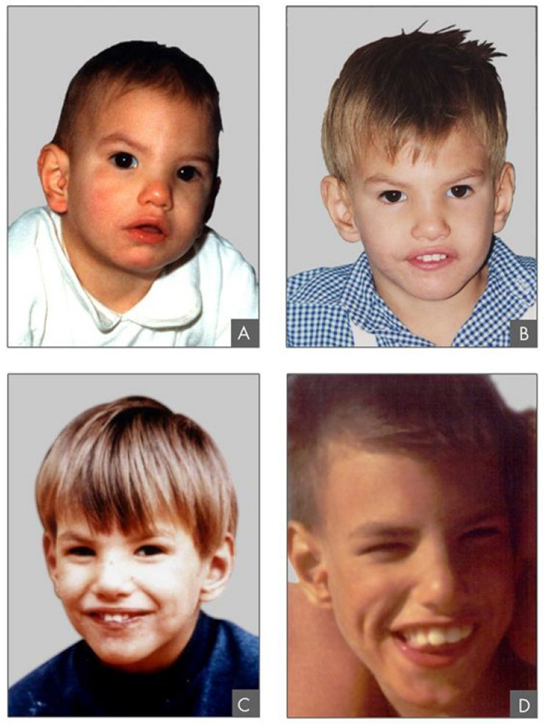


Figure 13.10図 13.10
This figure shows an individual with cri-du-chat syndrome at two, four, nine, and 12 years of age. (credit: Paola Cerruti Mainardi)
猫鳴き症候群のある人の、2歳、4歳、9歳、12歳時の姿。(出典:Paola Cerruti Mainardi)
Chromosomal Structural Rearrangements染色体構造の再編成
Cytologists have characterized numerous structural rearrangements in chromosomes, but chromosome inversions and translocations are the most common. We can identify both during meiosis by the adaptive pairing of rearranged chromosomes with their former homologs to maintain appropriate gene alignment. If the genes on two homologs are not oriented correctly, a recombination event could result in losing genes from one chromosome and gaining genes on the other. This would produce aneuploid gametes.
英語のヒント
細胞学者は染色体の多くの構造再編成を記載してきたが、最も普通なのは逆位と転座である。減数分裂では、再編成された染色体が元の相同染色体と遺伝子の対応を保つように形を変えて対合するので、どちらも同定できる。二つの相同染色体で遺伝子の向きが正しくなければ、組換えによって片方から遺伝子が失われ、他方には加わることがある。その結果、異数性の配偶子ができる。