第13章遺伝についての現代的理解
13.1 Chromosomal Theory and Genetic Linkage13.1 染色体説と遺伝的連鎖
Learning Objectives学習目標
By the end of this section, you will be able to do the following:
この節を学ぶと、次のことができるようになる。
- Discuss Sutton’s Chromosomal Theory of Inheritanceサットンの遺伝の染色体説を論じる。
- Describe genetic linkage遺伝的連鎖を説明する。
- Explain the process of homologous recombination, or crossing over相同組換え、すなわち乗換えの過程を説明する。
- Describe chromosome creation染色体の形成を説明する。
- Calculate the distances between three genes on a chromosome using a three-point test cross三点検定交雑を用いて、染色体上の三つの遺伝子間の距離を計算する。
Long before scientists visualized chromosomes under a microscope, the father of modern genetics, Gregor Mendel, began studying heredity in 1843. With improved microscopic techniques during the late 1800s, cell biologists could stain and visualize subcellular structures with dyes and observe their actions during cell division and meiosis. With each mitotic division, chromosomes replicated, condensed from an amorphous (no constant shape) nuclear mass into distinct X-shaped bodies (pairs of identical sister chromatids), and migrated to separate cellular poles.
英語のヒント
科学者が顕微鏡で染色体を観察するずっと前の1843年、近代遺伝学の父グレゴール・メンデルは遺伝の研究を始めた。1800年代末に顕微鏡技術が改良されると、細胞生物学者は細胞内構造を色素で染めて見えるようにし、細胞分裂や減数分裂中の動きを観察できた。有糸分裂のたびに染色体は複製され、一定の形のない核内の塊から明瞭なX字形の構造、すなわち同一の姉妹染色分体の対へ凝縮し、別々の細胞の極へ移動した。
Chromosomal Theory of Inheritance遺伝の染色体説
The speculation that chromosomes might be the key to understanding heredity led several scientists to examine Mendel’s publications and reevaluate his model in terms of chromosome behavior during mitosis and meiosis. In 1902, Theodor Boveri observed that proper sea urchin embryonic development does not occur unless chromosomes are present. That same year, Walter Sutton observed chromosome separation into daughter cells during meiosis (Figure 13.2). Together, these observations led to the Chromosomal Theory of Inheritance, which identified chromosomes as the genetic material responsible for Mendelian inheritance.
英語のヒント
染色体が遺伝を理解する鍵かもしれないという推測から、数人の科学者がメンデルの論文を調べ、有糸分裂と減数分裂中の染色体の動きに照らしてモデルを再評価した。1902年、テオドール・ボヴェリは、染色体がなければウニの胚が正常に発生しないと観察した。同じ年、ウォルター・サットンは減数分裂で染色体が娘細胞へ分かれることを観察した(図13.2)。これらの観察から、メンデル遺伝を担う遺伝物質が染色体であるとする、遺伝の染色体説が生まれた。
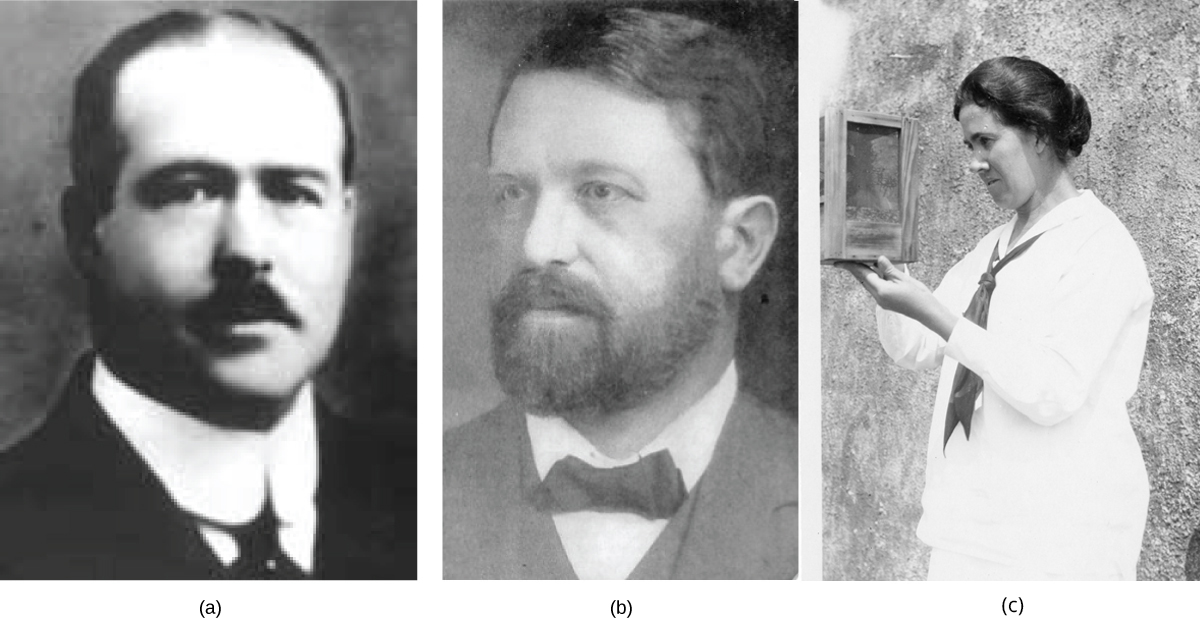

Figure 13.2図 13.2
(a) Walter Sutton and (b) Theodor Boveri developed the Chromosomal Theory of Inheritance, which states that chromosomes carry the unit of heredity (genes). Eleanor Carothers (c), was the first to provide physical evidence supporting the theory.
(a)ウォルター・サットンと(b)テオドール・ボヴェリは、染色体が遺伝の単位である遺伝子を運ぶとする染色体説を作った。(c)エレノア・カロザーズは、この説を支持する物理的な証拠を初めて示した。
The Chromosomal Theory of Inheritance was consistent with Mendel’s laws, which the following observations supported:
遺伝の染色体説はメンデルの法則と一致し、次の観察がそれを支えた。
- During meiosis, homologous chromosome pairs migrate as discrete structures that are independent of other chromosome pairs.減数分裂中、相同染色体の対は、ほかの対とは独立した別個の構造として移動する。
- Chromosome sorting from each homologous pair into pre-gametes appears to be random.各相同染色体対から配偶子の前駆細胞への振り分けは無作為に見える。
- Each parent synthesizes gametes that contain only half their chromosomal complement.各親は、自分の染色体の構成を半分だけ含む配偶子を作る。
- Even though male and female gametes (sperm and egg) differ in size and morphology, they have the same number of chromosomes, suggesting equal genetic contributions from each parent.雄と雌の配偶子(精子と卵)は大きさや形態が異なるが、染色体数は同じであり、両親からの遺伝的寄与が等しいことを示唆する。
- The gametic chromosomes combine during fertilization to produce offspring with the same chromosome number as their parents.配偶子の染色体は受精時に合わさり、親と同じ染色体数の子を作る。
Despite the lack of direct evidence that chromosomes carry traits, the compelling correlation between chromosome behavior during meiosis and Mendel's abstract laws led scientists to propose the Chromosomal Theory of Inheritance. Critics pointed out that individuals had far more independently segregating traits than they had chromosomes. About ten years after the theory was proposed, Eleanor Carothers was the first to discover physical evidence supporting it; she observed independent chromosome assortment in grasshoppers. Then, after several years of carrying out crosses with the fruit fly, Drosophila melanogaster, Thomas Hunt Morgan provided additional experimental evidence to support the Chromosomal Theory of Inheritance.
英語のヒント
染色体が形質を運ぶ直接証拠はなかったが、減数分裂時の染色体の動きとメンデルの抽象的な法則との間の説得力ある対応から、科学者は染色体説を提唱した。批判者は、個体には染色体の数よりはるかに多くの、独立に分離する形質があると指摘した。提唱から約10年後、エレノア・カロザーズがバッタで染色体の独立の振り分けを観察し、初めて物理的な裏付けを得た。その後、トーマス・ハント・モーガンはキイロショウジョウバエ(Drosophila melanogaster)の交配を数年行い、さらに実験的な証拠を示した。
Genetic Linkage and Distances遺伝的連鎖と距離
Mendel’s work suggested that traits are inherited independently of each other. Morgan identified a 1:1 correspondence between a segregating trait and the X chromosome, suggesting that random chromosome segregation was the physical basis of Mendel’s model. This also demonstrated that linked genes disrupt Mendel’s predicted outcomes. That each chromosome can carry many linked genes explains how individuals can have many more traits than they have chromosomes. However, researchers in Morgan’s laboratory suggested that alleles positioned on the same chromosome were not always inherited together. During meiosis, linked genes somehow became unlinked.
英語のヒント
メンデルの研究は形質が互いに独立して遺伝すると示唆した。モーガンは分離する形質とX染色体の1:1の対応を特定し、染色体の無作為な分離がモデルの物理的基盤であることを示唆した。また連鎖した遺伝子がメンデルの予測を崩すことも示した。各染色体が多数の連鎖遺伝子を持てることは、なぜ染色体数よりはるかに多くの形質があるかを説明する。しかしモーガンの研究室では、同じ染色体上の対立遺伝子が必ずしも一緒に遺伝しないと考えられた。減数分裂中に、連鎖した遺伝子が何らかの形で連鎖を解いていた。
Homologous Recombination相同組換え
In 1909, Frans Janssen observed chiasmata—the point at which chromatids are in contact with each other and may exchange segments—prior to the first meiotic division. He suggested that alleles become unlinked and chromosomes physically exchange segments. As chromosomes condensed and paired with their homologs, they appeared to interact at distinct points. Janssen suggested that these points corresponded to regions in which chromosome segments exchanged. We now know that the pairing and interaction between homologous chromosomes, or synapsis, does more than simply organize the homologs for migration to separate daughter cells. When synapsed, homologous chromosomes undergo reciprocal physical exchanges at their arms in homologous recombination, or more simply, “crossing over.”
英語のヒント
1909年、フランス・ヤンセンは減数第一分裂前にキアズマを観察した。これは染色分体が接し、部分を交換しうる場所である。対立遺伝子の連鎖が解け、染色体が物理的に部分を交換すると提唱した。染色体が凝縮して相同染色体と対になると、特定の場所で相互作用するように見えた。ヤンセンはそこが染色体部分の交換領域だと考えた。現在では、相同染色体の対形成と相互作用である対合は、別々の娘細胞へ移すために整列させるだけではないと分かっている。対合した染色体は腕の部分を相互に物理的交換する。これが相同組換え、簡単にいえば「乗換え」である。
To better understand the type of experimental results that researchers were obtaining at this time, consider a heterozygous individual that inherited dominant maternal alleles for two genes on the same chromosome (such as A and B) and two recessive paternal alleles for those same genes (such as a and b). If the genes are linked, one would expect this individual to produce gametes that are either AB or ab with a 1:1 ratio. If the genes are unlinked, the individual should produce AB, Ab, aB, and ab gametes with equal frequencies, according to the Mendelian concept of independent assortment. Because they correspond to new allele combinations, the genotypes Ab and aB are nonparental types that result from homologous recombination during meiosis. Parental types are progeny that exhibit the same allelic combination as their parents. Morgan and his colleagues, however, found that when they test crossed such heterozygous individuals to a homozygous recessive parent (AaBb × aabb), both parental and nonparental cases occurred. For example, 950 offspring might be recovered that were either AaBb or aabb, but 50 offspring would also result that were either Aabb or aaBb. These results suggested that linkage occurred most often, but a significant minority of offspring were the products of recombination.
英語のヒント
当時の実験結果を理解するため、同じ染色体上の二遺伝子の優性対立遺伝子AとBを母から、対応する劣性のaとbを父から受け継いだヘテロ接合体を考えよう。連鎖していれば配偶子はABまたはabで、比は1:1と予測される。連鎖していなければ独立の法則に従い、AB、Ab、aB、abが同じ頻度でできるはずである。AbとaBは新しい組み合わせなので、減数分裂中の相同組換えによる非親型である。親型とは、親と同じ対立遺伝子の組み合わせを示す子をいう。ところがモーガンらが、このようなヘテロ接合体を劣性ホモ接合の親と検定交雑(AaBb×aabb)すると、親型も非親型も生じた。例えば950個体がAaBbまたはaabbであっても、50個体はAabbまたはaaBbとなった。これは大部分では連鎖が起こるが、無視できない少数の子が組換え産物であることを示唆した。
One of the experiments in Morgan's lab involving the crosses of flies for two traits, body color (gray or black) and wing shape (normal and vestigial), demonstrated the recombination events that lead to the development of nonparental phenotypes (Figure 13.3).
モーガンの研究室では、体色(灰色または黒色)と翅の形(正常または痕跡翅)の二形質について交配した実験が、非親型の表現型を生む組換えを示した(図13.3)。