第8章光合成
8.3 Using Light Energy to Make Organic Molecules8.3 光エネルギーを使って有機分子をつくる
Learning Objectives学習目標
By the end of this section, you will be able to do the following:
この節を学び終えると、次のことができるようになる。
- Describe the Calvin cycleカルビン回路を説明する。
- Define carbon fixation炭素固定を定義する。
- Explain how photosynthesis works in the energy cycle of all living organismsあらゆる生物のエネルギーの循環で、光合成がどのように働くかを説明する。
After the energy from the sun is converted into chemical energy and temporarily stored in ATP and NADPH molecules, the cell has the fuel needed to build carbohydrate molecules for long-term energy storage. The products of the light-dependent reactions, ATP and NADPH, have lifespans in the range of millionths of seconds, whereas the products of the light-independent reactions (carbohydrates and other forms of reduced carbon) can survive almost indefinitely. The carbohydrate molecules made will have a backbone of carbon atoms. But where does the carbon come from? It comes from carbon dioxide—the gas that is a waste product of respiration in microbes, fungi, plants, and animals.
英語のヒント
太陽のエネルギーが化学エネルギーへ変換され、ATPとNADPHに一時的に蓄えられると、細胞には長期的なエネルギー貯蔵用の炭水化物をつくる燃料がそろう。光依存反応の生成物ATPとNADPHの寿命は100万分の1秒程度であるが、光非依存反応の生成物である炭水化物やほかの還元された炭素の形は、ほぼ無期限に存続できる。できる炭水化物には炭素原子の骨格がある。では、その炭素はどこから来るのだろうか。微生物、菌類、植物、動物の呼吸で不要物として生じる気体、二酸化炭素に由来する。
The Calvin Cycleカルビン回路
In plants, carbon dioxide (CO2) enters the leaves through stomata, where it diffuses over short distances through intercellular spaces until it reaches the mesophyll cells. Once in the mesophyll cells, CO2 diffuses into the stroma of the chloroplast—the site of light-independent reactions of photosynthesis. These reactions actually have several names associated with them. Another term, the Calvin cycle, is named for the man who discovered it, and because these reactions function as a cycle. Others call it the Calvin-Benson cycle to include the name of another scientist involved in its discovery. The most outdated name is “dark reaction,” because light is not directly required (Figure 8.18). However, the term dark reaction can be misleading because it implies incorrectly that the reaction only occurs at night or is independent of light, which is why most scientists and instructors no longer use it.
英語のヒント
植物では、二酸化炭素(CO2)が気孔を通って葉へ入り、細胞間隙を短い距離だけ拡散して、葉肉細胞へ届く。細胞内へ入ったCO2は、光非依存反応の場である葉緑体のストロマへ拡散する。これらの反応には、いくつかの名称がある。「カルビン回路」は、発見者の名前と、反応が回路として働くことにちなむ。発見に関わったもう一人の科学者も含めて「カルビン–ベンソン回路」と呼ぶこともある。最も古い名称は、光を直接必要としないことに由来する「暗反応」である(図8.18)。しかし、夜だけ起こる、または光に依存しないと誤解させるため、現在ほとんどの科学者や教育者はこの名称を使わない。
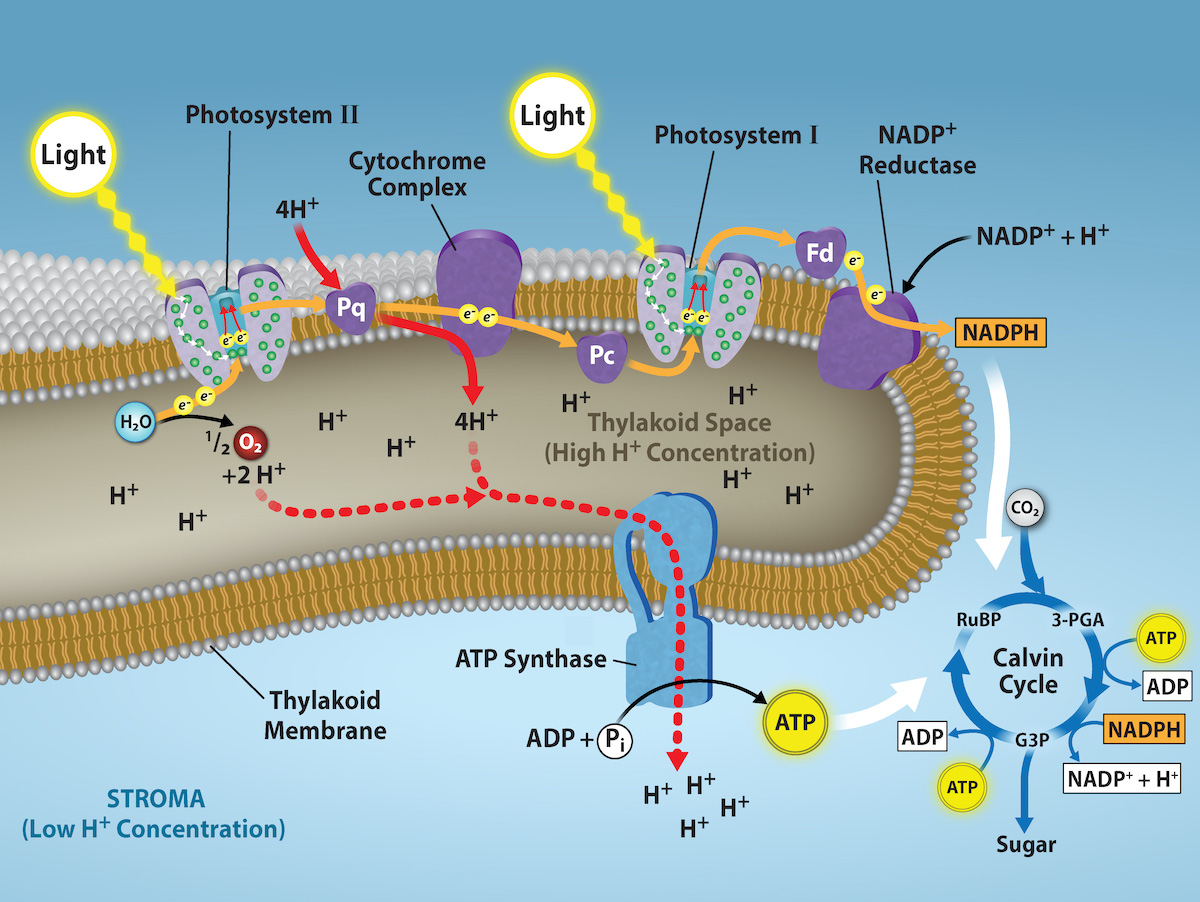
OpenStax, Rice University; Biology 2e. Credit: Rao, A., Ryan, K., Tag, A., Fletcher, S. and Hawkins, A. Department of Biology, Texas A&M University. · CC BY 4.0 · Source出典

Figure 8.18図 8.18
Light reactions harness energy from the sun to produce chemical bonds, ATP, and NADPH. These energy-carrying molecules are made in the stroma where carbon fixation takes place. Credit: Rao, A., Ryan, K., Tag, A., Fletcher, S. and Hawkins, A. Department of Biology, Texas A&M University.
明反応は太陽のエネルギーを利用し、化学結合、ATP、NADPHをつくる。これらのエネルギー運搬分子は、炭素固定が起こるストロマで生産される。出典:Rao, A.、Ryan, K.、Tag, A.、Fletcher, S.、Hawkins, A.、テキサスA&M大学生物学部。
The light-independent reactions of the Calvin cycle can be organized into three basic stages: fixation, reduction, and regeneration.
カルビン回路の光非依存反応は、固定、還元、再生という三つの基本段階に分けられる。
Stage 1: Fixation第1段階:固定
In the stroma, in addition to CO2, two other components are present to initiate the light-independent reactions: an enzyme called ribulose-1,5-bisphosphate carboxylase/oxygenase (RuBisCO), and three molecules of ribulose bisphosphate (RuBP), as shown in Figure 8.19. RuBP has five atoms of carbon, flanked by two phosphates.
英語のヒント
図8.19のように、ストロマにはCO2、 に加え、光非依存反応を始めるための二つの構成要素がある。一つはリブロース1,5-ビスリン酸カルボキシラーゼ/オキシゲナーゼ(RuBisCO)という酵素、もう一つはリブロースビスリン酸(RuBP)3分子である。RuBPは炭素原子5個をもち、両端にリン酸が一つずつ付いている。
RuBisCO catalyzes a reaction between CO2 and RuBP. For each CO2 molecule that reacts with one RuBP, two molecules of another compound 3-phospho glyceric acid (3-PGA) form. PGA has three carbons and one phosphate. Each turn of the cycle involves only one RuBP and one carbon dioxide and forms two molecules of 3-PGA. The number of carbon atoms remains the same, as the atoms move to form new bonds during the reactions (3 C atoms from 3CO2 + 15 C atoms from 3RuBP = 18 C atoms in 6 molecules of 3-PGA). This process is called carbon fixation, because CO2 is “fixed” from an inorganic form into organic molecules.
英語のヒント
RuBisCOは、CO2とRuBPの間の反応を触媒する。RuBP1分子と反応するCO21分子ごとに、別の化合物である3-ホスホグリセリン酸(3-PGA)が2分子できる。PGAは炭素3個とリン酸1個をもつ。回路1周で使われるのはRuBP1分子と二酸化炭素1分子だけで、3-PGA2分子ができる。反応中、原子が移動して新しい結合をつくっても、炭素原子の総数は変わらない。3CO2由来の炭素3個と3RuBP由来の炭素15個を合わせると、3-PGA6分子中の炭素18個になる。CO2が無機の形から有機分子へ「固定」されるので、この過程を炭素固定と呼ぶ。