第8章光合成
Stage 2: Reduction第2段階:還元
ATP and NADPH are used to convert the six molecules of 3-PGA into six molecules of a chemical called glyceraldehyde 3-phosphate (G3P). That is a reduction reaction because it involves the gain of electrons by 3-PGA. (Recall that a reduction is the gain of an electron by an atom or molecule.) Six molecules of both ATP and NADPH are used. For ATP, energy is released with the loss of the terminal phosphate atom, converting it into ADP; for NADPH, both energy and a hydrogen atom are lost, converting it into NADP+. Both of these molecules return to the nearby light-dependent reactions to be reused and re-energized.
英語のヒント
ATPとNADPHを使い、3-PGA6分子を、グリセルアルデヒド3-リン酸(G3P)という化合物6分子へ変換する。3-PGAが電子を受け取るので、これは還元反応である。原子や分子が電子を得ることが還元だったことを思い出せ。ATPもNADPHも6分子ずつ使う。ATPは末端のリン酸原子を失うとともにエネルギーを放出し、ADPへ変わる。NADPHはエネルギーと水素原子を失い、NADP+へ変わる。両分子は近くの光依存反応へ戻り、再びエネルギーを与えられて再利用される。
Stage 3: Regeneration第3段階:再生
Interestingly, at this point, only one of the G3P molecules leaves the Calvin cycle and is sent to the cytoplasm to contribute to the formation of other compounds needed by the plant. Because the G3P exported from the chloroplast has three carbon atoms, it takes three “turns” of the Calvin cycle to fix enough net carbon to export one G3P. But each turn makes two G3Ps, thus three turns make six G3Ps. One is exported while the remaining five G3P molecules remain in the cycle and are used to regenerate RuBP, which enables the system to prepare for more CO2 to be fixed. Three more molecules of ATP are used in these regeneration reactions.
英語のヒント
興味深いことに、この時点でカルビン回路を出るG3Pは1分子だけである。細胞質へ送られ、植物に必要な他の化合物の形成に使われる。葉緑体から出るG3Pは炭素3個をもつので、1分子を外へ出すのに十分な正味の炭素を固定するには、回路を3周する必要がある。1周につきG3Pが2分子できるため、3周すると6分子できる。そのうち1分子が外へ出て、残りの5分子は回路に残り、RuBPを再生するのに使われる。これによって、さらにCO2を固定する準備が整う。この再生反応では、ATPをさらに3分子使う。
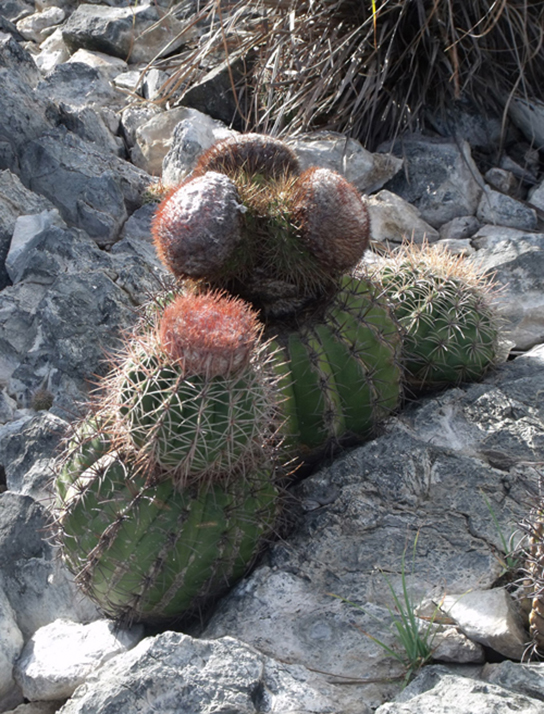

Figure 8.20図 8.20
The harsh conditions of the desert have led plants like these cacti to evolve variations of the light-independent reactions of photosynthesis. These variations increase the efficiency of water usage, helping to conserve water and energy. (credit: Piotr Wojtkowski)
砂漠の厳しい条件によって、こうしたサボテンなどの植物は、光合成の光非依存反応に変化を進化させた。それによって水の利用効率が高まり、水とエネルギーを節約できる。(出典:Piotr Wojtkowski)
The Energy Flowエネルギーの流れ
Whether the organism is a bacterium, plant, or animal, all living things access energy by breaking down carbohydrate and other carbon-rich organic molecules. But if plants make carbohydrate molecules, why would they need to break them down, especially when it has been shown that the gas organisms release as a “waste product” (CO2) acts as a substrate for the formation of more food in photosynthesis? Remember, living things need energy to perform life functions. In addition, an organism can either make its own food or eat another organism—either way, the food still needs to be broken down. Finally, in the process of breaking down food, called cellular respiration, heterotrophs release needed energy and produce “waste” in the form of CO2 gas.
英語のヒント
細菌でも植物でも動物でも、すべての生物は、炭水化物など炭素に富む有機分子を分解してエネルギーを得る。しかし、植物が炭水化物をつくるなら、なぜそれを分解する必要があるのだろうか。生物が「不要物」として出すCO2が、光合成でさらに食物をつくるための基質になることを考えると、なおさら不思議に思えるかもしれない。生物には、生命活動のためのエネルギーが必要なことを思い出せ。また、自分で食物をつくるにせよ、ほかの生物を食べるにせよ、食物は分解しなければならない。食物を分解する細胞呼吸という過程で、従属栄養生物は必要なエネルギーを放出し、CO2ガスという「不要物」を生み出す。
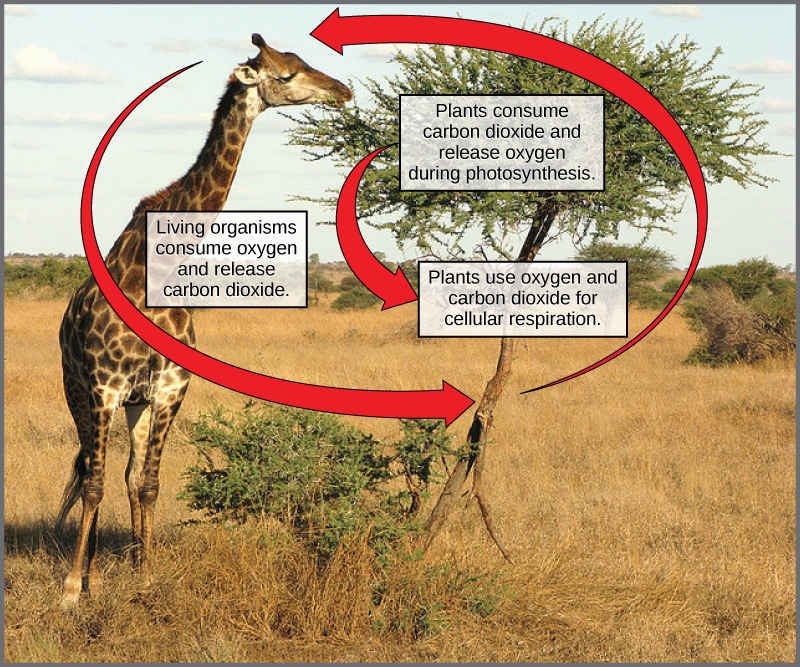
However, in nature, there is no such thing as “waste.” Every single atom of matter and energy is conserved, recycled over and over infinitely. Substances change form or move from one type of molecule to another, but their constituent atoms never disappear (Figure 8.22).
英語のヒント
しかし、自然界には「不要物」というものはない。物質とエネルギーの一つ一つの原子は保存され、無限に何度も再利用される。物質は形を変え、ある種類の分子から別の分子へ移るが、それを構成する原子が消えることはない(図8.22)。
In reality, CO2 is no more a form of waste than oxygen is wasteful to photosynthesis. Both are byproducts of reactions that move on to other reactions. Photosynthesis absorbs light energy to build carbohydrates in chloroplasts, and aerobic cellular respiration releases energy by using oxygen to metabolize carbohydrates in the cytoplasm and mitochondria. Both processes use electron transport chains to capture the energy necessary to drive other reactions. These two powerhouse processes, photosynthesis and cellular respiration, function in biological, cyclical harmony to allow organisms to access life-sustaining energy that originates millions of miles away in a burning star humans call the sun.
英語のヒント
実際、CO2が不要物であるというのは、光合成の酸素が無駄なものであるというのと同じくらい当たらない。どちらも、ある反応の副産物が別の反応へ進むものである。光合成は光エネルギーを吸収し、葉緑体で炭水化物をつくる。好気的な細胞呼吸は、細胞質とミトコンドリアで酸素を使って炭水化物を代謝し、エネルギーを放出する。どちらも電子伝達系で、ほかの反応を動かすためのエネルギーを取り込む。光合成と細胞呼吸という二つのエネルギー供給過程は、生物学的な循環の中で調和して働き、何百万マイルも離れた、ヒトが太陽と呼ぶ燃える恒星に由来する、生命を支えるエネルギーを生物が利用できるようにしている。
OpenStax, Rice University; Biology 2e. Credit: Rao, A., Ryan, and Tag, A. Department of Biology, Texas A&M University. · CC BY 4.0 · Source出典

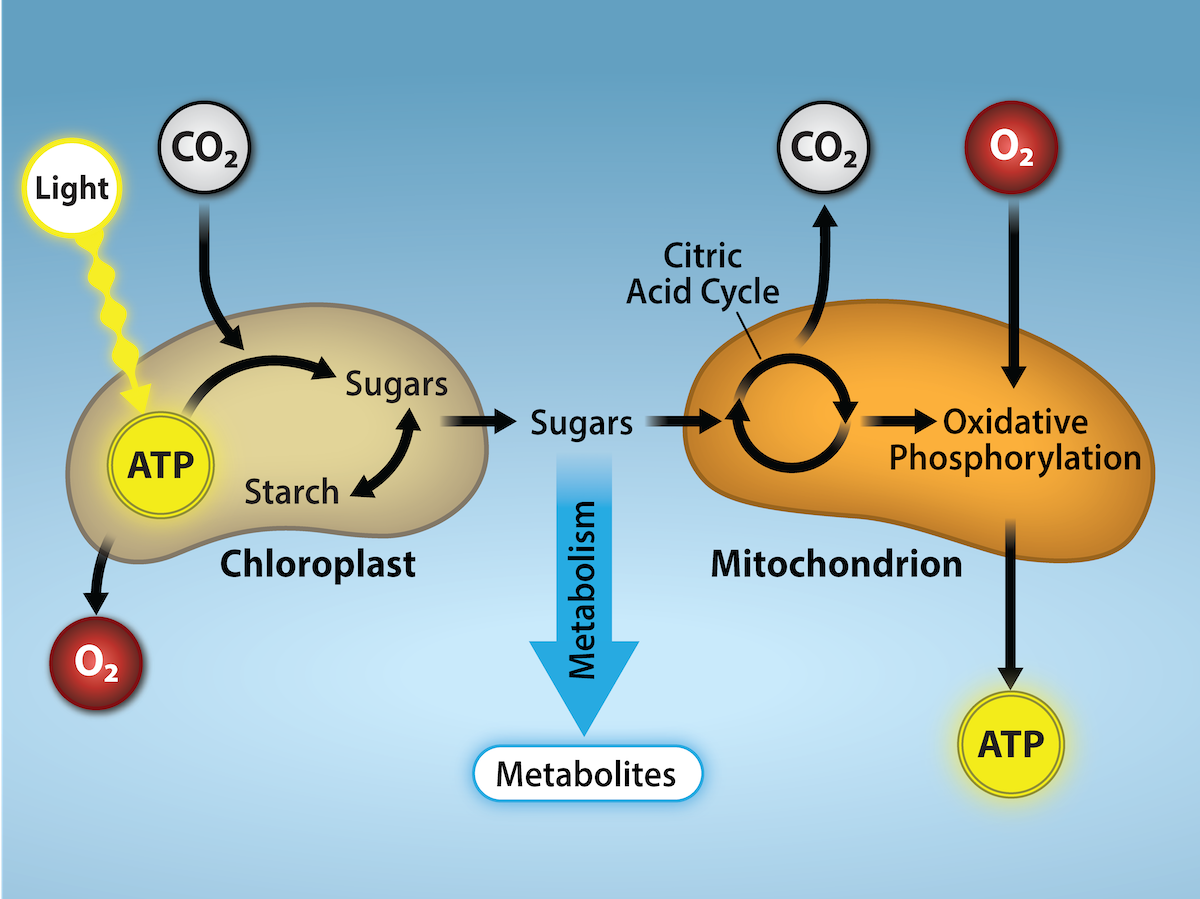
Figure 8.21図 8.21
Connection between Photosynthesis and Respiration Photosynthesis in chloroplasts is the process by which light energy is converted to chemical energy and stored in sugars. Initially, the light energy is converted into chemical energy during ATP synthesis in a process that gives off oxygen. The energy in ATP is then used to reduce CO2 to simple sugars. In contrast, cellular respiration is the process in which the chemical energy stored in sugars is converted into ATP, a source of chemical energy that can be used by the rest of the cell. In the process of converting the energy stored in the sugars to ATP, CO2 is released and oxygen is consumed. Credit: Rao, A., Ryan, and Tag, A. Department of Biology, Texas A&M University.
光合成と呼吸のつながり。葉緑体の光合成は、光エネルギーを化学エネルギーへ変え、糖に蓄える過程である。最初に、酸素を放出するATP合成過程で、光エネルギーが化学エネルギーへ変わる。続いてATPのエネルギーを使い、CO2を単純な糖へ還元する。一方、細胞呼吸は、糖に蓄えられた化学エネルギーを、細胞のほかの部分が使える化学エネルギー源であるATPへ変換する過程である。その際、CO2が放出され、酸素が消費される。出典:Rao, A.、Ryan、Tag, A.、テキサスA&M大学生物学部。
OpenStax, Rice University; Biology 2e. (credit: modification of work by Stuart Bassil) · CC BY 4.0 · Source出典

Figure 8.22図 8.22
Photosynthesis consumes carbon dioxide and produces oxygen. Aerobic respiration consumes oxygen and produces carbon dioxide. These two processes play an important role in the carbon cycle. (credit: modification of work by Stuart Bassil)
光合成は二酸化炭素を消費し、酸素を生産する。好気呼吸は酸素を消費し、二酸化炭素を生産する。二つの過程は炭素循環で重要な役割を果たす。(出典:Stuart Bassilの作品を改変)