第8章光合成
8.1 Overview of Photosynthesis8.1 光合成の概要
Learning Objectives学習目標
By the end of this section, you will be able to do the following:
この節を学び終えると、次のことができるようになる。
- Explain the significance of photosynthesis to other living organismsほかの生物にとっての光合成の意義を説明する。
- Describe the main structures involved in photosynthesis光合成に関わる主な構造を説明する。
- Identify the substrates and products of photosynthesis光合成の基質と生成物を特定する。
Photosynthesis is essential to almost all life on earth; both plants and animals depend on it. It is the only biological process that can capture energy that originates from sunlight and convert it into chemical compounds (carbohydrates) that every organism uses to power its metabolism. It is also a source of oxygen necessary for many living organisms. In brief, the energy of sunlight is “captured” to energize electrons, whose energy is then stored in the covalent bonds of sugar molecules. How long lasting and stable are those covalent bonds? The energy extracted today by the burning of coal and petroleum products represents sunlight energy captured and stored by photosynthesis 350 to 200 million years ago during the Carboniferous Period.
英語のヒント
光合成は地球のほぼすべての生命に不可欠で、植物も動物もそれに依存している。太陽光に由来するエネルギーを取り込み、すべての生物が代謝を動かすために使う化合物、すなわち炭水化物へ変えることができる、唯一の生物学的過程である。また、多くの生物に必要な酸素の供給源でもある。簡単にいうと、太陽光のエネルギーが「捕らえられて」電子を高エネルギー状態にし、そのエネルギーが糖分子の共有結合に蓄えられる。この結合は、どれほど長く安定して保たれるのだろうか。今日、石炭や石油製品を燃やして取り出すエネルギーは、3億5000万〜2億年前の石炭紀に、光合成によって捕らえられ、蓄えられた太陽光のエネルギーなのである。
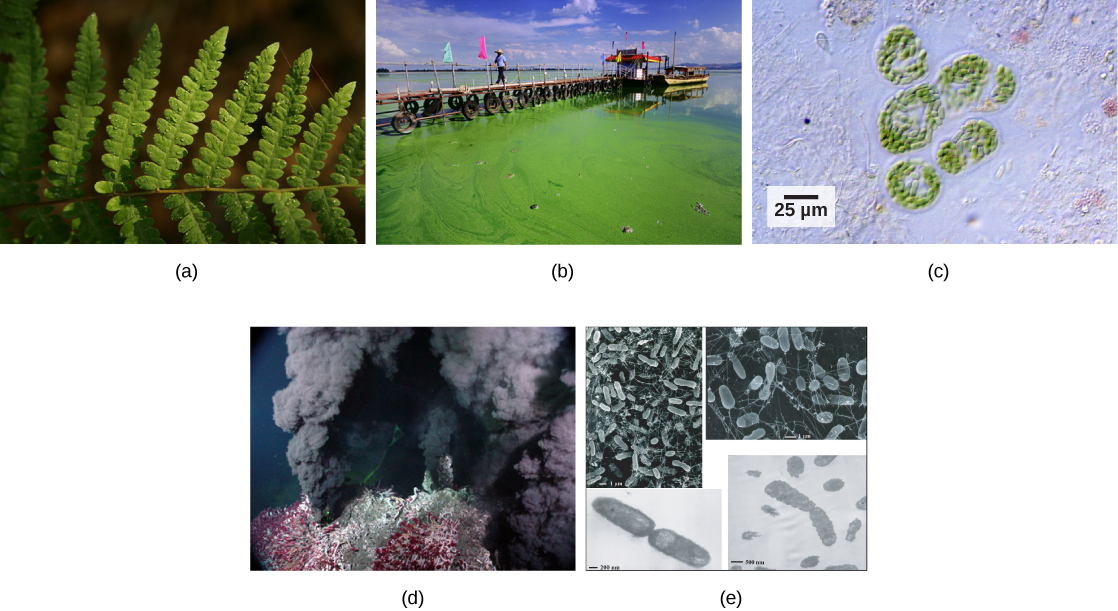
Plants, algae, and a group of bacteria called cyanobacteria are the only organisms capable of performing photosynthesis (Figure 8.2). Because they use light to manufacture their own food, they are called photoautotrophs (literally, “self-feeders using light”). Other organisms, such as animals, fungi, and most other bacteria, are termed heterotrophs (“other feeders”), because they must rely on the sugars produced by photosynthetic organisms for their energy needs. A third very interesting group of bacteria synthesize sugars, not by using sunlight’s energy, but by extracting energy from inorganic chemical compounds. For this reason, they are referred to as chemoautotrophs.
英語のヒント
植物、藻類、そしてシアノバクテリアという細菌群だけが、光合成を行える(図8.2)。光を使って自分の食物をつくるので、光独立栄養生物、文字どおり「光を使って自分を養うもの」と呼ばれる。動物、菌類、ほかの細菌の大部分などは、光合成生物がつくる糖にエネルギーを依存するため、従属栄養生物、「他者から栄養を得るもの」と呼ばれる。さらに、興味深い第3の細菌群は、太陽光のエネルギーを使うのではなく、無機化合物からエネルギーを取り出して糖を合成する。このため、化学独立栄養生物と呼ばれる。
OpenStax, Rice University; Biology 2e. (credit a: modification of work by Steve Hillebrand, U.S. Fish and Wildlife Service; credit b: modification of work by "eutrophication&hypoxia"/Flickr; credit c: modification of work by NASA; credit d: University of Washington, NOAA; credit e: modification of work by Mark Amend, West Coast and Polar Regions Undersea Research Center, UAF, NOAA) · CC BY 4.0 · Source出典
Figure 8.2図 8.2
Photoautotrophs including (a) plants, (b) algae, and (c) cyanobacteria synthesize their organic compounds via photosynthesis using sunlight as an energy source. Cyanobacteria and planktonic algae can grow over enormous areas in water, at times completely covering the surface. In a (d) deep sea vent, chemoautotrophs, such as these (e) thermophilic bacteria, capture energy from inorganic compounds to produce organic compounds. The ecosystem surrounding the vents has a diverse array of animals, such as tubeworms, crustaceans, and octopuses that derive energy from the bacteria. (credit a: modification of work by Steve Hillebrand, U.S. Fish and Wildlife Service; credit b: modification of work by "eutrophication&hypoxia"/Flickr; credit c: modification of work by NASA; credit d: University of Washington, NOAA; credit e: modification of work by Mark Amend, West Coast and Polar Regions Undersea Research Center, UAF, NOAA)
(a)植物、(b)藻類、(c)シアノバクテリアなどの光独立栄養生物は、太陽光をエネルギー源とする光合成で有機化合物を合成する。シアノバクテリアや浮遊性藻類は、水中の広大な範囲に増殖し、ときには水面を完全に覆う。(d)深海の噴出孔では、(e)好熱性細菌などの化学独立栄養生物が、無機化合物からエネルギーを取り出して有機化合物を生産する。周辺の生態系には、チューブワーム、甲殻類、タコなど、細菌からエネルギーを得る多様な動物がいる。(出典 a:Steve Hillebrand、米国魚類野生生物局の作品を改変、b:「eutrophication&hypoxia」/Flickrの作品を改変、c:NASAの作品を改変、d:ワシントン大学、NOAA、e:Mark Amend、West Coast and Polar Regions Undersea Research Center、UAF、NOAAの作品を改変)
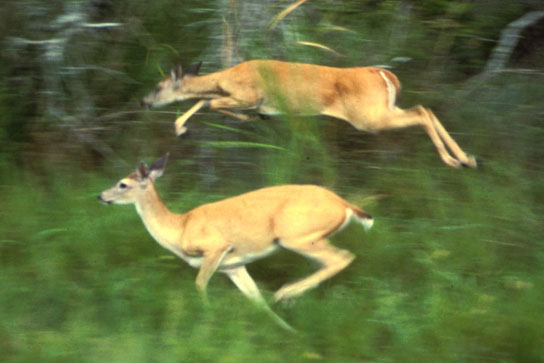
The importance of photosynthesis is not just that it can capture sunlight’s energy. After all, a lizard sunning itself on a cold day can use the sun’s energy to warm up in a process called behavioral thermoregulation. In contrast, photosynthesis is vital because it evolved as a way to store the energy from solar radiation (the “photo-” part) to energy in the carbon-carbon bonds of carbohydrate molecules (the “-synthesis” part). Those carbohydrates are the energy source that heterotrophs use to power the synthesis of ATP via respiration. Therefore, photosynthesis powers 99 percent of Earth’s ecosystems. When a top predator, such as a wolf, preys on a deer (Figure 8.3), the wolf is at the end of an energy path that went from nuclear reactions on the surface of the sun, to visible light, to photosynthesis, to vegetation, to deer, and finally to the wolf.
英語のヒント
光合成の重要性は、太陽光のエネルギーを取り込めることだけではない。寒い日に日光浴するトカゲも、行動性体温調節という過程で太陽のエネルギーを使って体を温められる。光合成が不可欠なのは、太陽放射のエネルギー(photo-の部分)を、炭水化物分子の炭素–炭素結合のエネルギーとして蓄える(-synthesisの部分)方法として進化したからである。従属栄養生物は、この炭水化物をエネルギー源として、呼吸によるATP合成を進める。したがって、地球の生態系の99パーセントを動かしているのは光合成である。オオカミのような頂点捕食者がシカを捕食するとき(図8.3)、そのオオカミは、太陽表面の核反応から可視光、光合成、植物、シカを経て、最後にオオカミへ至るエネルギーの道筋の終点にいるのである。
OpenStax, Rice University; Biology 2e. (credit: modification of work by Steve VanRiper, U.S. Fish and Wildlife Service) · CC BY 4.0 · Source出典
Figure 8.3図 8.3
The energy stored in carbohydrate molecules from photosynthesis passes through the food chain. The predator that eats these deer receives a portion of the energy that originated in the photosynthetic vegetation that the deer consumed. (credit: modification of work by Steve VanRiper, U.S. Fish and Wildlife Service)
光合成によって炭水化物に蓄えられたエネルギーは、食物連鎖を通って移動する。このシカを食べる捕食者は、シカが食べた光合成植物に由来するエネルギーの一部を受け取る。(出典:Steve VanRiper、米国魚類野生生物局の作品を改変)
Main Structures and Summary of Photosynthesis光合成の主な構造と概要
Photosynthesis is a multi-step process that requires specific wavelengths of visible sunlight, carbon dioxide (which is low in energy), and water as substrates (Figure 8.4). After the process is complete, it releases oxygen and produces glyceraldehyde-3-phosphate (G3P), as well as simple carbohydrate molecules (high in energy) that can then be converted into glucose, sucrose, or any of dozens of other sugar molecules. These sugar molecules contain energy and the energized carbon that all living things need to survive.
英語のヒント
光合成は多段階の過程で、太陽の可視光の特定の波長、低エネルギーの二酸化炭素、水を基質として必要とする(図8.4)。過程が完了すると酸素を放出し、グリセルアルデヒド3-リン酸(G3P)や、高エネルギーの単純な炭水化物分子を生み出す。これらは、グルコース、スクロース、あるいは数十種類の別の糖へ変換できる。この糖分子には、すべての生物が生きるために必要なエネルギーと、高エネルギー状態の炭素が含まれている。
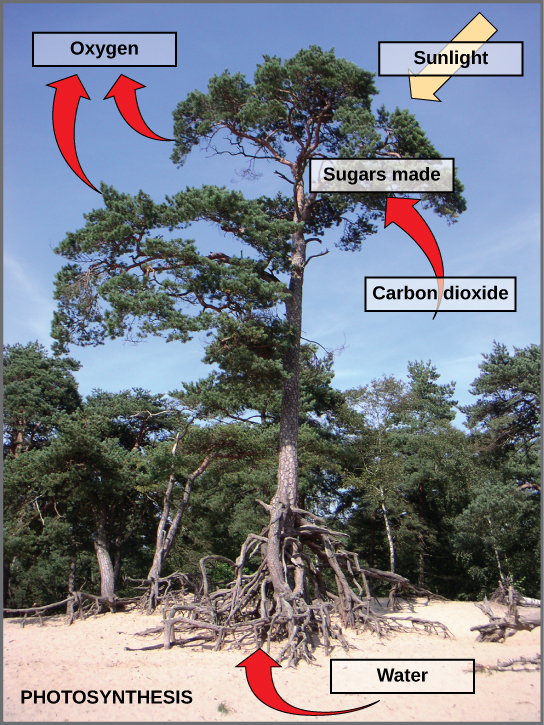
Figure 8.4図 8.4
Photosynthesis uses solar energy, carbon dioxide, and water to produce energy-storing carbohydrates. Oxygen is generated as a waste product of photosynthesis.
光合成は太陽エネルギー、二酸化炭素、水を使い、エネルギーを蓄える炭水化物をつくる。酸素は、光合成の不要な生成物として生じる。
The following is the chemical equation for photosynthesis (Figure 8.5):
光合成の化学反応式は、次のとおりである(図8.5)。
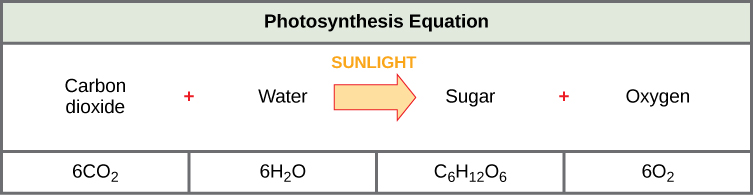


Figure 8.5図 8.5
The basic equation for photosynthesis is deceptively simple. In reality, the process takes place in many steps involving intermediate reactants and products. Glucose, the primary energy source in cells, is made from two three-carbon G3Ps.
光合成の基本式は、一見すると単純である。実際には、中間的な反応物や生成物が関わる多数の段階で進む。細胞の主要なエネルギー源であるグルコースは、三炭素のG3P2分子からつくられる。
Although the equation looks simple, the many steps that take place during photosynthesis are actually quite complex. Before learning the details of how photoautotrophs turn sunlight into food, it is important to become familiar with the structures involved.
英語のヒント
反応式は単純に見えるが、光合成の各段階は実際にはかなり複雑である。光独立栄養生物が太陽光を食物へ変える仕組みを詳しく学ぶ前に、関わる構造を理解しておくことが重要である。