第8章光合成
8.2 The Light-Dependent Reactions of Photosynthesis8.2 光合成の光依存反応
Learning Objectives学習目標
By the end of this section, you will be able to do the following:
この節を学び終えると、次のことができるようになる。
- Explain how plants absorb energy from sunlight植物が太陽光からエネルギーを吸収する仕組みを説明する。
- Describe short and long wavelengths of light短い波長と長い波長の光を説明する。
- Describe how and where photosynthesis takes place within a plant植物のどこで、どのように光合成が起こるか説明する。
How can light energy be used to make food? When a person turns on a lamp, electrical energy becomes light energy. Like all other forms of kinetic energy, light can travel, change form, and be harnessed to do work. In the case of photosynthesis, light energy is converted into chemical energy, which photoautotrophs use to build basic carbohydrate molecules (Figure 8.9). However, autotrophs only use a few specific wavelengths of sunlight.
英語のヒント
光のエネルギーは、どのように食物をつくるために使えるのだろうか。ランプを点灯すると、電気エネルギーが光エネルギーになる。ほかのすべての運動エネルギーの形と同様に、光は移動し、形を変え、仕事に利用できる。光合成の場合、光エネルギーは化学エネルギーへ変換され、光独立栄養生物はそれを使って基本的な炭水化物分子をつくる(図8.9)。ただし、利用するのは太陽光の特定の少数の波長だけである。
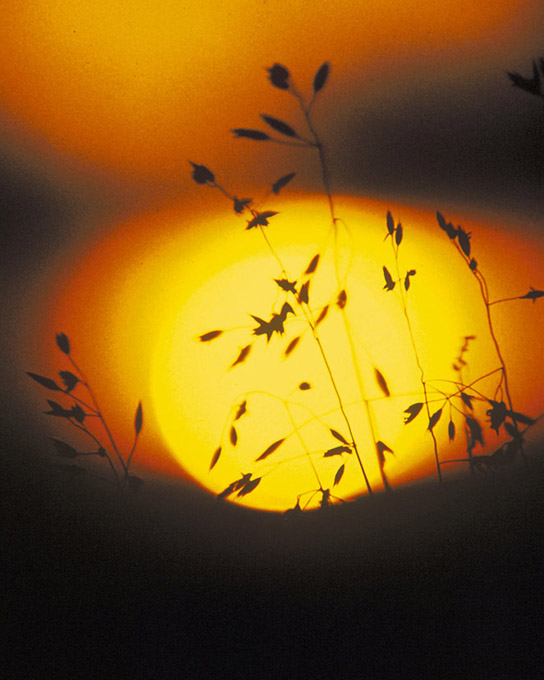
Figure 8.9図 8.9
Photoautotrophs can capture visible light energy in specific wavelengths from the sun, converting it into the chemical energy used to build food molecules. (credit: Gerry Atwell)
光独立栄養生物は、太陽からの可視光の特定の波長のエネルギーを捕らえ、食物分子をつくるための化学エネルギーへ変換できる。(出典:Gerry Atwell)
What Is Light Energy?光エネルギーとは何か
The sun emits an enormous amount of electromagnetic radiation (solar energy in a spectrum from very short gamma rays to very long radio waves). Humans can see only a tiny fraction of this energy, which we refer to as “visible light.” The manner in which solar energy travels is described as waves. Scientists can determine the amount of energy of a wave by measuring its wavelength (shorter wavelengths are more powerful than longer wavelengths)—the distance between consecutive crest points of a wave. Therefore, a single wave is measured from two consecutive points, such as from crest to crest or from trough to trough (Figure 8.10).
英語のヒント
太陽は膨大な量の電磁放射を放出している。これは、非常に短いガンマ線から非常に長い電波までのスペクトルに広がる太陽エネルギーである。ヒトが見られるのは、そのごく一部の「可視光」だけである。太陽エネルギーの伝わり方は、波として記述される。波の山から次の山までの距離である波長を測れば、波のエネルギー量を求められる。短い波長は長い波長より強いエネルギーをもつ。したがって、一つの波は、山から山、あるいは谷から谷のような連続する二点の間で測る(図8.10)。
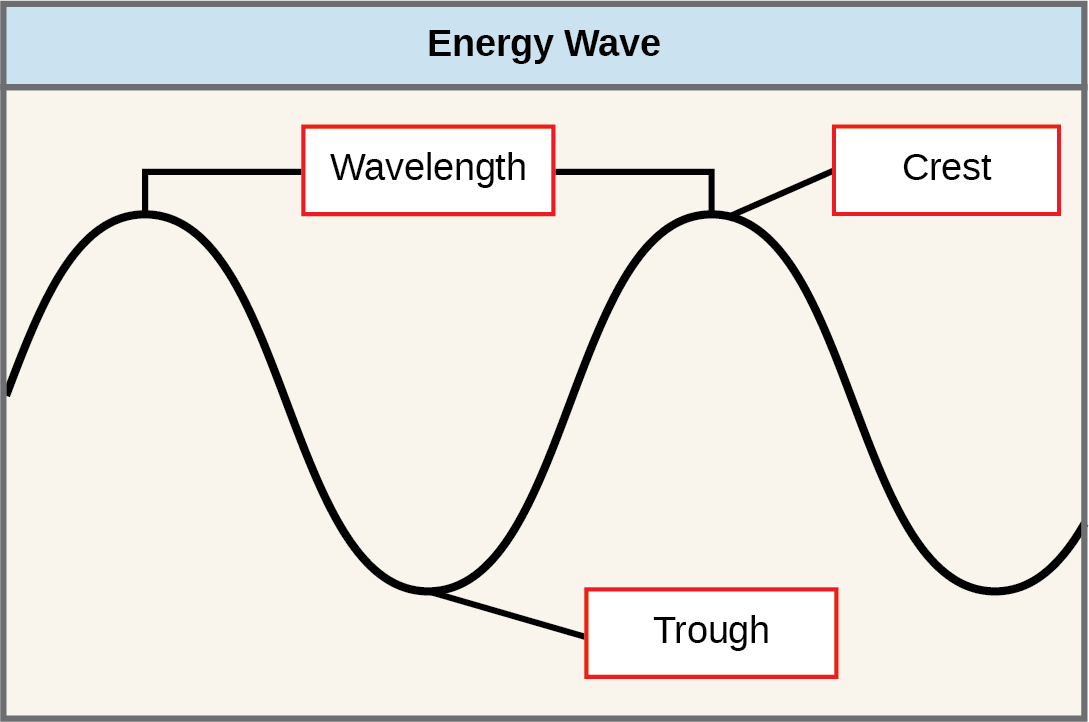
Figure 8.10図 8.10
The wavelength of a single wave is the distance between two consecutive points of similar position (two crests or two troughs) along the wave.
一つの波の波長は、波に沿って隣り合う、同じ位置関係の二点(山と山、または谷と谷)の間の距離である。
Visible light constitutes only one of many types of electromagnetic radiation emitted from the sun and other stars. Scientists differentiate the various types of radiant energy from the sun within the electromagnetic spectrum. The electromagnetic spectrum is the range of all possible frequencies of radiation (Figure 8.11). The difference between wavelengths relates to the amount of energy carried by them.
英語のヒント
可視光は、太陽やほかの恒星が放出する多くの電磁放射の一種類にすぎない。科学者は、太陽からのさまざまな放射エネルギーを、電磁スペクトルの中で区別する。電磁スペクトルとは、放射が取りうるすべての周波数の範囲である(図8.11)。波長の違いは、それが運ぶエネルギー量に関係する。
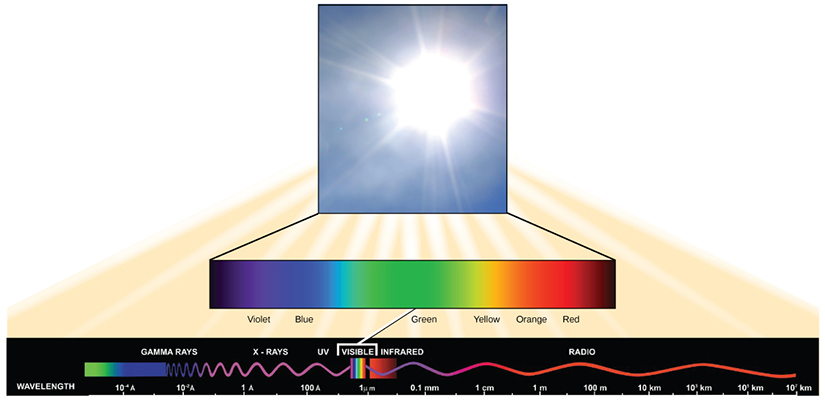


Figure 8.11図 8.11
The sun emits energy in the form of electromagnetic radiation. This radiation exists at different wavelengths, each of which has its own characteristic energy. All electromagnetic radiation, including visible light, is characterized by its wavelength.
太陽は電磁放射の形でエネルギーを放出する。放射にはさまざまな波長があり、それぞれに固有のエネルギーがある。可視光を含むすべての電磁放射は、波長によって特徴づけられる。
Each type of electromagnetic radiation travels at a particular wavelength. The longer the wavelength, the less energy it carries. Short, tight waves carry the most energy. This may seem illogical, but think of it in terms of a piece of moving heavy rope. It takes little effort by a person to move a rope in long, wide waves. To make a rope move in short, tight waves, a person would need to apply significantly more energy.
英語のヒント
電磁放射の各種類は、特定の波長で伝わる。波長が長いほど、運ぶエネルギーは小さくなる。短く詰まった波が、最も多くのエネルギーを運ぶ。直感に反するように思えるかもしれないが、重いロープを動かす場面を考えてみよ。長く幅広い波を起こすのは、わずかな労力で済む。短く詰まった波を起こすには、はるかに多くのエネルギーを加える必要がある。
The electromagnetic spectrum (Figure 8.11) shows several types of electromagnetic radiation originating from the sun, including X-rays and ultraviolet (UV) rays. The higher-energy waves can penetrate tissues and damage cells and DNA, which explains why both X-rays and UV rays can be harmful to living organisms.
英語のヒント
電磁スペクトル(図8.11)には、X線や紫外線(UV)を含む、太陽に由来するさまざまな電磁放射が示されている。高エネルギーの波は組織を透過し、細胞やDNAを傷つけることがある。そのため、X線も紫外線も生物に有害になりうるのである。
Absorption of Light光の吸収
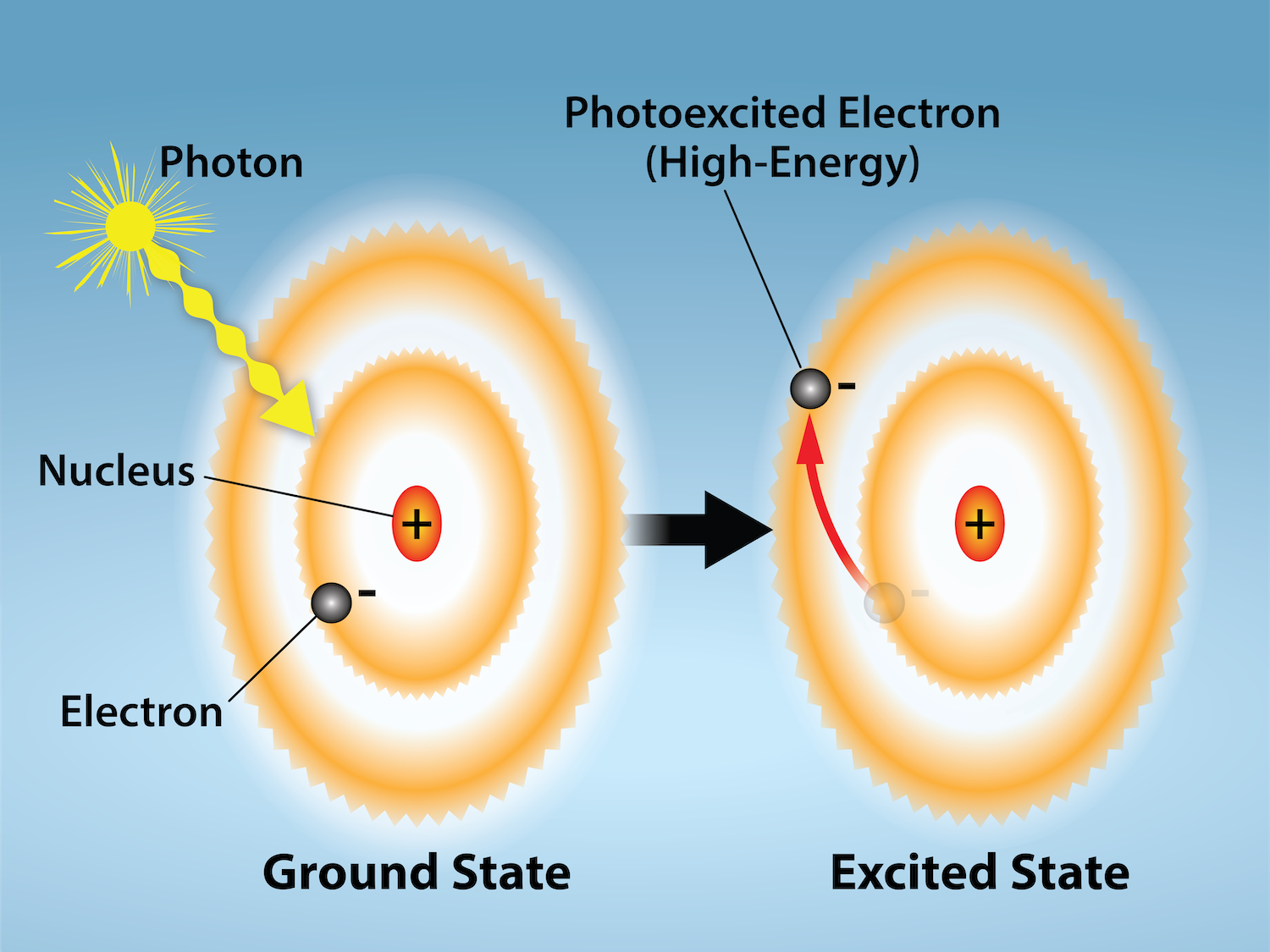
Light energy initiates the process of photosynthesis when pigments absorb specific wavelengths of visible light. Organic pigments, whether in the human retina or the chloroplast thylakoid, have a narrow range of energy levels that they can absorb. Energy levels lower than those represented by red light are insufficient to raise an orbital electron to an excited (quantum) state. Energy levels higher than those in blue light will physically tear the molecules apart, in a process called bleaching. Our retinal pigments can only “see” (absorb) wavelengths between 700 nm and 400 nm of light, a spectrum that is therefore called visible light. For the same reasons, plants, pigment molecules absorb only light in the wavelength range of 700 nm to 400 nm; plant physiologists refer to this range for plants as photosynthetically active radiation.
英語のヒント
色素が可視光の特定の波長を吸収すると、光エネルギーによって光合成が始まる。ヒトの網膜にあるものでも、葉緑体のチラコイドにあるものでも、有機色素が吸収できるエネルギー準位の範囲は狭く限られている。赤色光より低いエネルギーでは、軌道上の電子を励起した量子状態へ上げるのに足りない。青色光より高いエネルギーは、分子を物理的に引き裂き、退色という現象を起こす。網膜の色素が「見る」、つまり吸収できるのは700〜400 nmの波長だけなので、このスペクトルを可視光と呼ぶ。同じ理由で、植物の色素分子も700〜400 nmの波長だけを吸収する。植物生理学では、この範囲を光合成有効放射と呼ぶ。
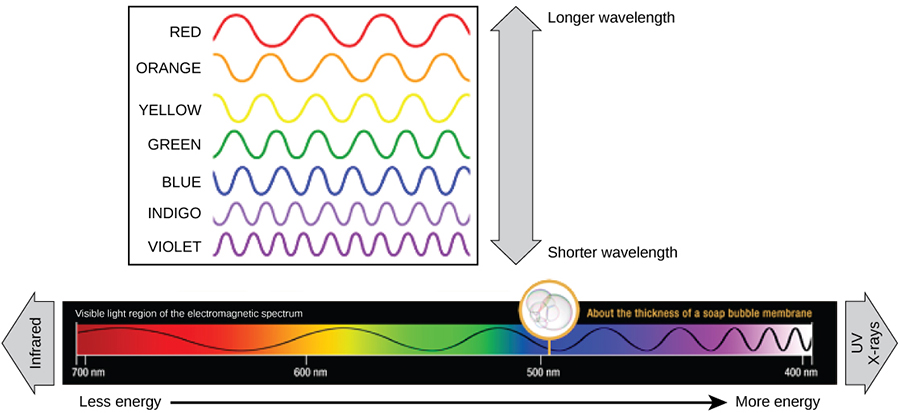
The visible light seen by humans as white light actually exists in a rainbow of colors. Certain objects, such as a prism or a drop of water, disperse white light to reveal the colors to the human eye. The visible light portion of the electromagnetic spectrum shows the rainbow of colors, with violet and blue having shorter wavelengths, and therefore higher energy. At the other end of the spectrum toward red, the wavelengths are longer and have lower energy (Figure 8.13).
英語のヒント
ヒトに白く見える可視光は、実際には虹のようにさまざまな色からできている。プリズムや水滴などは白色光を分散させ、目に各色を見えるようにする。電磁スペクトルの可視光部分は虹色を示し、紫や青の波長は短いため、エネルギーが高くなる。反対端の赤側では波長が長く、エネルギーが低くなる(図8.13)。
OpenStax, Rice University; Biology 2e. Credit: Rao, A. and Ryan, K. Department of Biology, Texas A&M University. · CC BY 4.0 · Source出典

Figure 8.12図 8.12
Light energy can excite electrons. When a photon of light energy interacts with an electron, the electron may absorb the energy and jump from its lowest energy ground state to an excited state. Credit: Rao, A. and Ryan, K. Department of Biology, Texas A&M University.
光エネルギーは電子を励起できる。光子が電子と相互作用すると、電子はそのエネルギーを吸収し、最も低いエネルギーの基底状態から励起状態へ移ることがある。出典:Rao, A.、Ryan, K.、テキサスA&M大学生物学部。
OpenStax, Rice University; Biology 2e. (credit: modification of work by NASA) · CC BY 4.0 · Source出典

Figure 8.13図 8.13
The colors of visible light do not carry the same amount of energy. Violet has the shortest wavelength and therefore carries the most energy, whereas red has the longest wavelength and carries the least amount of energy. (credit: modification of work by NASA)
可視光の各色が運ぶエネルギー量は同じではない。紫は最も波長が短く、最大のエネルギーを運ぶ。赤は最も波長が長く、運ぶエネルギーは最小である。(出典:NASAの作品を改変)