第8章光合成
Understanding Pigments色素を理解する
Different kinds of pigments exist, and each absorbs only specific wavelengths (colors) of visible light. Pigments reflect or transmit the wavelengths they cannot absorb, making them appear a mixture of the reflected or transmitted light colors.
英語のヒント
色素にはさまざまな種類があり、それぞれ可視光の特定の波長、すなわち特定の色だけを吸収する。吸収できない波長は反射または透過させるため、反射光や透過光の色が混ざった色に見える。
Chlorophylls and carotenoids are the two major classes of photosynthetic pigments found in plants and algae; each class has multiple types of pigment molecules. There are five major chlorophylls: a, b, c and d and a related molecule found in prokaryotes called bacteriochlorophyll. Chlorophyll a and chlorophyll b are found in higher plant chloroplasts and will be the focus of the following discussion.
英語のヒント
植物と藻類の光合成色素は、クロロフィル類とカロテノイド類の二大群に分かれ、それぞれに複数の種類がある。主なクロロフィルは五つあり、a、b、c、dに加え、原核生物にある関連分子のバクテリオクロロフィルである。クロロフィルaとbは高等植物の葉緑体にあり、以下ではこの二つを中心に扱う。
With dozens of different forms, carotenoids are a much larger group of pigments. The carotenoids found in fruit—such as the red of tomato (lycopene), the yellow of corn seeds (zeaxanthin), or the orange of an orange peel (β-carotene)—are used as advertisements to attract seed dispersers. In photosynthesis, carotenoids function as photosynthetic pigments that are very efficient molecules for the disposal of excess energy. When a leaf is exposed to full sun, the light-dependent reactions are required to process an enormous amount of energy; if that energy is not handled properly, it can do significant damage. Therefore, many carotenoids reside in the thylakoid membrane, absorb excess energy, and safely dissipate that energy as heat.
英語のヒント
カロテノイドには数十種類の型があり、はるかに大きな色素群を形成している。トマトの赤色のリコペン、トウモロコシの種子の黄色のゼアキサンチン、オレンジの皮の橙色のβ-カロテンなど、果実にあるカロテノイドは、種子を散布する動物を引き寄せる宣伝として働く。光合成では、カロテノイドは過剰なエネルギーの処理に非常に効率的な光合成色素として働く。葉が直射日光にさらされると、光依存反応は膨大なエネルギーを処理しなければならない。適切に扱わなければ、大きな損傷が生じる。そのため、多くのカロテノイドはチラコイド膜内にあり、余剰エネルギーを吸収し、安全に熱として散らす。
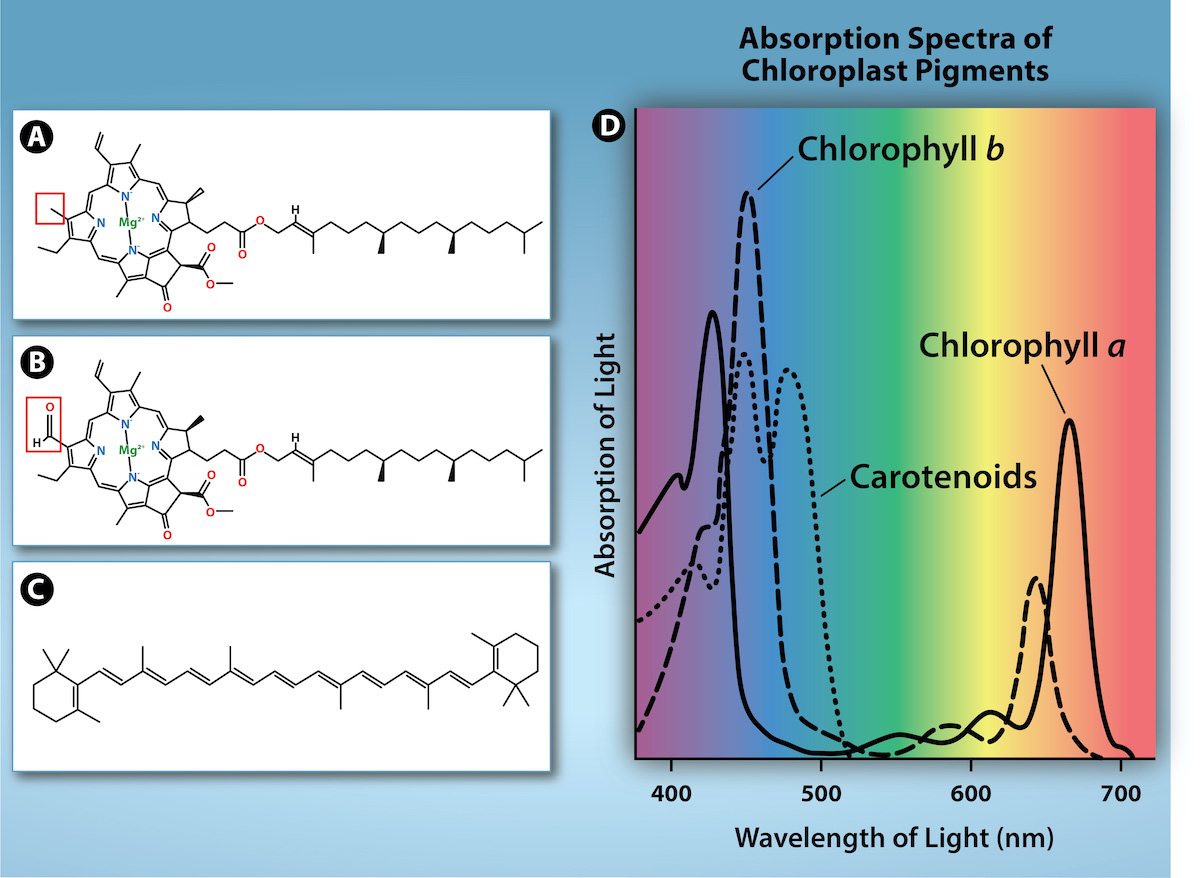
Each type of pigment can be identified by the specific pattern of wavelengths it absorbs from visible light: This is termed the absorption spectrum. The graph in Figure 8.14 shows the absorption spectra for chlorophyll a, chlorophyll b, and a type of carotenoid pigment called β-carotene (which absorbs blue and green light). Notice how each pigment has a distinct set of peaks and troughs, revealing a highly specific pattern of absorption. Chlorophyll a absorbs wavelengths from either end of the visible spectrum (blue and red), but not green. Because green is reflected or transmitted, chlorophyll appears green. Carotenoids absorb in the short-wavelength blue region, and reflect the longer yellow, red, and orange wavelengths.
英語のヒント
色素の各種類は、可視光から吸収する波長の特有のパターンによって識別でき、これを吸収スペクトルと呼ぶ。図8.14は、クロロフィルa、クロロフィルb、および青色と緑色の光を吸収するカロテノイドの一種、β-カロテンの吸収スペクトルである。それぞれに固有の山と谷があり、特有の吸収パターンを示すことに注目せよ。クロロフィルaは可視光スペクトルの両端、青と赤を吸収するが、緑は吸収しない。緑は反射または透過するので、クロロフィルは緑色に見える。カロテノイドは、短波長の青色領域を吸収し、より長波長の黄、赤、橙を反射する。
OpenStax, Rice University; Biology 2e. Credit: Rao, A., Ryan, K., Tag, A., Fletcher, S. and Hawkins, A. Department of Biology, Texas A&M University. · CC BY 4.0 · Source出典
Figure 8.14図 8.14
(a) Chlorophyll a, (b) chlorophyll b, and (c) β-carotene are hydrophobic organic pigments found in the thylakoid membrane. Chlorophyll a and b, which are identical except for the part indicated in the red box, are responsible for the green color of leaves. β-carotene is responsible for the orange color in carrots. Each pigment has (d) a unique absorbance spectrum. Credit: Rao, A., Ryan, K., Tag, A., Fletcher, S. and Hawkins, A. Department of Biology, Texas A&M University.
(a)クロロフィルa、(b)クロロフィルb、(c)β-カロテンは、チラコイド膜にある疎水性の有機色素である。クロロフィルaとbは、赤い枠で示した部分を除いて同じで、葉の緑色を生む。β-カロテンはニンジンの橙色を生む。それぞれの色素は(d)固有の吸収スペクトルをもつ。出典:Rao, A.、Ryan, K.、Tag, A.、Fletcher, S.、Hawkins, A.、テキサスA&M大学生物学部。
Many photosynthetic organisms have a mixture of pigments, and by using these pigments, the organism can absorb energy from a wider range of wavelengths. Not all photosynthetic organisms have full access to sunlight. Some organisms grow underwater where light intensity and quality decrease and change with depth. Other organisms grow in competition for light. Plants on the rainforest floor must be able to absorb any bit of light that comes through, because the taller trees absorb most of the sunlight and scatter the remaining solar radiation (Figure 8.15).
英語のヒント
多くの光合成生物は複数の色素をもち、それらを使うことで、より広い波長域のエネルギーを吸収できる。すべての光合成生物が十分な日光を得られるわけではない。水中に育つ生物では、深さに応じて光の強度が減り、質も変わる。光を奪い合いながら生育する生物もいる。熱帯雨林の林床の植物は、背の高い木々が大半の太陽光を吸収し、残りを散乱させるため、届くわずかな光も吸収できなければならない(図8.15)。
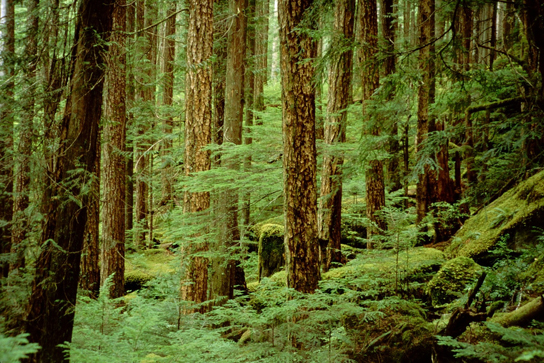


Figure 8.15図 8.15
Plants that commonly grow in the shade have adapted to low levels of light by changing the relative concentrations of their chlorophyll pigments. (credit: Jason Hollinger)
日陰でよく育つ植物は、クロロフィル色素の相対濃度を変えることによって、弱い光へ適応している。(出典:Jason Hollinger)
When studying a photosynthetic organism, scientists can determine the types of pigments present by generating absorption spectra. An instrument called a spectrophotometer can differentiate which wavelengths of light a substance can absorb. Spectrophotometers measure transmitted light and compute from it the absorption. By extracting pigments from leaves and placing these samples into a spectrophotometer, scientists can identify which wavelengths of light an organism can absorb. Additional methods for the identification of plant pigments include various types of chromatography that separate the pigments by their relative affinities to solid and mobile phases.
英語のヒント
光合成生物を調べる際、吸収スペクトルを作成すると、存在する色素の種類を判定できる。分光光度計という装置は、物質がどの波長の光を吸収するかを区別する。透過光を測定し、そこから吸収を計算する装置である。葉から色素を抽出して試料を装置へ入れると、その生物が吸収できる波長を特定できる。色素の同定には、固定相と移動相への相対的な親和性の違いで色素を分離する、各種のクロマトグラフィーも使われる。
How Light-Dependent Reactions Work光依存反応の仕組み
The overall function of light-dependent reactions is to convert solar energy into chemical energy in the form of NADPH and ATP. This chemical energy supports the light-independent reactions and fuels the assembly of sugar molecules. The light-dependent reactions are depicted in Figure 8.16. Protein complexes and pigment molecules work together to produce NADPH and ATP. The numbering of the photosystems is derived from the order in which they were discovered, not in the order of the transfer of electrons.
英語のヒント
光依存反応の全体的な役割は、太陽エネルギーをNADPHとATPの形の化学エネルギーへ変えることである。この化学エネルギーが光非依存反応を支え、糖分子の組み立てを駆動する。図8.16に光依存反応を示す。タンパク質複合体と色素分子が協働して、NADPHとATPをつくる。光化学系の番号は、電子が流れる順序ではなく、発見された順序に由来する。
OpenStax, Rice University; Biology 2e. Credit: Rao, A., Ryan, K., Fletcher, S. and Hawkins, A. Department of Biology, Texas A&M University. · CC BY 4.0 · Source出典

Figure 8.16図 8.16
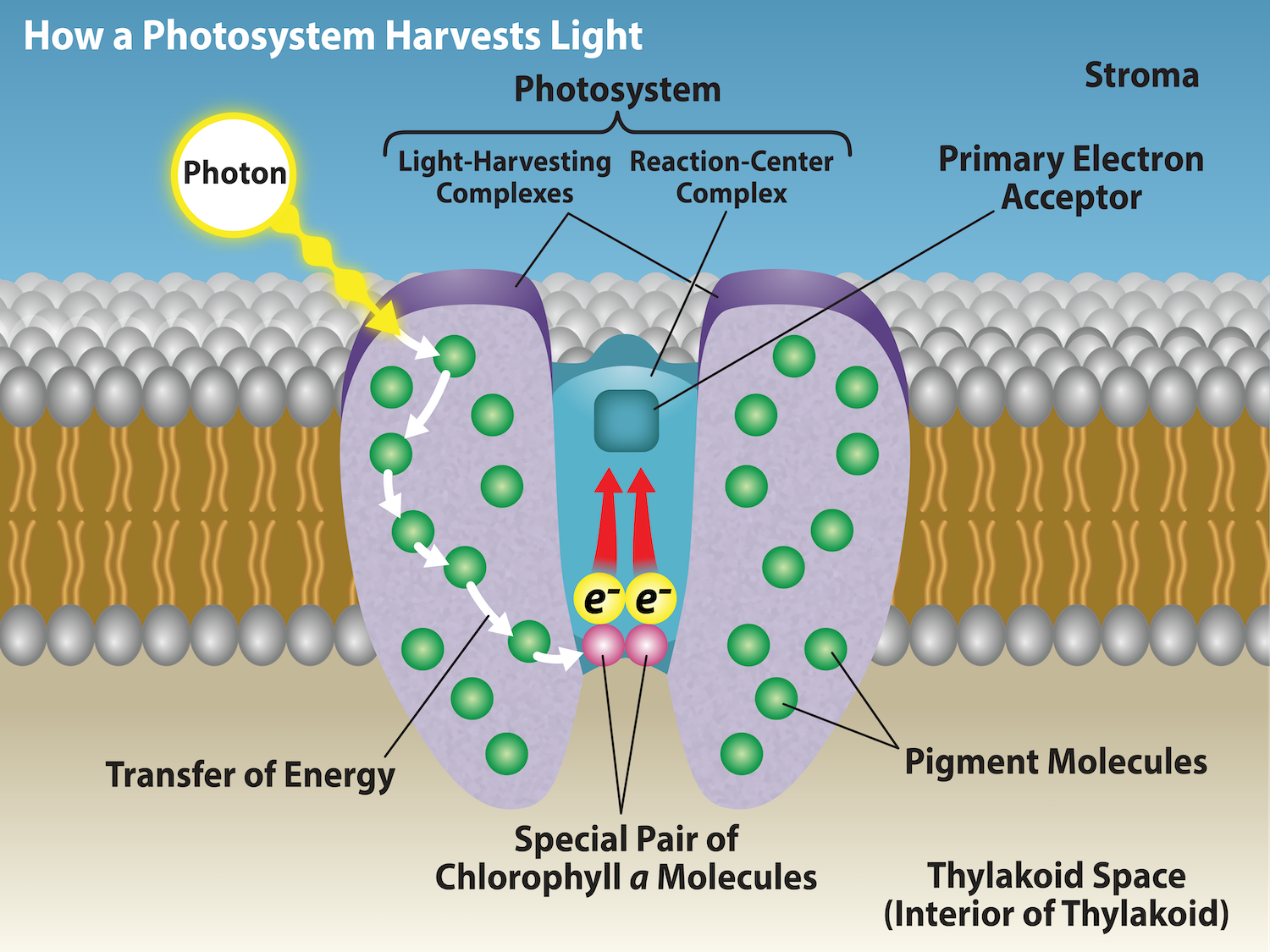
A photosystem consists of 1) a light-harvesting complex and 2) a reaction center. Pigments in the light-harvesting complex pass light energy to two special chlorophyll a molecules in the reaction center. The light excites an electron from the chlorophyll a pair, which passes to the primary electron acceptor. The excited electron must then be replaced. Credit: Rao, A., Ryan, K., Fletcher, S. and Hawkins, A. Department of Biology, Texas A&M University.
光化学系は、1)集光複合体と、2)反応中心からなる。集光複合体の色素が、反応中心の特別なクロロフィルa2分子へ光エネルギーを渡す。光がこの対の電子を励起し、電子は一次電子受容体へ移る。その後、励起されて出ていった電子を補う必要がある。出典:Rao, A.、Ryan, K.、Fletcher, S.、Hawkins, A.、テキサスA&M大学生物学部。
The actual step that converts light energy into chemical energy takes place in a multiprotein complex called a photosystem, two types of which are found embedded in the thylakoid membrane: photosystem II (PSII) and photosystem I (PSI) (Figure 8.17). The two complexes differ on the basis of what they oxidize (that is, the source of the low-energy electron supply) and what they reduce (the place to which they deliver their energized electrons).
英語のヒント
光エネルギーを化学エネルギーへ変える実際の段階は、光化学系と呼ばれる多タンパク質複合体で起こる。チラコイド膜には、光化学系II(PSII)と光化学系I(PSI)の二種類が埋め込まれている(図8.17)。両者は、何を酸化するか、すなわち低エネルギー電子の供給源と、何を還元するか、すなわち高エネルギーになった電子を渡す先によって区別される。
Both photosystems have the same basic structure; a number of antenna pigments to which the chlorophyll molecules are bound surround the reaction center where the photochemistry takes place. Each photosystem is serviced by the light-harvesting complex, which passes energy from sunlight to the reaction center; it consists of multiple antenna pigments that contain a mixture of 300 to 400 chlorophyll a and b molecules as well as other pigments like carotenoids. The absorption of a single photon or distinct quantity or “packet” of light by any of the chlorophylls pushes that molecule into an excited state. In short, the light energy has now been captured by biological molecules but is not stored in any useful form yet. The energy is transferred from chlorophyll to chlorophyll until eventually (after about a millionth of a second), it is delivered to the reaction center. Up to this point, only energy has been transferred between molecules, not electrons.
英語のヒント
二つの光化学系の基本構造は同じである。クロロフィル分子が結び付いた多数のアンテナ色素が、光化学反応の起こる反応中心を囲む。各光化学系には、太陽光のエネルギーを反応中心へ渡す集光複合体がある。それは、300〜400個のクロロフィルa・b分子と、カロテノイドなどの別の色素が混在する、複数のアンテナ色素からなる。どれかのクロロフィルが光子、すなわち一定量の光の「包み」を一つ吸収すると、その分子は励起状態になる。この時点で光エネルギーは生体分子に捕らえられているが、まだ利用できる形には蓄えられていない。エネルギーはクロロフィルからクロロフィルへ渡され、約100万分の1秒後に反応中心へ届く。ここまで分子間を移動したのはエネルギーだけで、電子ではない。
The reaction center contains a pair of chlorophyll a molecules with a special property. Those two chlorophylls can undergo oxidation upon excitation; they can actually give up an electron in a process called a photoact. It is at this step in the reaction center during photosynthesis that light energy is converted into an excited electron. All of the subsequent steps involve getting that electron onto the energy carrier NADPH for delivery to the Calvin cycle where the electron is deposited onto carbon for long-term storage in the form of a carbohydrate. PSII and PSI are two major components of the photosynthetic electron transport chain, which also includes the cytochrome complex. The cytochrome complex, an enzyme composed of two protein complexes, transfers the electrons from the carrier molecule plastoquinone (Pq) to the protein plastocyanin (Pc), thus enabling both the transfer of protons across the thylakoid membrane and the transfer of electrons from PSII to PSI.
英語のヒント
反応中心には、特別な性質をもつクロロフィルaの対がある。この2分子は、励起されると酸化され、光化学的な作用によって実際に電子を手放すことができる。光合成で、光エネルギーが励起電子へ変換されるのは、この反応中心の段階である。その後のすべての段階は、電子を運搬体NADPHへ移し、カルビン回路へ届けることに関わる。そこで電子は炭素へ渡され、炭水化物の形で長期間蓄えられる。PSIIとPSIは光合成電子伝達系の二大構成要素であり、系にはシトクロム複合体も含まれる。シトクロム複合体は、二つのタンパク質複合体からなる酵素で、運搬分子プラストキノン(Pq)からタンパク質プラストシアニン(Pc)へ電子を移す。これによって、チラコイド膜を挟んだ陽子の移動と、PSIIからPSIへの電子の移動が可能になる。
The reaction center of PSII (called P680) delivers its high-energy electrons, one at the time, to the primary electron acceptor, and through the electron transport chain (Pq to cytochrome complex to plastocyanine) to PSI. P680’s missing electron is replaced by extracting a low-energy electron from water; thus, water is “split” during this stage of photosynthesis, and PSII is re-reduced after every photoact. Splitting one H2O molecule releases two electrons, two hydrogen atoms, and one atom of oxygen. However, splitting two molecules is required to form one molecule of diatomic O2 gas. About 10 percent of the oxygen is used by mitochondria in the leaf to support oxidative phosphorylation. The remainder escapes to the atmosphere where it is used by aerobic organisms to support respiration.
英語のヒント
PSIIの反応中心P680は、高エネルギー電子を1個ずつ一次電子受容体へ渡し、電子伝達系、すなわちPq、シトクロム複合体、プラストシアニンを経て、PSIへ届ける。P680が失った電子は、水から低エネルギー電子を取り出して補う。そのため、この段階で水が「分解」され、PSIIは光化学作用のたびに再び還元される。H2O1分子を分解すると、電子2個、水素原子2個、酸素原子1個が放出される。ただし、二原子分子であるO2を1分子つくるには、水を2分子分解する必要がある。酸素の約10パーセントは葉のミトコンドリアで、酸化的リン酸化に使われる。残りは大気へ放出され、好気性生物の呼吸に利用される。
As electrons move through the proteins that reside between PSII and PSI, they lose energy. This energy is used to move hydrogen atoms from the stromal side of the membrane to the thylakoid lumen. Those hydrogen atoms, plus the ones produced by splitting water, accumulate in the thylakoid lumen and will be used to synthesize ATP in a later step. Because the electrons have lost energy prior to their arrival at PSI, they must be re-energized by PSI, hence, another photon is absorbed by the PSI antenna. That energy is relayed to the PSI reaction center (called P700). P700 is oxidized and sends a high-energy electron to NADP+ to form NADPH. Thus, PSII captures the energy to create proton gradients to make ATP, and PSI captures the energy to reduce NADP+ into NADPH. The two photosystems work in concert, in part, to guarantee that the production of NADPH will roughly equal the production of ATP. Other mechanisms exist to fine-tune that ratio to exactly match the chloroplast’s constantly changing energy needs.
英語のヒント
電子はPSIIとPSIの間のタンパク質を通るうちに、エネルギーを失う。そのエネルギーは、水素原子を膜のストロマ側からチラコイド内腔へ移すのに使われる。これらは水の分解で生じた水素原子とともに内腔へ蓄積し、後の段階でATP合成に使われる。電子はPSIへ届く前にエネルギーを失っているため、PSIで再びエネルギーを与えられなければならない。そこでPSIのアンテナが別の光子を吸収し、そのエネルギーを反応中心P700へ伝える。P700は酸化され、高エネルギー電子をNADP+へ送ってNADPHをつくる。このようにPSIIは、ATPをつくる陽子勾配のためのエネルギーを取り込み、PSIはNADP+をNADPHへ還元するエネルギーを取り込む。両光化学系は協調して働き、NADPHとATPの生産量をおおむね等しく保つ役割も果たす。さらに別の仕組みがその比率を微調整し、絶えず変わる葉緑体のエネルギー需要に正確に合わせる。