第8章光合成
Basic Photosynthetic Structures光合成に関わる基本構造
In plants, photosynthesis generally takes place in leaves, which consist of several layers of cells. The process of photosynthesis occurs in a middle layer called the mesophyll. The gas exchange of carbon dioxide and oxygen occurs through small, regulated openings called stomata (singular: stoma), which also play roles in the regulation of gas exchange and water balance. The stomata are typically located on the underside of the leaf, which helps to minimize water loss due to high temperatures on the upper surface of the leaf. Each stoma is flanked by guard cells that regulate the opening and closing of the stomata by swelling or shrinking in response to osmotic changes.
英語のヒント
植物では、光合成は通常、細胞が何層か重なった葉で行われる。その中ほどにある、葉肉と呼ばれる層で光合成が起こる。二酸化炭素と酸素の交換は、気孔という小さな開閉調節可能な穴を通じて行われる。英語では複数形がstomata、単数形がstomaである。気孔はガス交換と水分バランスの調節にも関わる。気孔は通常、葉の裏側にあり、葉の表面の高温による水の損失を抑えるのに役立つ。それぞれの気孔は孔辺細胞に挟まれている。孔辺細胞は浸透圧の変化に応じて膨らんだり縮んだりし、気孔の開閉を調節する。
In all autotrophic eukaryotes, photosynthesis takes place inside an organelle called a chloroplast. For plants, chloroplast-containing cells exist mostly in the mesophyll. Chloroplasts have a double membrane envelope (composed of an outer membrane and an inner membrane), and are ancestrally derived from ancient free-living cyanobacteria. Within the chloroplast are stacked, disc-shaped structures called thylakoids. Embedded in the thylakoid membrane is chlorophyll, a pigment (molecule that absorbs light) responsible for the initial interaction between light and plant material, and numerous proteins that make up the electron transport chain. The thylakoid membrane encloses an internal space called the thylakoid lumen. As shown in Figure 8.6, a stack of thylakoids is called a granum, and the liquid-filled space surrounding the granum is called stroma or “bed” (not to be confused with stoma or “mouth,” an opening on the leaf epidermis).
英語のヒント
独立栄養性の真核生物では、光合成は葉緑体という細胞小器官の内部で起こる。植物の葉緑体を含む細胞は、大半が葉肉にある。葉緑体は外膜と内膜からなる二重の包膜をもち、その祖先は古代の自由生活性シアノバクテリアに由来する。葉緑体の中には、チラコイドという円盤状の構造が積み重なっている。チラコイド膜には、光と植物の物質との最初の相互作用を担う色素、クロロフィルと、電子伝達系を構成する多数のタンパク質が埋め込まれている。色素とは光を吸収する分子のことである。チラコイド膜は、チラコイド内腔という内部空間を包んでいる。図8.6のように、チラコイドの積み重なりをグラナム、その周囲の液体で満たされた空間をストロマ、すなわち「床」と呼ぶ。葉の表皮の開口であるストマ、「口」と混同しないようにせよ。
The Two Parts of Photosynthesis光合成の二つの部分
Photosynthesis takes place in two sequential stages: the light-dependent reactions and the light-independent reactions. In the light-dependent reactions, energy from sunlight is absorbed by chlorophyll and that energy is converted into stored chemical energy. In the light-independent reactions, the chemical energy harvested during the light-dependent reactions drives the assembly of sugar molecules from carbon dioxide. Therefore, although the light-independent reactions do not use light as a reactant, they require the products of the light-dependent reactions to function. In addition, however, several enzymes of the light-independent reactions are activated by light. The light-dependent reactions utilize certain molecules to temporarily store the energy: These are referred to as energy carriers. The energy carriers that move energy from light-dependent reactions to light-independent reactions can be thought of as “full” because they are rich in energy. After the energy is released, the “empty” energy carriers return to the light-dependent reaction to obtain more energy. Figure 8.7 illustrates the components inside the chloroplast where the light-dependent and light-independent reactions take place.
英語のヒント
光合成は、光依存反応と光非依存反応という、順に続く二段階で起こる。光依存反応では、クロロフィルが太陽光のエネルギーを吸収し、蓄えられた化学エネルギーへ変換する。光非依存反応では、そこで得た化学エネルギーを使い、二酸化炭素から糖分子を組み立てる。そのため、光非依存反応は光を反応物として使わないが、働くためには光依存反応の生成物を必要とする。また、光非依存反応の酵素のいくつかは、光によって活性化される。光依存反応は、特定の分子を用いてエネルギーを一時的に蓄える。これらをエネルギー運搬体と呼ぶ。光依存反応から光非依存反応へエネルギーを運ぶ運搬体は、エネルギーが豊富なので「満タン」と考えられる。エネルギーを放出すると「空」になり、光依存反応へ戻って新たなエネルギーを得る。図8.7に、二つの反応が起こる葉緑体内の構成要素を示す。
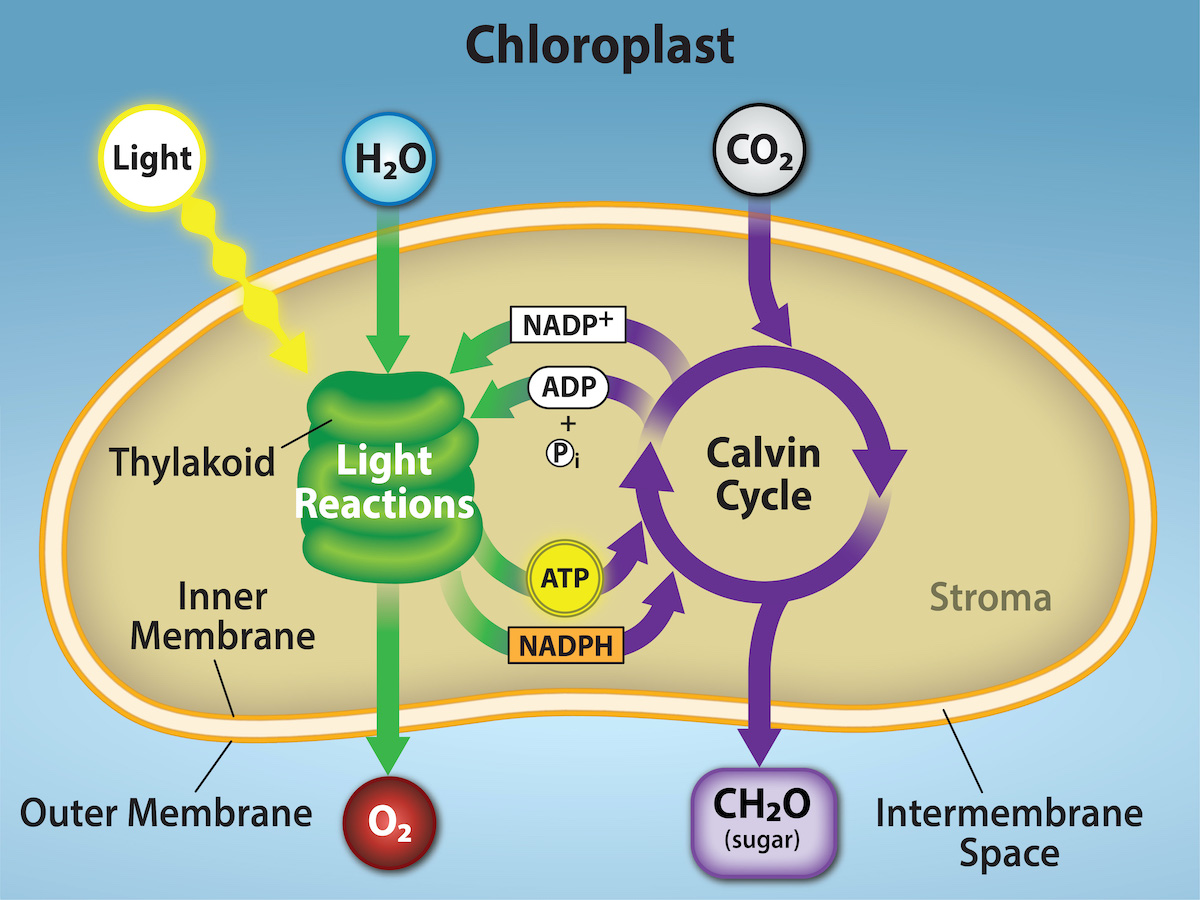
OpenStax, Rice University; Biology 2e. Credit: Rao, A., Ryan, K., Fletcher, S., Hawkins, A. and Tag, A. Texas A&M University. · CC BY 4.0 · Source出典

Figure 8.7図 8.7
Photosynthesis takes place in two stages: light-dependent reactions and the Calvin cycle. Light-dependent reactions, which take place in the thylakoid membrane, use light energy to make ATP and NADPH. The Calvin cycle, which takes place in the stroma, uses energy derived from these compounds to make G3P from CO2. Credit: Rao, A., Ryan, K., Fletcher, S., Hawkins, A. and Tag, A. Texas A&M University.
光合成は、光依存反応とカルビン回路の二段階で起こる。チラコイド膜で起こる光依存反応は、光エネルギーを使ってATPとNADPHをつくる。ストロマで起こるカルビン回路は、それらの化合物のエネルギーを使ってCO2からG3Pをつくる。出典:Rao, A.、Ryan, K.、Fletcher, S.、Hawkins, A.、Tag, A.、テキサスA&M大学。