第29章為替相場と国際資金移動
Participants in the Exchange Rate Market為替市場の参加者
The foreign exchange market does not involve the ultimate suppliers and demanders of foreign exchange literally seeking each other. If Martina decides to leave her home in Venezuela and take a trip in the United States, she does not need to find a U.S. citizen who is planning to take a vacation in Venezuela and arrange a person-to-person currency trade. Instead, the foreign exchange market works through financial institutions, and it operates on several levels.
英語のヒント
外国為替市場では、外国為替の最終的な供給者と需要者が、文字どおり互いを探し回るわけではない。マルティナが故郷のベネズエラを離れ、アメリカへ旅行することを決めても、ベネズエラで休暇を過ごそうとするアメリカ市民を見つけ、個人間の通貨交換を手配する必要はない。外国為替市場は金融機関を通じて機能し、いくつもの段階で営まれる。
Most people and firms who are exchanging a substantial quantity of currency go to a bank, and most banks provide foreign exchange as a service to customers. These banks (and a few other firms), known as dealers, then trade the foreign exchange. This is called the interbank market.
英語のヒント
相当量の通貨を交換する人や企業の大半は銀行へ行き、大半の銀行は顧客向けサービスとして外国為替を提供する。ディーラーと呼ばれるこれらの銀行と少数のほかの企業が、さらに外国為替を取引する。これを銀行間市場という。
In the world economy, roughly 2,000 firms are foreign exchange dealers. The U.S. economy has less than 100 foreign exchange dealers, but the largest 12 or so dealers carry out more than half the total transactions. The foreign exchange market has no central location, but the major dealers keep a close watch on each other at all times.
英語のヒント
世界経済には、外国為替ディーラーが約2,000社ある。アメリカ経済の外国為替ディーラーは100社未満だが、最大手約12社で総取引の半分超を行う。外国為替市場には中心となる場所はないが、大手ディーラーは常に互いを注意深く見ている。
The foreign exchange market is huge not because of the demands of tourists, firms, or even foreign direct investment, but instead because of portfolio investment and the actions of interlocking foreign exchange dealers. International tourism is a very large industry, involving about $1 trillion per year. Global exports are about 23.5% of global GDP or about $19 trillion per year. Foreign direct investment totaled about $870 billion in the end of 2021. These quantities are dwarfed, however, by the $6.6 trillion per day traded in foreign exchange markets. Most transactions in the foreign exchange market are for portfolio investment—relatively short-term movements of financial capital between currencies—and because of the large foreign exchange dealers' actions as they constantly buy and sell with each other.
英語のヒント
外国為替市場が巨大なのは、旅行者や企業、さらには外国直接投資の需要によるのではなく、証券投資と、相互に結びついた外国為替ディーラーの行動による。国際観光は非常に大きな産業で、年間約1兆ドルに及ぶ。世界の輸出は世界のGDPの約23.5%、年間約19兆ドルである。外国直接投資は2021年末に総額約8,700億ドルだった。しかし、これらの額も、外国為替市場で取引される1日6.6兆ドルに比べれば小さい。外国為替市場の取引の大半は、証券投資、すなわち通貨間の比較的短期の金融資本移動によるものであり、また、大手外国為替ディーラーが常に互いに売買する行動によるものである。
Strengthening and Weakening Currency通貨高と通貨安
When the prices of most goods and services change, the price "rises or "falls". For exchange rates, the terminology is different. When the exchange rate for a currency rises, so that the currency exchanges for more of other currencies, we refer to it as appreciating or “strengthening.” When the exchange rate for a currency falls, so that a currency trades for less of other currencies, we refer to it as depreciating or “weakening.”
英語のヒント
大半の財・サービスの価格が変わる場合、価格は「上がる」または「下がる」という。為替レートでは、用語が異なる。ある通貨の為替レートが上がり、その通貨をより多くの他通貨と交換できるようになることを、通貨の増価、または通貨高という。ある通貨の為替レートが下がり、その通貨で得られる他通貨が少なくなることを、通貨の減価、または通貨安という。
To illustrate the use of these terms, consider the exchange rate between the U.S. dollar and the Canadian dollar since 1980, in Figure 29.3 (a). The vertical axis in Figure 29.3 (a) shows the price of $1 in U.S. currency, measured in terms of Canadian currency. Clearly, exchange rates can move up and down substantially. A U.S. dollar traded for $1.17 Canadian in 1980. The U.S. dollar appreciated or strengthened to $1.39 Canadian in 1986, depreciated or weakened to $1.15 Canadian in 1991, and then appreciated or strengthened to $1.60 Canadian by early in 2002, fell to roughly $1.20 Canadian in 2009, and then had a sharp spike up and decline in 2009 and 2010. In August 2022, the U.S. dollar stood at $1.28 Canadian. The units in which we measure exchange rates can be confusing, because we measure the exchange rate of the U.S. dollar exchange using a different currency—the Canadian dollar. However, exchange rates always measure the price of one unit of currency by using a different currency.
英語のヒント
これらの用語の使い方を示すため、図29.3(a)にある、1980年以降の米ドルとカナダ・ドルの為替レートを考えよう。図29.3(a)の縦軸は、1米ドルの価格をカナダ通貨で測ったものである。明らかに、為替レートは大きく上下しうる。1980年には、1米ドルは1.17カナダ・ドルで取引された。米ドルは1986年に1.39カナダ・ドルへ増価、すなわち米ドル高となり、1991年には1.15カナダ・ドルへ減価、すなわち米ドル安となった。次に、2002年初頭までに1.60カナダ・ドルへ増価し、2009年には約1.20カナダ・ドルへ下がり、2009年と2010年には急上昇と下落を見せた。2022年8月には、1米ドルは1.28カナダ・ドルだった。米ドルの為替レートを、カナダ・ドルという別の通貨で測るので、為替レートの測定単位は混乱を招くことがある。しかし為替レートでは、常にある通貨1単位の価格を、別の通貨を使って測るのである。
Strengthen or Appreciate vs. Weaken or Depreciate通貨高・増価と、通貨安・減価
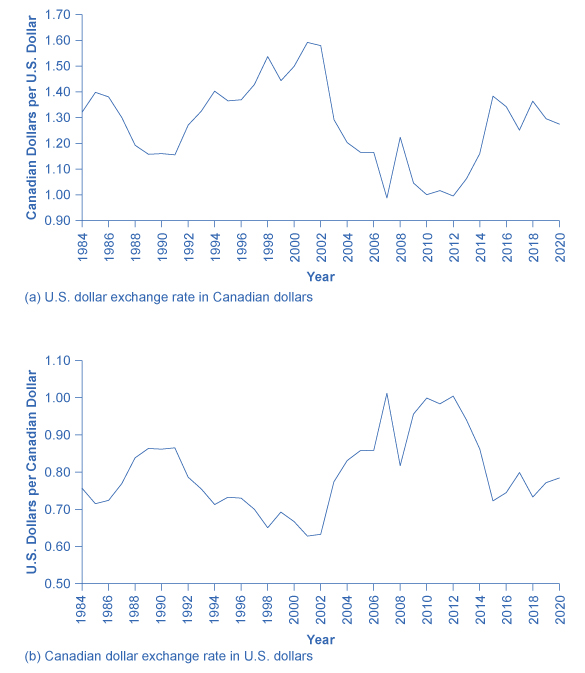
Figure 29.3図 29.3
Exchange rates tend to fluctuate substantially, even between bordering companies such as the United States and Canada. By looking closely at the time values, it is clear that the values in part (a) are a mirror image of part (b), which demonstrates that the depreciation of one currency correlates to the appreciation of the other and vice versa. This means that when comparing the exchange rates between two countries (in this case, the United States and Canada), the depreciation (or weakening) of one country (the U.S. dollar for this example) indicates the appreciation (or strengthening) of the other currency (which in this example is the Canadian dollar). (Source: Federal Reserve Economic Data (FRED) https://research.stlouisfed.org/fred2/series/EXCAUS)
英語のヒント
為替レートは、アメリカとカナダのような隣接する企業の間でさえ、大きく変動する傾向がある。各時点の値をよく見ると、(a)の値が(b)の鏡像になっていることがわかる。これは、一方の通貨の減価が他方の通貨の増価と対応し、その逆も同じであることを示す。つまり、二国、この場合はアメリカとカナダの為替レートを比較するとき、一方の国、この例では米ドルの減価または通貨安は、他方の通貨、この例ではカナダ・ドルの増価または通貨高を示すのである。(出典:連邦準備銀行経済データ〔FRED〕 https://research.stlouisfed.org/fred2/series/EXCAUS)
In looking at the exchange rate between two currencies, the appreciation or strengthening of one currency must mean the depreciation or weakening of the other. Figure 29.3 (b) shows the exchange rate for the Canadian dollar, measured in terms of U.S. dollars. The exchange rate of the U.S. dollar measured in Canadian dollars, in Figure 29.3 (a), is a perfect mirror image with the Canadian dollar exchange rate measured in U.S. dollars, in Figure 29.3 (b). A fall in the Canada $/U.S. $ ratio means a rise in the U.S. $/Canada $ ratio, and vice versa.
英語のヒント
Canadian Dollars per 1 U.S. Dollar.
英語のヒント
1米ドル当たりのカナダ・ドル。
With the price of a typical good or service, it is clear that higher prices benefit sellers and hurt buyers, while lower prices benefit buyers and hurt sellers. In the case of exchange rates, where the buyers and sellers are not always intuitively obvious, it is useful to trace how a stronger or weaker currency will affect different market participants. Consider, for example, the impact of a stronger U.S. dollar on six different groups of economic actors, as Figure 29.4 shows: (1) U.S. exporters selling abroad; (2) foreign exporters (that is, firms selling imports in the U.S. economy); (3) U.S. tourists abroad; (4) foreign tourists visiting the United States; (5) U.S. investors (either foreign direct investment or portfolio investment) considering opportunities in other countries; (6) and foreign investors considering opportunities in the U.S. economy.
英語のヒント
通常の財・サービスの価格では、高い価格は売り手に利益を与え、買い手に不利益を与え、低い価格は買い手に利益を与え、売り手に不利益を与えることが明らかである。為替レートの場合、誰が買い手で誰が売り手かは、必ずしも直感的に明らかではない。そのため、通貨高や通貨安が、異なる市場参加者にどう影響するかをたどると役立つ。たとえば図29.4のように、米ドル高が六つの異なる経済主体の集団に与える影響を考えよう。(1)海外で販売するアメリカの輸出業者、(2)外国の輸出業者、つまりアメリカ経済で輸入品を売る企業、(3)海外のアメリカ人旅行者、(4)アメリカを訪れる外国人旅行者、(5)外国直接投資または証券投資の機会を他国で検討するアメリカの投資家、(6)アメリカ経済での機会を検討する外国投資家である。
How Do Exchange Rate Movements Affect Each Group?為替レートの動きは、それぞれの集団にどう影響するか
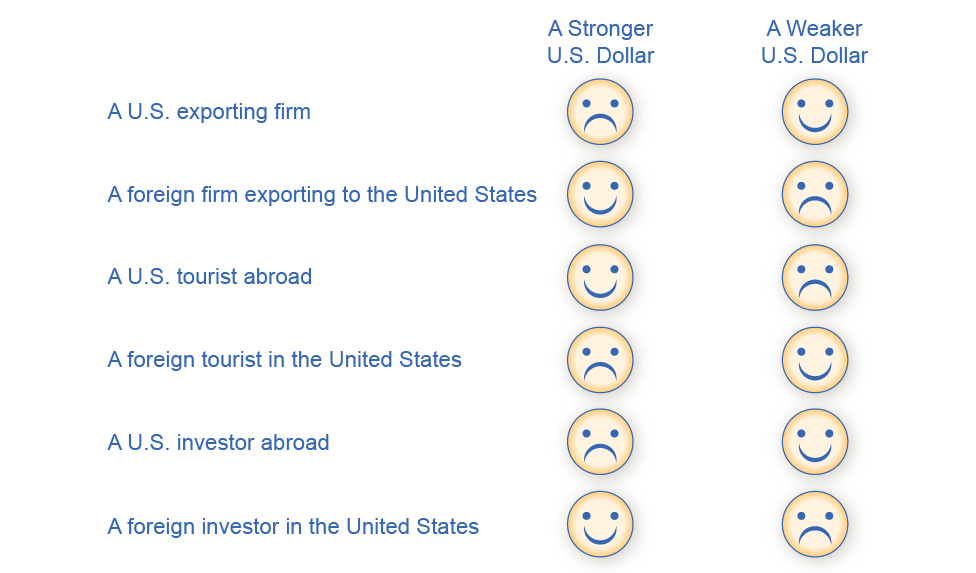


Figure 29.4図 29.4
Exchange rate movements affect exporters, tourists, and international investors in different ways.
英語のヒント
為替レートの動きは、輸出業者、旅行者、国際投資家に、それぞれ異なる影響を与える。
For a U.S. firm selling abroad, a stronger U.S. dollar is a curse. A strong U.S. dollar means that foreign currencies are correspondingly weak. When this exporting firm earns foreign currencies through its export sales, and then converts them back to U.S. dollars to pay workers, suppliers, and investors, the stronger dollar means that the foreign currency buys fewer U.S. dollars than if the currency had not strengthened, and that the firm’s profits (as measured in dollars) fall. As a result, the firm may choose to reduce its exports, or it may raise its selling price, which will also tend to reduce its exports. In this way, a stronger currency reduces a country’s exports.
英語のヒント
海外で販売するアメリカ企業にとって、米ドル高は災いである。米ドルが強いとは、対応する外国通貨が弱いことを意味する。この輸出企業は、輸出販売で外貨を稼ぎ、それを米ドルへ戻して、従業員、仕入先、投資家に支払う。このときドル高であれば、ドルが増価しなかった場合より、外貨で買える米ドルが少なくなり、ドルで測った企業の利益が減る。その結果、企業は輸出を減らすことを選ぶかもしれない。または販売価格を上げるかもしれず、それも輸出を減らす傾向を持つ。このように、通貨高はその国の輸出を減らす。
Conversely, for a foreign firm selling in the U.S. economy, a stronger dollar is a blessing. Each dollar earned through export sales, when traded back into the exporting firm's home currency, will now buy more home currency than expected before the dollar had strengthened. As a result, the stronger dollar means that the importing firm will earn higher profits than expected. The firm will seek to expand its sales in the U.S. economy, or it may reduce prices, which will also lead to expanded sales. In this way, a stronger U.S. dollar means that consumers will purchase more from foreign producers, expanding the country’s level of imports.
英語のヒント
逆に、アメリカ経済で販売する外国企業にとって、ドル高は恵みである。輸出販売によって得た1ドルを、輸出企業の本国通貨へ戻すと、ドル高になる前に予想したよりも多くの本国通貨が買える。そのため、ドル高は、輸入企業が予想より高い利益を得ることを意味する。企業はアメリカ経済での販売拡大を目指すか、価格を下げるかもしれない。値下げも販売拡大につながる。このように、米ドル高は、消費者が外国の生産者からより多く購入し、その国の輸入水準が拡大することを意味する。
For a U.S. tourist abroad, who is exchanging U.S. dollars for foreign currency as necessary, a stronger U.S. dollar is a benefit. The tourist receives more foreign currency for each U.S. dollar, and consequently the cost of the trip in U.S. dollars is lower. When a country’s currency is strong, it is a good time for citizens of that country to tour abroad. Imagine a U.S. tourist who has saved up $5,000 for a trip to South Africa. In February 2018, $1 bought 11.9 South African rand, so the tourist had 59,500 rand to spend. By 2018, $1 bought 14.5 rand, which for the tourist translates to 72,500 rand. For foreign visitors to the United States, the opposite pattern holds true. A relatively stronger U.S. dollar means that their own currencies are relatively weaker, so that as they shift from their own currency to U.S. dollars, they have fewer U.S. dollars than previously. When a country’s currency is strong, it is not an especially good time for foreign tourists to visit.
英語のヒント
必要に応じて米ドルを外貨へ交換する、海外のアメリカ人旅行者にとって、米ドル高は利益となる。旅行者は1米ドル当たりより多くの外貨を受け取るので、米ドルでの旅行費用は下がる。自国通貨が強いときは、その国の市民が海外旅行をする好機である。南アフリカ旅行のために5,000ドルを貯めたアメリカ人旅行者を想像しよう。2018年2月には1ドルで11.9南アフリカ・ランドが買えたので、旅行者には使えるお金が59,500ランドあった。2018年には1ドルで14.5ランドが買え、旅行者にとっては72,500ランドになった。アメリカを訪れる外国人には、逆の関係が当てはまる。相対的な米ドル高は、彼らの自国通貨が相対的に弱いことを意味する。そのため、自国通貨から米ドルへ交換すると、以前よりも少ない米ドルしか得られない。ある国の通貨が強いときは、外国人旅行者が訪れるのに、とくによい時期とはいえない。
A stronger dollar injures the prospects of a U.S. financial investor who has already invested money in another country. A U.S. financial investor abroad must first convert U.S. dollars to a foreign currency, invest in a foreign country, and then later convert that foreign currency back to U.S. dollars. If in the meantime the U.S. dollar becomes stronger and the foreign currency becomes weaker, then when the investor converts back to U.S. dollars, the rate of return on that investment will be less than originally expected at the time it was made.
英語のヒント
ドル高は、すでに他国へ資金を投じたアメリカの金融投資家の見通しを損なう。海外投資を行うアメリカの金融投資家は、まず米ドルを外貨へ交換し、外国で投資し、その後でその外貨を米ドルへ戻さなければならない。その間に米ドルが強くなり、外貨が弱くなると、米ドルへ戻すとき、その投資の収益率は、投資した時点での当初の予想を下回る。
However, a stronger U.S. dollar boosts the returns of a foreign investor putting money into a U.S. investment. That foreign investor converts from the home currency to U.S. dollars and seeks a U.S. investment, while later planning to switch back to the home currency. If, in the meantime, the dollar grows stronger, then when the time comes to convert from U.S. dollars back to the foreign currency, the investor will receive more foreign currency than expected at the time the original investment was made.
英語のヒント
しかし、米ドル高は、アメリカに投資する外国投資家の収益を高める。その外国投資家は、自国通貨から米ドルへ交換してアメリカでの投資先を探し、後で自国通貨へ戻すことを予定する。その間にドル高になれば、米ドルから外貨へ戻すとき、投資家は、当初の投資時点で予想していたよりも多くの外貨を受け取る。
The preceding paragraphs all focus on the case where the U.S. dollar becomes stronger. The first column in Figure 29.4 illustrates the corresponding happy or unhappy economic reactions. The following Work It Out feature centers the analysis on the opposite: a weaker dollar.
英語のヒント
ここまでの段落はすべて、米ドルが強くなる場合に注目した。図29.4の第1列は、それに対応する、好ましい、または好ましくない経済的な反応を示す。次の「解いてみよう」では、反対にドルが弱くなる場合を中心に分析する。