第29章為替相場と国際資金移動
29.2 Demand and Supply Shifts in Foreign Exchange Markets29.2 外国為替市場における需要と供給の移動
Learning Objectives学習目標
Learning Objectives学習目標
By the end of this section, you will be able to:
英語のヒント
この節を学ぶと、次のことができるようになる。
- Explain supply and demand for exchange rates
英語のヒント
為替レートの供給と需要を説明する - Define arbitrage
英語のヒント
裁定取引を定義する - Explain purchasing power parity's importance when comparing countries.
英語のヒント
国を比較する際の購買力平価の重要性を説明する。
The foreign exchange market involves firms, households, and investors who demand and supply currencies coming together through their banks and the key foreign exchange dealers. Figure 29.5 (a) offers an example for the exchange rate between the U.S. dollar and the Mexican peso. The vertical axis shows the exchange rate for U.S. dollars, which in this case is measured in pesos. The horizontal axis shows the quantity of U.S. dollars traded in the foreign exchange market each day. The demand curve (D) for U.S. dollars intersects with the supply curve (S) of U.S. dollars at the equilibrium point (E), which is an exchange rate of 10 pesos per dollar and a total volume of $8.5 billion.
英語のヒント
外国為替市場では、通貨を需要し供給する企業、家計、投資家が、銀行や主要な外国為替ディーラーを通じて結びつく。図29.5(a)は、米ドルとメキシコ・ペソの為替レートの例を示す。縦軸は米ドルの為替レートで、この場合はペソで測る。横軸は、外国為替市場で毎日取引される米ドルの量を示す。米ドルの需要曲線(D)は、米ドルの供給曲線(S)と均衡点(E)で交わる。そこでの為替レートは1ドル当たり10ペソ、総取引量は85億ドルである。
Demand and Supply for the U.S. Dollar and Mexican Peso Exchange Rate米ドルとメキシコ・ペソの為替レートの需要と供給
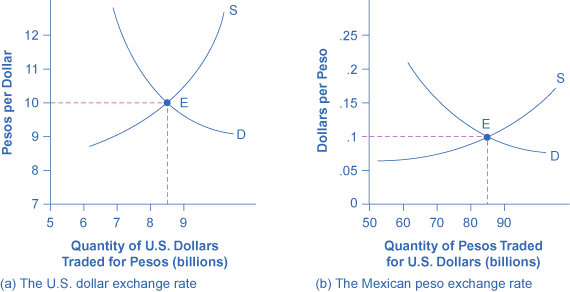
Figure 29.5図 29.5
(a) The quantity measured on the horizontal axis is in U.S. dollars, and the exchange rate on the vertical axis is the price of U.S. dollars measured in Mexican pesos. (b) The quantity measured on the horizontal axis is in Mexican pesos, while the price on the vertical axis is the price of pesos measured in U.S. dollars. In both graphs, the equilibrium exchange rate occurs at point E, at the intersection of the demand curve (D) and the supply curve (S).
英語のヒント
(a)横軸の数量は米ドルで測り、縦軸の為替レートは、米ドルの価格をメキシコ・ペソで測ったものである。(b)横軸の数量はメキシコ・ペソで測り、縦軸の価格は、ペソの価格を米ドルで測ったものである。どちらのグラフでも、均衡為替レートは、需要曲線(D)と供給曲線(S)の交点Eに生じる。
Figure 29.5 (b) presents the same demand and supply information from the perspective of the Mexican peso. The vertical axis shows the exchange rate for Mexican pesos, which is measured in U.S. dollars. The horizontal axis shows the quantity of Mexican pesos traded in the foreign exchange market. The demand curve (D) for Mexican pesos intersects with the supply curve (S) of Mexican pesos at the equilibrium point (E), which is an exchange rate of 10 cents in U.S. currency for each Mexican peso and a total volume of 85 billion pesos. Note that the two exchange rates are inverses: 10 pesos per dollar is the same as 10 cents per peso (or $0.10 per peso). In the actual foreign exchange market, almost all of the trading for Mexican pesos is for U.S. dollars. What factors would cause the demand or supply to shift, thus leading to a change in the equilibrium exchange rate? We discuss the answer to this question in the following section.
英語のヒント
図29.5(b)は、同じ需要と供給の情報を、メキシコ・ペソの側から示す。縦軸はメキシコ・ペソの為替レートを米ドルで測ったもの、横軸は外国為替市場で取引されるメキシコ・ペソの量である。メキシコ・ペソの需要曲線(D)は、メキシコ・ペソの供給曲線(S)と均衡点(E)で交わる。そこでの為替レートは、1メキシコ・ペソ当たり10米セント、総取引量は850億ペソである。二つの為替レートが逆数であることに注意しよう。1ドル当たり10ペソは、1ペソ当たり10セント、つまり1ペソ当たり0.10ドルと同じである。実際の外国為替市場でも、メキシコ・ペソの取引は、ほぼすべて米ドルとの間で行われる。どのような要因が需要や供給を移動させ、均衡為替レートの変化をもたらすのだろうか。次の部分で、この問いへの答えを論じる。
Expectations about Future Exchange Rates将来の為替レートについての予想
One reason to demand a currency on the foreign exchange market is the belief that the currency's value is about to increase. One reason to supply a currency—that is, sell it on the foreign exchange market—is the expectation that the currency's value is about to decline. For example, imagine that a leading business newspaper, like the Wall Street Journal or the Financial Times, runs an article predicting that the Mexican peso will appreciate in value. Figure 29.6 illustrates the likely effects of such an article. Demand for the Mexican peso shifts to the right, from D0 to D1, as investors become eager to purchase pesos. Conversely, the supply of pesos shifts to the left, from S0 to S1, because investors will be less willing to give them up. The result is that the equilibrium exchange rate rises from 10 cents/peso to 12 cents/peso and the equilibrium exchange rate rises from 85 billion to 90 billion pesos as the equilibrium moves from E0 to E1.
英語のヒント
外国為替市場で通貨を需要する理由の一つは、その通貨の価値が上がりそうだという信念である。通貨を供給する、つまり外国為替市場で売る理由の一つは、その通貨の価値が下がりそうだという予想である。たとえば、『ウォール・ストリート・ジャーナル』や『フィナンシャル・タイムズ』のような有力経済紙が、メキシコ・ペソの価値が上がると予測する記事を掲載したとしよう。図29.6は、その記事が及ぼすであろう影響を示す。投資家がペソを積極的に買おうとするため、メキシコ・ペソの需要はD0からD1へ右に移動する。逆に、投資家はペソを手放したがらなくなるので、ペソの供給はS0からS1へ左に移動する。その結果、均衡がE0からE1へ移ると、均衡為替レートは1ペソ当たり10セントから12セントへ上がり、均衡為替レートは850億ペソから900億ペソへ上がる。
Exchange Rate Market for Mexican Peso Reacts to Expectations about Future Exchange Rates将来の為替レートの予想に反応するメキシコ・ペソの為替市場
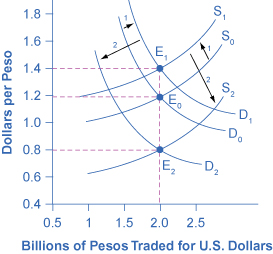


Figure 29.6図 29.6
An announcement that the peso exchange rate is likely to strengthen in the future will lead to greater demand for the peso in the present from investors who wish to benefit from the appreciation. Similarly, it will make investors less likely to supply pesos to the foreign exchange market. Both the shift of demand to the right and the shift of supply to the left cause an immediate appreciation in the exchange rate.
英語のヒント
ペソの為替レートが将来強くなりそうだという発表は、その増価から利益を得たい投資家による、現在のペソ需要を増やす。同様に、投資家は外国為替市場へのペソ供給を控えるようになる。需要の右への移動と、供給の左への移動は、どちらも為替レートの即時の増価を引き起こす。
Figure 29.6 also illustrates some peculiar traits of supply and demand diagrams in the foreign exchange market. In contrast to all the other cases of supply and demand you have considered, in the foreign exchange market, supply and demand typically both move at the same time. Groups of participants in the foreign exchange market like firms and investors include some who are buyers and some who are sellers. An expectation of a future shift in the exchange rate affects both buyers and sellers—that is, it affects both demand and supply for a currency.
英語のヒント
図29.6は、外国為替市場の需要・供給図に特有の性質も示す。これまで考えてきたほかのすべての需要と供給の例とは異なり、外国為替市場では、通常、供給と需要の両方が同時に動く。企業や投資家といった外国為替市場の参加者集団には、買い手も売り手も含まれる。将来の為替レートの変化についての予想は、買い手と売り手の両方、つまり通貨の需要と供給の両方に影響する。
The shifts in demand and supply curves both cause the exchange rate to shift in the same direction. In this example, they both make the peso exchange rate stronger. However, the shifts in demand and supply work in opposing directions on the quantity traded. In this example, the rising demand for pesos is causing the quantity to rise while the falling supply of pesos is causing quantity to fall. In this specific example, the result is a higher quantity. However, in other cases, the result could be that quantity remains unchanged or declines.
英語のヒント
需要曲線と供給曲線の移動は、どちらも為替レートを同じ方向に動かす。この例では、どちらもペソの為替レートを強める。しかし、取引量に対しては、需要と供給の移動は反対方向に働く。この例では、ペソ需要の増加は数量を増やし、ペソ供給の減少は数量を減らす。この特定の例では、結果は数量の増加である。しかし別の場合には、数量が変わらない、あるいは減るという結果もありうる。
This example also helps to explain why exchange rates often move quite substantially in a short period of a few weeks or months. When investors expect a country’s currency to strengthen in the future, they buy the currency and cause it to appreciate immediately. The currency's appreciation can lead other investors to believe that future appreciation is likely—and thus lead to even further appreciation. Similarly, a fear that a currency might weaken quickly leads to an actual weakening of the currency, which often reinforces the belief that the currency will weaken further. Thus, beliefs about the future path of exchange rates can be self-reinforcing, at least for a time, and a large share of the trading in foreign exchange markets involves dealers trying to outguess each other on what direction exchange rates will move next.
英語のヒント
この例は、為替レートが数週間や数か月という短期間に、しばしばかなり大きく動く理由の説明にも役立つ。投資家が、ある国の通貨が将来強くなると予想すると、その通貨を買い、直ちに増価させる。通貨の増価は、ほかの投資家に将来も増価しそうだと思わせ、そのためさらに増価を進めることがある。同様に、通貨が弱くなるかもしれないという恐れは、速やかに実際の通貨安につながり、それがしばしば、さらに通貨が弱くなるという信念を強める。このように、為替レートの将来の道筋についての信念は、少なくとも一時的には、自己強化的になりうる。外国為替市場の取引の大部分では、ディーラーが、次に為替レートがどちらへ動くかについて、互いを出し抜いて予測しようとしている。