第29章為替相場と国際資金移動
Demanders and Suppliers of Currency in Foreign Exchange Markets外国為替市場における通貨の需要者と供給者
In foreign exchange markets, demand and supply become closely interrelated, because a person or firm who demands one currency must at the same time supply another currency—and vice versa. To get a sense of this, it is useful to consider four groups of people or firms who participate in the market: (1) firms that are involved in international trade of goods and services; (2) tourists visiting other countries; (3) international investors buying ownership (or part-ownership) of a foreign firm; (4) international investors making financial investments that do not involve ownership. Let’s consider these categories in turn.
英語のヒント
外国為替市場では、需要と供給は密接に関わり合う。ある通貨を需要する人や企業は、同時に別の通貨を供給しなければならず、その逆も同じだからである。これを理解するには、市場に参加する人や企業を、四つの集団に分けて考えると役立つ。(1)財・サービスの国際貿易に関わる企業、(2)外国を訪れる旅行者、(3)外国企業の所有権またはその一部を買う国際投資家、(4)所有を伴わない金融投資を行う国際投資家である。これらを順に考えよう。
Firms that buy and sell on international markets find that their costs for workers, suppliers, and investors are measured in the currency of the nation where their production occurs, but their revenues from sales are measured in the currency of the different nation where their sales happened. Thus, a Chinese firm exporting abroad will earn some other currency—say, U.S. dollars—but will need Chinese yuan to pay the workers, suppliers, and investors who are based in China. In the foreign exchange markets, this firm will be a supplier of U.S. dollars and a demander of Chinese yuan.
英語のヒント
国際市場で売買する企業では、従業員、仕入先、投資家への費用は、生産を行う国の通貨で測られるが、販売収入は、販売が行われた別の国の通貨で測られる。したがって、海外へ輸出する中国企業は、たとえば米ドルといった別の通貨を稼ぐが、中国にいる従業員、仕入先、投資家への支払いには人民元が必要となる。外国為替市場では、この企業は米ドルの供給者であり、人民元の需要者となる。
International tourists will supply their home currency to receive the currency of the country they are visiting. For example, an American tourist who is visiting China will supply U.S. dollars into the foreign exchange market and demand Chinese yuan.
英語のヒント
海外旅行者は、訪問先の国の通貨を得るために、自国通貨を供給する。たとえば、中国を訪れるアメリカ人旅行者は、外国為替市場で米ドルを供給し、人民元を需要する。
We often divide financial investments that cross international boundaries, and require exchanging currency into two categories. Foreign direct investment (FDI) refers to purchasing a firm (at least ten percent) in another country or starting up a new enterprise in a foreign country For example, in 2008 the Belgian beer-brewing company InBev bought the U.S. beer-maker Anheuser-Busch for $52 billion. To make this purchase, InBev would have to supply euros (the currency of Belgium) to the foreign exchange market and demand U.S. dollars.
英語のヒント
国境を越え、通貨の交換を必要とする金融投資は、しばしば二つに分けられる。外国直接投資(FDI)とは、他国の企業を少なくとも10%購入すること、または外国で新しい事業を起こすことである。たとえば2008年、ベルギーのビール醸造会社インベブは、アメリカのビールメーカー、アンハイザー・ブッシュを520億ドルで買収した。この購入のために、インベブは外国為替市場へ、ベルギーの通貨であるユーロを供給し、米ドルを需要しなければならない。
The other kind of international financial investment, portfolio investment, involves a purely financial investment that does not entail any management responsibility. An example would be a U.S. financial investor who purchased U.K. government bonds, or deposited money in a British bank. To make such investments, the American investor would supply U.S. dollars in the foreign exchange market and demand British pounds.
英語のヒント
国際的な金融投資のもう一つの種類である証券投資は、経営責任を一切伴わない、純粋な金融投資である。たとえば、アメリカの金融投資家がイギリス国債を購入したり、イギリスの銀行に預金したりする場合である。そのような投資のために、アメリカの投資家は外国為替市場で米ドルを供給し、英ポンドを需要する。
Business people often link portfolio investment to expectations about how exchange rates will shift. Look at a U.S. financial investor who is considering purchasing U.K. issued bonds. For simplicity, ignore any bond interest payment (which will be small in the short run anyway) and focus on exchange rates. Say that a British pound is currently worth $1.50 in U.S. currency. However, the investor believes that in a month, the British pound will be worth $1.60 in U.S. currency. Thus, as Figure 29.2 (a) shows, this investor would change $24,000 for 16,000 British pounds. In a month, if the pound is worth $1.60, then the portfolio investor can trade back to U.S. dollars at the new exchange rate, and have $25,600—a nice profit. A portfolio investor who believes that the foreign exchange rate for the pound will work in the opposite direction can also invest accordingly. Say that an investor expects that the pound, now worth $1.50 in U.S. currency, will decline to $1.40. Then, as Figure 29.2 (b) shows, that investor could start off with £20,000 in British currency (borrowing the money if necessary), convert it to $30,000 in U.S. currency, wait a month, and then convert back to approximately £21,429 in British currency—again making a nice profit. Of course, this kind of investing comes without guarantees, and an investor will suffer losses if the exchange rates do not move as predicted.
英語のヒント
企業人は、証券投資を、為替レートがどう変わるかという予想と結びつけることが多い。イギリス発行の債券の購入を検討する、アメリカの金融投資家を見てみよう。単純化のため、債券の利払いは無視し、為替レートに注目する。いずれにせよ、短期の利払いは小さい。現在、1英ポンドが1.50米ドルの価値を持つとしよう。しかし投資家は、1か月後には1英ポンドが1.60米ドルになると考えている。そこで図29.2(a)のように、投資家は24,000ドルを16,000英ポンドへ交換する。1か月後にポンドが1.60ドルになれば、証券投資家は新しい為替レートで米ドルに交換し直し、25,600ドルを得られる。よい利益である。ポンドの為替レートが反対方向に動くと考える証券投資家も、それに応じて投資できる。現在1.50米ドルのポンドが1.40ドルへ下がると、投資家が予想するとしよう。その場合、図29.2(b)のように、投資家は20,000英ポンドから始め、必要ならその資金を借り、30,000米ドルに交換する。1か月待って、再び約21,429英ポンドに交換すれば、やはりよい利益を得られる。もちろん、このような投資に保証はなく、為替レートが予想どおりに動かなければ、投資家は損失を被る。
A Portfolio Investor Trying to Benefit from Exchange Rate Movements為替レートの動きから利益を得ようとする証券投資家
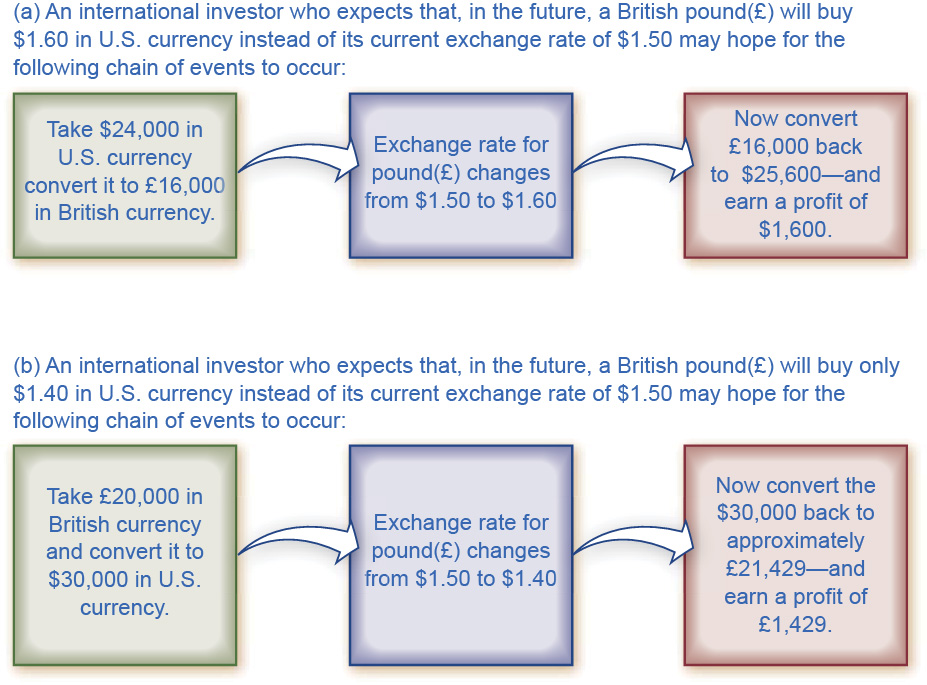

Figure 29.2図 29.2
Expectations of a currency's future value can drive its demand and supply in foreign exchange markets.
英語のヒント
通貨の将来価値についての予想は、外国為替市場での需要と供給を動かしうる。
Many portfolio investment decisions are not as simple as betting that the currency's value will change in one direction or the other. Instead, they involve firms trying to protect themselves from movements in exchange rates. Imagine you are running a U.S. firm that is exporting to France. You have signed a contract to deliver certain products and will receive 1 million euros a year from now. However, you do not know how much this contract will be worth in U.S. dollars, because the dollar/euro exchange rate can fluctuate in the next year. Let’s say you want to know for sure what the contract will be worth, and not take a risk that the euro will be worth less in U.S. dollars than it currently is. You can hedge, which means using a financial transaction to protect yourself against a risk from one of your investments (in this case, currency risk from the contract). Specifically, you can sign a financial contract and pay a fee that guarantees you a certain exchange rate one year from now—regardless of what the market exchange rate is at that time. Now, it is possible that the euro will be worth more in dollars a year from now, so your hedging contract will be unnecessary, and you will have paid a fee for nothing. However, if the value of the euro in dollars declines, then you are protected by the hedge. When parties wish to enter financial contracts like hedging, they normally rely on a financial institution or brokerage company to handle the hedging. These companies either take a fee or create a spread in the exchange rate in order to earn money through the service they provide.
英語のヒント
多くの証券投資の決定は、通貨価値がどちらかの方向に動くと賭けるほど単純ではない。むしろ、為替レートの動きから自社を守ろうとする企業が関わる。フランスへ輸出するアメリカ企業を経営していると想像しよう。ある製品を引き渡す契約を結び、1年後に100万ユーロを受け取る。しかし、今後1年間にドルとユーロの為替レートは変動しうるため、この契約が米ドルでいくらになるかはわからない。契約がいくらになるかを確実に知り、ユーロの米ドル価値が現在よりも下がる危険は避けたいとしよう。そこで、ヘッジを行える。これは、金融取引を用いて、自分の投資に伴う危険から身を守ることである。この場合は契約に伴う為替リスクが対象となる。具体的には、金融契約を結んで手数料を払い、その時点の市場為替レートにかかわらず、1年後に特定の為替レートを保証してもらえる。1年後、ユーロのドル価値が上がっている可能性もある。その場合、ヘッジ契約は不要であり、手数料を無駄に払ったことになる。しかし、ユーロのドル価値が下がれば、ヘッジに守られる。ヘッジなどの金融契約を結びたい当事者は、通常、金融機関や仲介会社にその取扱いを頼む。これらの会社は、提供するサービスで収益を得るため、手数料を取るか、為替レートに売買の差額を設ける。
Both foreign direct investment and portfolio investment involve an investor who supplies domestic currency and demands a foreign currency. With portfolio investment, the client purchases less than ten percent of a company. As such, business players often get involved with portfolio investment with a short term focus. With foreign direct investment the investor purchases more than ten percent of a company and the investor typically assumes some managerial responsibility. Thus, foreign direct investment tends to have a more long-run focus. As a practical matter, an investor can withdraw portfolio investments from a country much more quickly than foreign direct investments. A U.S. portfolio investor who wants to buy or sell U.K. government bonds can do so with a phone call or a few computer keyboard clicks. However, a U.S. firm that wants to buy or sell a company, such as one that manufactures automobile parts in the United Kingdom, will find that planning and carrying out the transaction takes a few weeks, even months. Table 29.2 summarizes the main categories of currency demanders and suppliers.
英語のヒント
外国直接投資にも証券投資にも、自国通貨を供給して外国通貨を需要する投資家が関わる。証券投資では、顧客が購入するのは企業の10%未満である。そのため、企業の参加者は短期的な観点で証券投資を行うことが多い。外国直接投資では、投資家は企業の10%超を購入し、通常、何らかの経営責任を引き受ける。そのため、外国直接投資はより長期的な観点を持つ傾向がある。実際上、投資家は、外国直接投資よりも証券投資の方を、はるかに速くその国から引き揚げられる。イギリス国債を売買したいアメリカの証券投資家は、電話一本か、コンピューターのキーを数回押すだけでそれを行える。しかし、イギリスの自動車部品メーカーのような企業を売買したいアメリカ企業の場合、取引の計画と実行には数週間、ときには数か月を要する。表29.2は、通貨の需要者と供給者の主な区分をまとめている。
Demand for the U.S. Dollar Comes from… 米ドルの需要は、次の主体から生じる…… |
Supply of the U.S. Dollar Comes from… 米ドルの供給は、次の主体から生じる…… |
|---|---|
A U.S. exporting firm that earned foreign currency and is trying to pay U.S.-based expenses 外貨を稼ぎ、アメリカ国内の費用を支払おうとするアメリカの輸出企業 |
A foreign firm that has sold imported goods in the United States, earned U.S. dollars, and is trying to pay expenses incurred in its home country アメリカで輸入品を売って米ドルを稼ぎ、本国で発生した費用を支払おうとする外国企業 |
Foreign tourists visiting the United States アメリカを訪れる外国人旅行者 |
U.S. tourists leaving to visit other countries 外国を訪れるために出国するアメリカ人旅行者 |
Foreign investors who wish to make direct investments in the U.S. economy アメリカ経済への直接投資を望む外国投資家 |
U.S. investors who want to make foreign direct investments in other countries 他国への外国直接投資を望むアメリカの投資家 |
Foreign investors who wish to make portfolio investments in the U.S. economy アメリカ経済への証券投資を望む外国投資家 |
U.S. investors who want to make portfolio investments in other countries 他国への証券投資を望むアメリカの投資家 |