第29章為替相場と国際資金移動
Using Soft Pegs and Hard Pegsソフト・ペッグとハード・ペッグの利用
When a government intervenes in the foreign exchange market so that the currency's exchange rate is different from what the market would have produced, it establishes a “peg” for its currency. A soft peg is the name for an exchange rate policy where the government usually allows the market to set exchange rate, but in some cases, especially if the exchange rate seems to be moving rapidly in one direction, the central bank will intervene in the market. With a hard peg exchange rate policy, the central bank sets a fixed and unchanging value for the exchange rate. A central bank can implement soft peg and hard peg policies.
英語のヒント
政府が外国為替市場に介入し、通貨の為替レートを市場が生み出すはずのものとは異なる値にすると、その通貨に「ペッグ」を設けたことになる。ソフト・ペッグとは、通常は市場に為替レートを決めさせるが、場合によっては、とくに為替レートが一方向へ急速に動いているように見えるとき、中央銀行が市場に介入する為替レート政策の名称である。ハード・ペッグの為替レート政策では、中央銀行は固定された変わらない為替レートの値を設定する。中央銀行は、ソフト・ペッグ政策もハード・ペッグ政策も実施できる。
Suppose the market exchange rate for the Brazilian currency, the real, would be 35 cents/real with a daily quantity of 15 billion real traded in the market, as the equilibrium E0 in Figure 29.12 (a) and Figure 29.12 (b) show. However, Brazil's government decides that the exchange rate should be 30 cents/real, as Figure 29.12 (a) shows. Perhaps Brazil sets this lower exchange rate to benefit its export industries. Perhaps it is an attempt to stimulate aggregate demand by stimulating exports. Perhaps Brazil believes that the current market exchange rate is higher than the long-term purchasing power parity value of the real, so it is minimizing fluctuations in the real by keeping it at this lower rate. Perhaps the government set the target exchange rate sometime in the past, and it is now maintaining it for the sake of stability. Whatever the reason, if Brazil’s central bank wishes to keep the exchange rate below the market level, it must face the reality that at this weaker exchange rate of 30 cents/real, the quantity demanded of its currency at 17 billion reals is greater than the quantity supplied of 13 billion reals in the foreign exchange market.
英語のヒント
図29.12(a)と図29.12(b)の均衡E0のように、ブラジル通貨レアルの市場為替レートが1レアル当たり35セントで、市場では1日150億レアルが取引されるとしよう。しかしブラジル政府は、図29.12(a)のように、為替レートを1レアル当たり30セントとすべきだと決める。ブラジルは輸出産業に利益を与えるために、この低い為替レートを設定するのかもしれない。輸出を刺激して総需要を刺激しようとしているのかもしれない。現在の市場為替レートがレアルの長期的な購買力平価を上回っていると考え、低いレートに保つことでレアルの変動を最小限にしようとしているのかもしれない。政府が過去のある時点で目標為替レートを設定し、今は安定のために維持しているのかもしれない。理由が何であれ、ブラジル中央銀行が為替レートを市場水準より低く保ちたいなら、1レアル当たり30セントという弱い為替レートでは、外国為替市場で自国通貨の需要量170億レアルが、供給量130億レアルを上回るという現実に向き合わなければならない。
Pegging an Exchange Rate為替レートをペッグする
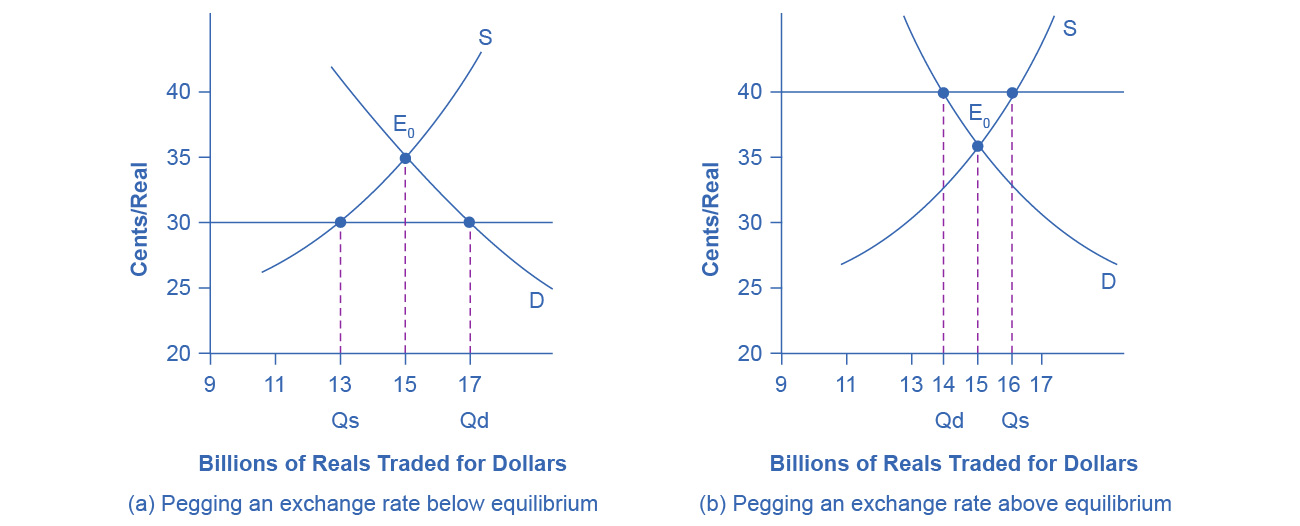

Figure 29.12図 29.12
(a) If an exchange rate is pegged below what would otherwise be the equilibrium, then the currency's quantity demanded will exceed the quantity supplied. (b) If an exchange rate is pegged above what would otherwise be the equilibrium, then the currency's quantity supplied exceeds the quantity demanded.
英語のヒント
(a)為替レートを、そうでなければ成立する均衡より低く固定すると、その通貨の需要量は供給量を上回る。(b)為替レートを、そうでなければ成立する均衡より高く固定すると、その通貨の供給量は需要量を上回る。
The Brazilian central bank could weaken its exchange rate in two ways. One approach is to use an expansionary monetary policy that leads to lower interest rates. In foreign exchange markets, the lower interest rates will reduce demand and increase supply of the real and lead to depreciation. Central banks do not use this technique often because lowering interest rates to weaken the currency may be in conflict with the country’s monetary policy goals. Alternatively, Brazil’s central bank could trade directly in the foreign exchange market. The central bank can expand the money supply by creating reals, use the reals to purchase foreign currencies, and avoid selling any of its own currency. In this way, it can fill the gap between quantity demanded and quantity supplied of its currency.
英語のヒント
ブラジル中央銀行は、二つの方法で為替レートを弱められる。一つは、金利を下げる拡張的金融政策を用いる方法である。外国為替市場では、金利の低下によってレアルの需要が減り、供給が増え、減価につながる。中央銀行はこの手法をあまり使わない。通貨を弱めるための金利引下げが、その国の金融政策目標と衝突するおそれがあるからである。別の方法として、ブラジル中央銀行は、外国為替市場で直接取引できる。中央銀行はレアルを創造して貨幣供給量を増やし、そのレアルで外国通貨を購入し、自国通貨の売却を一切避けることができる。このようにして、自国通貨の需要量と供給量の差を埋められる。
Figure 29.12 (b) shows the opposite situation. Here, the Brazilian government desires a stronger exchange rate of 40 cents/real than the market rate of 35 cents/real. Perhaps Brazil desires the stronger currency to reduce aggregate demand and to fight inflation, or perhaps Brazil believes that that current market exchange rate is temporarily lower than the long-term rate. Whatever the reason, at the higher desired exchange rate, the quantity supplied of 16 billion reals exceeds the quantity demanded of 14 billion reals.
英語のヒント
図29.12(b)は、逆の状況を示す。ここでは、ブラジル政府は、市場レートである1レアル当たり35セントより強い、40セントの為替レートを望む。ブラジルは、総需要を減らしてインフレと闘うために、より強い通貨を望むのかもしれない。あるいは、現在の市場為替レートが、一時的に長期のレートを下回っていると考えているのかもしれない。理由が何であれ、望む高い為替レートでは、供給量160億レアルが需要量140億レアルを上回る。
Brazil’s central bank can use a contractionary monetary policy to raise interest rates, which will increase demand and reduce currency supply on foreign exchange markets, and lead to an appreciation. Alternatively, Brazil’s central bank can trade directly in the foreign exchange market. In this case, with an excess supply of its own currency in foreign exchange markets, the central bank must use reserves of foreign currency, like U.S. dollars, to demand its own currency and thus cause an appreciation of its exchange rate.
英語のヒント
ブラジル中央銀行は、引締め的金融政策で金利を上げることができる。それによって外国為替市場での通貨需要が増え、供給が減り、増価につながる。あるいは、ブラジル中央銀行は外国為替市場で直接取引できる。この場合、外国為替市場には自国通貨の超過供給があるので、中央銀行は米ドルなどの外貨準備を使って自国通貨を需要し、為替レートを増価させなければならない。
Both a soft peg and a hard peg policy require that the central bank intervene in the foreign exchange market. However, a hard peg policy attempts to preserve a fixed exchange rate at all times. A soft peg policy typically allows the exchange rate to move up and down by relatively small amounts in the short run of several months or a year, and to move by larger amounts over time, but seeks to avoid extreme short-term fluctuations.
英語のヒント
ソフト・ペッグ政策もハード・ペッグ政策も、中央銀行が外国為替市場に介入する必要がある。ただし、ハード・ペッグ政策は、常に固定為替レートを維持しようとする。ソフト・ペッグ政策は通常、数か月や1年という短期には為替レートが比較的小さく上下することを認め、時間とともにより大きく動くことも認めるが、極端な短期変動は避けようとする。