第29章為替相場と国際資金移動
29.4 Exchange Rate Policies29.4 為替レート政策
Learning Objectives学習目標
Learning Objectives学習目標
By the end of this section, you will be able to:
英語のヒント
この節を学ぶと、次のことができるようになる。
- Differentiate among a floating exchange rate, a soft peg, a hard peg, and a merged currency
英語のヒント
変動為替レート、ソフト・ペッグ、ハード・ペッグ、統合通貨を区別する - Identify the tradeoffs that come with a floating exchange rate, a soft peg, a hard peg, and a merged currency
英語のヒント
変動為替レート、ソフト・ペッグ、ハード・ペッグ、統合通貨に伴うトレードオフを明らかにする
Exchange rate policies come in a range of different forms listed in Figure 29.10: let the foreign exchange market determine the exchange rate; let the market set the value of the exchange rate most of the time, but have the central bank sometimes intervene to prevent fluctuations that seem too large; have the central bank guarantee a specific exchange rate; or share a currency with other countries. Let’s discuss each type of exchange rate policy and its tradeoffs.
英語のヒント
為替レート政策には、図29.10に挙げるさまざまな形がある。外国為替市場に為替レートを決めさせる、多くの場合は市場に為替レートの値を決めさせるが大きすぎると思われる変動を防ぐために中央銀行がときに介入する、中央銀行が特定の為替レートを保証する、ほかの国と通貨を共有する、といった形である。それぞれの為替レート政策と、そのトレードオフを論じよう。
A Spectrum of Exchange Rate Policies為替レート政策の選択肢
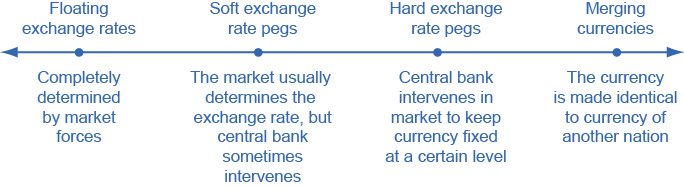
Figure 29.10図 29.10
A nation may adopt one of a variety of exchange rate regimes, from floating rates in which the foreign exchange market determines the rates to pegged rates where governments intervene to manage the exchange rate's value, to a common currency where the nation adopts another country or group of countries' currency.
英語のヒント
国は、さまざまな為替制度の一つを採用できる。外国為替市場がレートを決める変動相場制、政府が介入して為替レートの値を管理するペッグ制、他国または複数国の通貨を採用する共通通貨まで、選択肢がある。
Floating Exchange Rates変動為替レート
We refer to a policy which allows the foreign exchange market to set exchange rates as a floating exchange rate. The U.S. dollar is a floating exchange rate, as are the currencies of about 40% of the countries in the world economy. The major concern with this policy is that exchange rates can move a great deal in a short time.
英語のヒント
外国為替市場に為替レートを決めさせる政策を、変動相場制という。米ドルは変動相場であり、世界経済の約40%の国の通貨もそうである。この政策の主な懸念は、為替レートが短期間に大きく動く可能性である。
Consider the U.S. exchange rate expressed in terms of another fairly stable currency, the Japanese yen, as Figure 29.11 shows. On January 1, 2002, the exchange rate was 133 yen/dollar. On January 1, 2005, it was 103 yen/dollar. On June 1, 2007, it was 122 yen/dollar, on January 1, 2012, it was 77 yen per dollar, and on March 1, 2015, it was 120 yen per dollar. Since 2015, it has dropped again; by the end of December 2020, the exchange rate stood at 103 yen per dollar. As investor sentiment swings back and forth, driving exchange rates up and down, exporters, importers, and banks involved in international lending are all affected. At worst, large movements in exchange rates can drive companies into bankruptcy or trigger a nationwide banking collapse. However, even in the moderate case of the yen/dollar exchange rate, these movements of roughly 30 percent back and forth impose stress on both economies as firms must alter their export and import plans to take the new exchange rates into account. Especially in smaller countries where international trade is a relatively large share of GDP, exchange rate movements can rattle their economies.
英語のヒント
図29.11のように、かなり安定した別の通貨である日本円で表した、米ドルの為替レートを考えよう。2002年1月1日の為替レートは、1ドル当たり133円だった。2005年1月1日は103円、2007年6月1日は122円、2012年1月1日は77円、2015年3月1日は120円だった。2015年以降は再び下がり、2020年12月末には1ドル当たり103円となった。投資家心理が揺れ動き、為替レートを上下させると、輸出業者、輸入業者、国際融資に関わる銀行は、いずれも影響を受ける。最悪の場合、為替レートの大幅な動きは、企業を倒産に追い込んだり、全国的な銀行崩壊を引き起こしたりする。しかし、円/ドル為替レートという穏やかな場合でさえ、約30%もの往復する動きは、両国の経済に負担をかける。企業は新しい為替レートを考慮して、輸出入計画を変更しなければならないからである。とりわけ、GDPに占める国際貿易の割合が比較的大きい小国では、為替レートの動きが経済を揺さぶりうる。
U.S. Dollar Exchange Rate in Japanese Yen日本円で表した米ドル為替レート
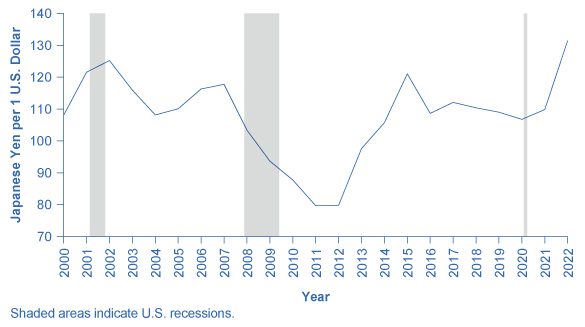


Figure 29.11図 29.11
Even seemingly stable exchange rates such as the Japanese Yen to the U.S. Dollar can vary when closely examined over time. This figure shows a relatively stable rate between 2000 and 2007 of over 25%. Beginning in 2007 until 2012, there was a significant appreciation of the Yen (relative to the U.S. Dollar) by about 14% and again at the end of the year in 2014 also by about 14%. Since then, between 2016 and 2020 there was an appreciation of about 13% from 118 yen per dollar to 103 yen per dollar. (Source: Federal Reserve Economic Data (FRED) https://research.stlouisfed.org/fred2/series/DEXJPUS)
英語のヒント
日本円と米ドルのように、一見安定している為替レートでさえ、時間を追って詳しく調べると変化しうる。この図は、2000~2007年の比較的安定したレートを示し、その変化は25%超である。2007年から2012年までには、米ドルに対して円が約14%大きく増価し、2014年末にも再び約14%増価した。それ以降、2016~2020年には、1ドル当たり118円から103円へ、約13%の増価があった。(出典:連邦準備銀行経済データ〔FRED〕 https://research.stlouisfed.org/fred2/series/DEXJPUS)
However, movements of floating exchange rates have advantages, too. After all, prices of goods and services rise and fall throughout a market economy, as demand and supply shift. If an economy experiences strong inflows or outflows of international financial capital, or has relatively high inflation, or if it experiences strong productivity growth so that purchasing power changes relative to other economies, then it makes economic sense for the exchange rate to shift as well.
英語のヒント
しかし、変動為替レートの動きには利点もある。そもそも市場経済では、需要と供給の移動につれて、財・サービスの価格は至る所で上下する。国際的な金融資本の大幅な流入や流出がある場合、比較的高いインフレがある場合、または生産性が大きく伸びて他の経済に対する購買力が変わる場合には、為替レートも変化することには経済的な意味がある。
Floating exchange rate advocates often argue that if government policies were more predictable and stable, then inflation rates and interest rates would be more predictable and stable. Exchange rates would bounce around less, too. The economist Milton Friedman (1912–2006), for example, wrote a defense of floating exchange rates in 1962 in his book Capitalism and Freedom:
英語のヒント
変動相場制の支持者は、政府の政策がもっと予測可能で安定していれば、インフレ率や金利ももっと予測可能で安定すると論じることが多い。為替レートの激しい変動も減るだろうというのである。たとえば経済学者ミルトン・フリードマン(1912~2006年)は、1962年の著書『資本主義と自由』で、変動為替レートを次のように擁護した。
Being in favor of floating exchange rates does not mean being in favor of unstable exchange rates. When we support a free price system [for goods and services] at home, this does not imply that we favor a system in which prices fluctuate wildly up and down. What we want is a system in which prices are free to fluctuate but in which the forces determining them are sufficiently stable so that in fact prices move within moderate ranges. This is equally true in a system of floating exchange rates. The ultimate objective is a world in which exchange rates, while free to vary, are, in fact, highly stable because basic economic policies and conditions are stable.英語のヒント
変動為替レートを支持することは、不安定な為替レートを支持することを意味しない。国内で〔財・サービスの〕自由な価格制度を支持するからといって、価格が激しく上下する制度を好むということにはならない。私たちが望むのは、価格が自由に変動できる一方、価格を決める力が十分に安定しているため、実際には価格が穏やかな範囲内で動く制度である。これは変動為替レートの制度にも同じように当てはまる。究極の目標は、為替レートが自由に変わりうる一方で、基本的な経済政策と条件が安定しているため、実際には非常に安定している世界である。
Advocates of floating exchange rates admit that, yes, exchange rates may sometimes fluctuate. They point out, however, that if a central bank focuses on preventing either high inflation or deep recession, with low and reasonably steady interest rates, then exchange rates will have less reason to vary.
英語のヒント
変動相場制の支持者は、確かに為替レートがときに変動しうることを認める。しかし、中央銀行が、低く適度に安定した金利を保ちつつ、高いインフレや深い景気後退を防ぐことに注力すれば、為替レートが変動する理由は減ると指摘する。