第29章為替相場と国際資金移動
29.3 Macroeconomic Effects of Exchange Rates29.3 為替レートのマクロ経済効果
Learning Objectives学習目標
Learning Objectives学習目標
By the end of this section you will be able to:
英語のヒント
この節を終えると、次のことができるようになる。
- Explain how exchange rate shifting influences aggregate demand and supply
英語のヒント
為替レートの変化が総需要と総供給にどう影響するかを説明する - Explain how shifting exchange rates also can influence loans and banks
英語のヒント
為替レートの変化が融資や銀行にもどう影響しうるかを説明する
A central bank will be concerned about the exchange rate for multiple reasons: (1) Movements in the exchange rate will affect the quantity of aggregate demand in an economy; (2) frequent substantial fluctuations in the exchange rate can disrupt international trade and cause problems in a nation’s banking system–this may contribute to an unsustainable balance of trade and large inflows of international financial capital, which can set up the economy for a deep recession if international investors decide to move their money to another country. Let’s discuss these scenarios in turn.
英語のヒント
中央銀行が為替レートを気にかける理由は複数ある。(1)為替レートの動きは、経済の総需要量に影響する。(2)為替レートが頻繁に大きく変動すると、国際貿易を乱し、その国の銀行制度に問題を生じさせることがある。これは、持続不可能な貿易収支や、国際的な金融資本の大幅な流入の一因となりうる。その結果、国際投資家が資金を他国へ移すと決めた場合、経済が深い景気後退に陥る条件が整ってしまう。これらの状況を順に論じよう。
Exchange Rates, Aggregate Demand, and Aggregate Supply為替レート、総需要、総供給
Foreign trade in goods and services typically involves incurring the costs of production in one currency while receiving revenues from sales in another currency. As a result, movements in exchange rates can have a powerful effect on incentives to export and import, and thus on aggregate demand in the economy as a whole.
英語のヒント
財・サービスの対外貿易では、通常、生産費用をある通貨で負担し、販売収入を別の通貨で受け取る。そのため、為替レートの動きは、輸出入の誘因、ひいては経済全体の総需要に、強い影響を与えうる。
For example, in 1999, when the euro first became a currency, its value measured in U.S. currency was $1.16/euro, which dropped to a low of about $0.83/euro in 2000. By the end of 2013, the euro had risen (and the U.S. dollar had correspondingly weakened) to $1.37/euro. However, by the beginning of 2021, the exchange rate was down to $1.12/euro. Consider the situation of a French firm that each year incurs €10 million in costs, and sells its products in the United States for $10 million. At a time in 1999, when this firm converted $10 million back to euros at the exchange rate of $1.06/euro (that is, $10 million × [€1/$1.06]), it received €9.4 million, and suffered a loss. In 2013, when this same firm converted $10 million back to euros at the exchange rate of $1.37/euro (that is, $10 million × [€1 euro/$1.37]), it received approximately €7.3 million and an even larger loss. In the beginning of 2021, with the exchange rate back at $1.12/euro the firm would suffer a loss once again. This example shows how a stronger euro discourages exports by the French firm, because it makes the costs of production in the domestic currency higher relative to the sales revenues earned in another country. From the point of view of the U.S. economy, the example also shows how a weaker U.S. dollar encourages exports.
英語のヒント
たとえば、ユーロが初めて通貨となった1999年、その米ドルで測った価値は1ユーロ当たり1.16ドルだったが、2000年には約0.83ドルという安値へ下がった。2013年末までに、ユーロは1ユーロ当たり1.37ドルへ上がり、それに対応して米ドルは弱くなった。しかし、2021年初めまでに、為替レートは1ユーロ当たり1.12ドルへ下がっていた。毎年1,000万ユーロの費用がかかり、アメリカで1,000万ドルの製品を売るフランス企業を考えよう。1999年のある時点で、この企業が1ユーロ当たり1.06ドルの為替レートで1,000万ドルをユーロへ戻すと、つまり1,000万ドル×〔1ユーロ/1.06ドル〕を計算すると、940万ユーロを受け取り、損失を被った。2013年に同じ企業が、1ユーロ当たり1.37ドルの為替レートで1,000万ドルをユーロへ戻すと、つまり1,000万ドル×〔1ユーロ/1.37ドル〕を計算すると、受取額は約730万ユーロとなり、さらに大きな損失を被った。2021年初めに為替レートが1ユーロ当たり1.12ドルへ戻ると、この企業は再び損失を被ることになる。この例は、ユーロ高がフランス企業の輸出をどのように抑制するかを示す。ユーロ高は、他国で得る販売収入に対して、自国通貨での生産費用を相対的に高くするからである。アメリカ経済の視点からは、この例は、米ドル安がどのように輸出を促すかも示している。
Since an increase in exports results in more dollars flowing into the economy, and an increase in imports means more dollars are flowing out, it is easy to conclude that exports are “good” for the economy and imports are “bad,” but this overlooks the role of exchange rates. If an American consumer buys a Japanese car for $20,000 instead of an American car for $30,000, it may be tempting to argue that the American economy has lost out. However, the Japanese company will have to convert those dollars to yen to pay its workers and operate its factories. Whoever buys those dollars will have to use them to purchase American goods and services, so the money comes right back into the American economy. At the same time, the consumer saves money by buying a less expensive import, and can use the extra money for other purposes.
英語のヒント
輸出の増加は経済へ流入するドルを増やし、輸入の増加は流出するドルを増やすため、輸出は経済に「よい」、輸入は「悪い」と結論づけがちである。しかし、それは為替レートの役割を見落としている。アメリカの消費者が30,000ドルのアメリカ車ではなく、20,000ドルの日本車を買うと、アメリカ経済が損をしたと論じたくなるかもしれない。しかし、日本企業は従業員に支払い、工場を運営するため、そのドルを円へ交換しなければならない。そのドルを買った人は誰であれ、それをアメリカの財・サービスの購入に使わなければならないので、お金はアメリカ経済へ戻ってくる。同時に、消費者は安い輸入品を買って支出を節約し、余ったお金をほかの目的に使える。
Fluctuations in Exchange Rates為替レートの変動
Exchange rates can fluctuate a great deal in the short run. As yet one more example, the Indian rupee moved from 39 rupees/dollar in February 2008 to 51 rupees/dollar in March 2009, a decline of more than one-fourth in the value of the rupee on foreign exchange markets. Figure 29.9 earlier showed that even two economically developed neighboring economies like the United States and Canada can see significant movements in exchange rates over a few years. For firms that depend on export sales, or firms that rely on imported inputs to production, or even purely domestic firms that compete with firms tied into international trade—which in many countries adds up to half or more of a nation’s GDP—sharp movements in exchange rates can lead to dramatic changes in profits and losses. A central bank may desire to keep exchange rates from moving too much as part of providing a stable business climate, where firms can focus on productivity and innovation, not on reacting to exchange rate fluctuations.
英語のヒント
為替レートは、短期に大きく変動しうる。もう一つ例を挙げると、インド・ルピーは2008年2月の1ドル当たり39ルピーから、2009年3月の1ドル当たり51ルピーへ動き、外国為替市場でのルピーの価値は4分の1超も下落した。先の図29.9は、アメリカとカナダのように経済的に発展した隣接する二つの経済でさえ、数年の間に大きな為替変動を経験しうることを示した。輸出販売に依存する企業、生産への輸入投入物に依存する企業、さらに、国際貿易に結びついた企業と競争する純粋な国内企業にとっても、急激な為替変動は利益と損失を劇的に変化させうる。これらを合わせると、多くの国ではGDPの半分以上に及ぶ。中央銀行は、企業が為替変動への対応ではなく、生産性や革新に集中できる安定した事業環境を提供する一環として、為替レートが動きすぎることを防ぎたいと考えるかもしれない。
One of the most economically destructive effects of exchange rate fluctuations can happen through the banking system. Financial institutions measure most international loans are measured in a few large currencies, like U.S. dollars, European euros, and Japanese yen. In countries that do not use these currencies, banks often borrow funds in the currencies of other countries, like U.S. dollars, but then lend in their own domestic currency. The left-hand chain of events in Figure 29.9 shows how this pattern of international borrowing can work. A bank in Thailand borrows one million in U.S. dollars. Then the bank converts the dollars to its domestic currency—in the case of Thailand, the currency is the baht—at a rate of 40 baht/dollar. The bank then lends the baht to a firm in Thailand. The business repays the loan in baht, and the bank converts it back to U.S. dollars to pay off its original U.S. dollar loan.
英語のヒント
為替変動が経済に与える最も破壊的な影響の一つは、銀行制度を通じて起こりうる。金融機関では、国際融資の大半が、米ドル、欧州のユーロ、日本円など、少数の主要通貨で測られる。これらの通貨を使わない国では、銀行は米ドルなど他国の通貨で資金を借り、それを自国通貨で貸すことが多い。図29.9の左側の出来事の連鎖は、この国際借入れの仕組みがどのように機能しうるかを示す。タイの銀行が100万米ドルを借りる。次に、1ドル当たり40バーツのレートで、ドルを自国通貨へ交換する。タイの通貨はバーツである。そして銀行は、そのバーツをタイの企業に貸す。企業はバーツで融資を返済し、銀行はそれを米ドルへ戻して、当初の米ドル借入れを返済する。
International Borrowing国際借入れ
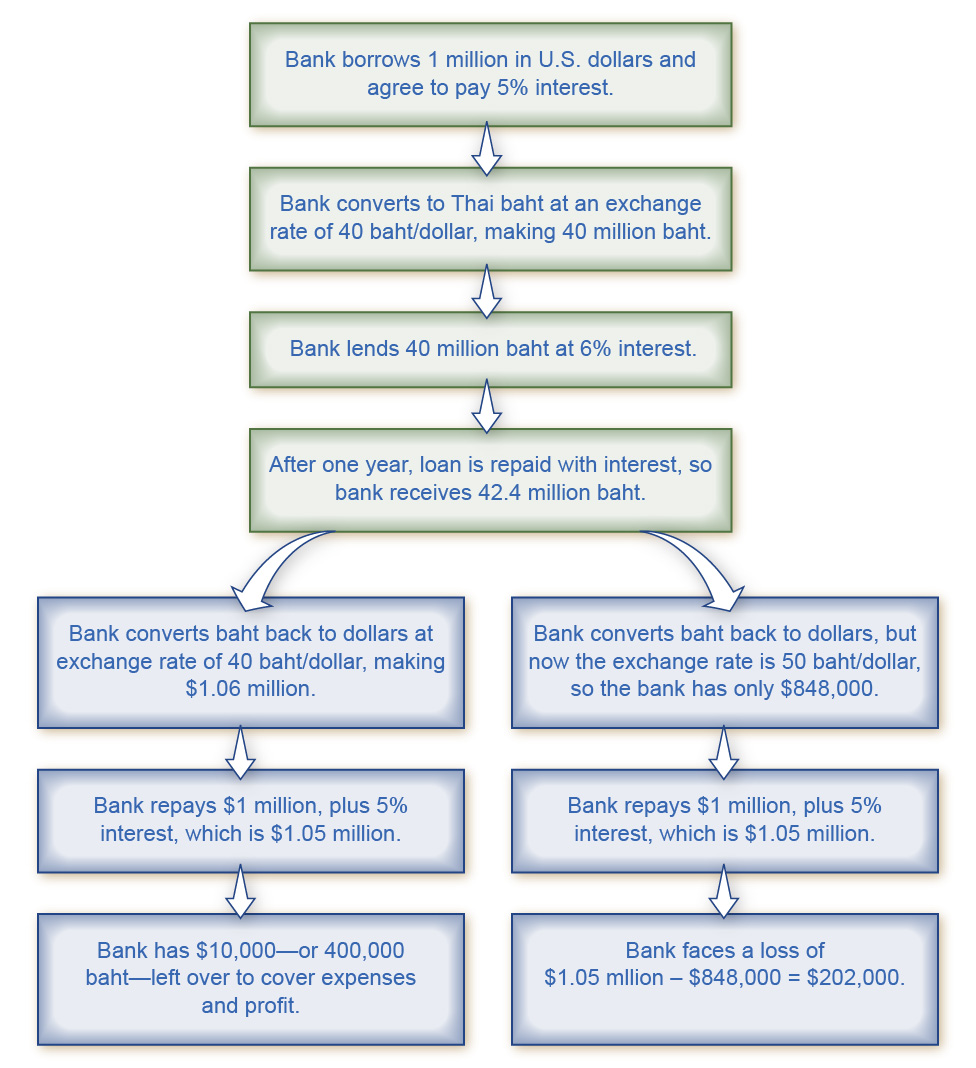

Figure 29.9図 29.9
The scenario of international borrowing that ends on the left is a success story, but the scenario that ends on the right shows what happens when the exchange rate weakens.
英語のヒント
左側で終わる国際借入れの筋書きは成功例であるが、右側で終わる筋書きは、為替レートが弱くなった場合に何が起きるかを示す。
This process of borrowing in a foreign currency and lending in a domestic currency can work just fine, as long as the exchange rate does not shift. In the scenario outlined, if the dollar strengthens and the baht weakens, a problem arises. The right-hand chain of events in Figure 29.9 illustrates what happens when the baht unexpectedly weakens from 40 baht/dollar to 50 baht/dollar. The Thai firm still repays the loan in full to the bank. However, because of the shift in the exchange rate, the bank cannot repay its loan in U.S. dollars. (Of course, if the exchange rate had changed in the other direction, making the Thai currency stronger, the bank could have realized an unexpectedly large profit.)
英語のヒント
外貨で借り、自国通貨で貸すというこの過程は、為替レートが変わらない限り、問題なく機能しうる。ここで示した状況では、ドルが強くなり、バーツが弱くなると、問題が起きる。図29.9の右側の出来事の連鎖は、バーツが予想外に1ドル当たり40バーツから50バーツへ弱くなる場合に何が起きるかを示す。タイ企業は、それでも銀行へ融資を全額返済する。しかし、為替レートが変わったため、銀行は米ドル建ての借入れを返済できない。(もちろん、為替レートが反対方向に変わり、タイ通貨が強くなっていれば、銀行は予想外に大きな利益を得られたはずである。)
In 1997–1998, countries across eastern Asia, like Thailand, Korea, Malaysia, and Indonesia, experienced a sharp depreciation of their currencies, in some cases 50% or more. These countries had been experiencing substantial inflows of foreign investment capital, with bank lending increasing by 20% to 30% per year through the mid-1990s. When their exchange rates depreciated, the banking systems in these countries were bankrupt. Argentina experienced a similar chain of events in 2002. When the Argentine peso depreciated, Argentina’s banks found themselves unable to pay back what they had borrowed in U.S. dollars.
英語のヒント
1997~1998年、タイ、韓国、マレーシア、インドネシアなど東アジア各地の国々は、場合によっては50%以上という、自国通貨の急激な減価を経験した。これらの国には多額の外国投資資本が流入しており、1990年代半ばまで、銀行貸出しは年率20~30%で増えていた。為替レートが減価すると、これらの国の銀行制度は破綻した。アルゼンチンも2002年、似た一連の出来事を経験した。アルゼンチン・ペソが減価すると、アルゼンチンの銀行は、米ドルで借りた資金を返済できなくなった。
Banks play a vital role in any economy in facilitating transactions and in making loans to firms and consumers. When most of a country’s largest banks become bankrupt simultaneously, a sharp decline in aggregate demand and a deep recession results. Since the main responsibilities of a central bank are to control the money supply and to ensure that the banking system is stable, a central bank must be concerned about whether large and unexpected exchange rate depreciation will drive most of the country’s existing banks into bankruptcy. For more on this concern, return to the chapter on The International Trade and Capital Flows.
英語のヒント
銀行はどの経済でも、取引を円滑にし、企業や消費者へ融資するという重要な役割を果たす。ある国の大手銀行の大半が同時に破綻すると、総需要の急減と深い景気後退が起きる。中央銀行の主な責任は、貨幣供給を管理し、銀行制度の安定を確保することなので、予想外の大幅な為替減価が、その国の既存銀行の大半を破綻に追い込まないかを気にかけなければならない。この懸念についてさらに学ぶには、「国際貿易と資本移動」の章に戻ってほしい。