第20章経済成長
20.3 Components of Economic Growth20.3 経済成長の構成要素
Learning Objectives学習目標
Learning Objectives学習目標
By the end of this section, you will be able to:
英語のヒント
この節を学ぶと、次のことができるようになる。
- Discuss the components of economic growth, including physical capital, human capital, and technology
英語のヒント
物的資本、人的資本、技術など、経済成長の構成要素を論じる - Explain capital deepening and its significance
英語のヒント
資本深化とその重要性を説明する - Analyze the methods employed in economic growth accounting studies
英語のヒント
経済成長会計の研究で用いられる方法を分析する - Identify factors that contribute to a healthy climate for economic growth
英語のヒント
経済成長のための健全な環境に寄与する要因を特定する
Over decades and generations, seemingly small differences of a few percentage points in the annual rate of economic growth make an enormous difference in GDP per capita. In this module, we discuss some of the components of economic growth, including physical capital, human capital, and technology.
英語のヒント
何十年、何世代という時間をかけると、経済の年成長率の数パーセントポイントという小さく見える違いが、一人当たりGDPに巨大な差をもたらす。この節では、物的資本、人的資本、技術など、経済成長の構成要素をいくつか論じる。
The category of physical capital includes the plant and equipment that firms use as well as things like roads (also called infrastructure). Again, greater physical capital implies more output. Physical capital can affect productivity in two ways: (1) an increase in the quantity of physical capital (for example, more computers of the same quality); and (2) an increase in the quality of physical capital (same number of computers but the computers are faster, and so on). Human capital refers to the skills and knowledge that make workers productive. Human capital and physical capital accumulation are similar: In both cases, investment now pays off in higher productivity in the future.
英語のヒント
物的資本には、企業が使う工場や設備に加え、インフラとも呼ばれる道路のようなものが含まれる。ここでも、物的資本が多いほど産出も多くなる。物的資本は二つの経路で生産性に影響する。一つは量の増加、例えば同じ品質のコンピューターが増えることである。もう一つは質の向上、例えば台数は同じでもコンピューターが高速になることである。人的資本とは、労働者の生産性を高める技能と知識を指す。人的資本と物的資本の蓄積は似ている。どちらも、現在の投資が将来の高い生産性となって報われる。
The category of technology is the “joker in the deck.” Earlier we described it as the combination of invention and innovation. When most people think of new technology, the invention of new products like the laser, the smartphone, or some new wonder drug come to mind. In food production, developing more drought-resistant seeds is another example of technology. Technology, as economists use the term, however, includes still more. It includes new ways of organizing work, like the invention of the assembly line, new methods for ensuring better quality of output in factories, and innovative institutions that facilitate the process of converting inputs into output. In short, technology comprises all the advances that make the existing machines and other inputs produce more, and at higher quality, as well as altogether new products.
英語のヒント
技術という項目は「トランプのジョーカー」に当たる。先に、技術を発明とイノベーションの組み合わせと説明した。多くの人が新技術と聞いて思い浮かべるのは、レーザー、スマートフォン、新しい特効薬のような製品の発明である。食料生産では、干ばつに強い種子の開発も技術の一例である。しかし、経済学者が使う技術という言葉は、さらに広いものを含む。組立ラインの発明のような仕事の新しい組織方法、工場の産出物の品質を高める新しい方法、投入を産出に変える過程を促進する革新的な制度も含む。つまり技術は、まったく新しい製品だけでなく、既存の機械や他の投入物が、より多く、より高い品質で生産するためのあらゆる進歩を含む。
It may not make sense to compare the GDPs of China and say, Benin, simply because of the great difference in population size. To understand economic growth, which is really concerned with the growth in living standards of an average person, it is often useful to focus on GDP per capita. Using GDP per capita also makes it easier to compare countries with smaller numbers of people, like Belgium, Uruguay, or Zimbabwe, with countries that have larger populations, like the United States, the Russian Federation, or Nigeria.
英語のヒント
中国と、例えばベナンのGDPを比較しても、人口規模の差が大きすぎるため、意味がないかもしれない。経済成長は実際には平均的な人の生活水準の向上に関わるので、それを理解するには一人当たりGDPに注目すると役立つことが多い。一人当たりGDPを使えば、ベルギー、ウルグアイ、ジンバブエのような人口の少ない国と、米国、ロシア連邦、ナイジェリアのような人口の多い国との比較も容易になる。
To obtain a per capita production function, divide each input in Figure 20.2(a) by the population. This creates a second aggregate production function where the output is GDP per capita (that is, GDP divided by population). The inputs are the average level of human capital per person, the average level of physical capital per person, and the level of technology per person—see Figure 20.2(b). The result of having population in the denominator is mathematically appealing. Increases in population lower per capita income. However, increasing population is important for the average person only if the rate of income growth exceeds population growth. A more important reason for constructing a per capita production function is to understand the contribution of human and physical capital.
英語のヒント
Capital Deepening資本深化
When society increases the level of capital per person, we call the result capital deepening. The idea of capital deepening can apply both to additional human capital per worker and to additional physical capital per worker.
英語のヒント
社会が一人当たり資本の水準を高めると、その結果を資本深化という。資本深化の考え方は、労働者一人当たりの人的資本の増加にも、物的資本の増加にも適用できる。
Recall that one way to measure human capital is to look at the average levels of education in an economy. Figure 20.5 illustrates the human capital deepening for U.S. workers by showing that the proportion of the U.S. population with a high school and a college degree is rising. As recently as 1970, for example, only about half of U.S. adults had at least a high school diploma. By the start of the twenty-first century, more than 80% of adults had graduated from high school. The idea of human capital deepening also applies to the years of experience that workers have, but the average experience level of U.S. workers has not changed much in recent decades. Thus, the key dimension for deepening human capital in the U.S. economy focuses more on additional education and training than on a higher average level of work experience.
英語のヒント
人的資本を測る方法の一つは、その経済の平均教育水準を見ることだと思い出そう。図20.5は、高校卒業者と大学卒業者の人口に占める割合の上昇によって、米国の労働者の人的資本深化を示している。例えば1970年という比較的最近でも、少なくとも高校卒業資格を持つ米国の成人は約半数にすぎなかった。21世紀初頭には、80%以上の成人が高校を卒業していた。人的資本深化は労働者の経験年数にも当てはまるが、米国の労働者の平均経験水準は、近年の数十年間にあまり変わっていない。したがって、米国経済の人的資本深化で鍵となるのは、平均的な職務経験の増加よりも、教育や訓練の追加である。
Human Capital Deepening in the U.S.米国における人的資本深化
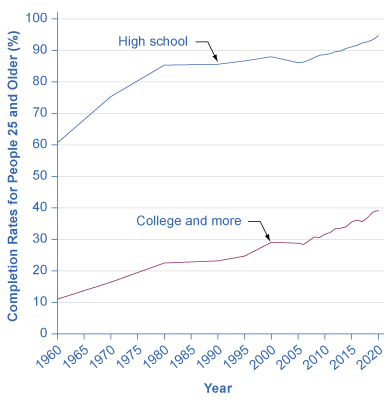
Figure 20.5図 20.5
Rising levels of education for persons 25 and older show the deepening of human capital in the U.S. economy. Even today, under one-third of U.S. adults have completed a four-year college degree. There is clearly room for additional deepening of human capital to occur. (Source: Penn World Tables, 10.0 https://www.rug.nl/ggdc/productivity/pwt/?lang=en)
英語のヒント
25歳以上の教育水準の上昇は、米国経済の人的資本深化を示している。今日でも、4年制大学の学位を取得した米国の成人は3分の1未満である。人的資本をさらに深化させる余地が明らかにある。(出典:Penn World Tables 10.0、https://www.rug.nl/ggdc/productivity/pwt/?lang=en)
Figure 20.6 shows physical capital deepening in the U.S. economy. The average U.S. worker in the late 2000s was working with physical capital worth almost three times as much as that of the average worker of the early 1950s.
英語のヒント
図20.6は、米国経済における物的資本深化を示している。2000年代後半の米国の平均的な労働者は、1950年代初頭の平均的な労働者のほぼ3倍の価値の物的資本を使って働いていた。
Physical Capital per Worker in the United States米国の労働者一人当たり物的資本
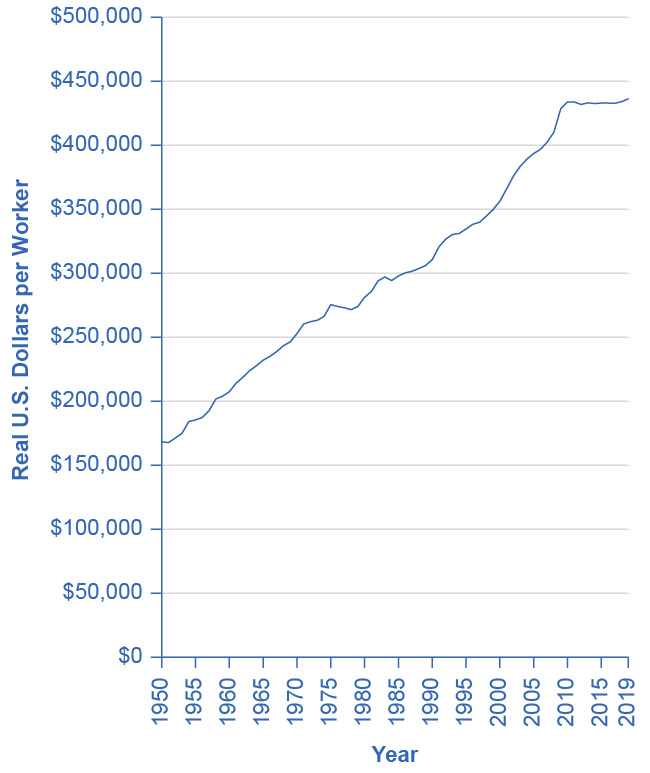


Figure 20.6図 20.6
The value of the physical capital, measured by plant and equipment, used by the average worker in the U.S. economy has risen over the decades. The increase may have leveled off a bit in the 1970s and 1980s, which were, not coincidentally, times of slower-than-usual growth in worker productivity. We see a renewed increase in physical capital per worker in the late 1990s, followed by a flattening in the early 2000s. (Source: Center for International Comparisons of Production, Income and Prices, University of Pennsylvania)
英語のヒント
米国経済の平均的な労働者が使う物的資本の価値は、工場や設備で測ると、数十年にわたり増えてきた。1970年代と1980年代には増加がやや横ばいになった可能性があるが、この時期の労働生産性上昇率が通常より低かったのは偶然ではない。1990年代後半には一人当たり物的資本が再び増え、2000年代初頭には横ばいになっている。(出典:ペンシルベニア大学・生産、所得、物価の国際比較センター)
Not only does the current U.S. economy have better-educated workers with more and improved physical capital than it did several decades ago, but these workers have access to more advanced technologies. Growth in technology is impossible to measure with a simple line on a graph, but evidence that we live in an age of technological marvels is all around us—discoveries in genetics and in the structure of particles, the wireless internet, and other inventions almost too numerous to count. The U.S. Patent and Trademark Office typically has issued more than 150,000 patents annually in recent years.
英語のヒント
現在の米国経済の労働者は、数十年前より教育水準が高く、より多く、より優れた物的資本を持つだけでなく、より進んだ技術も利用できる。技術の進歩をグラフの単純な線で測ることは不可能だが、技術の驚異の時代に生きている証拠は周囲にあふれている。遺伝学や粒子構造の発見、無線インターネット、その他数え切れないほどの発明がある。米国特許商標庁は、近年、通常年間15万件以上の特許を発行している。
This recipe for economic growth—investing in labor productivity, with investments in human capital and technology, as well as increasing physical capital—also applies to other economies. South Korea, for example, already achieved universal enrollment in primary school (the equivalent of kindergarten through sixth grade in the United States) by 1965, when Korea’s GDP per capita was still near its rock bottom low. By the late 1980s, Korea had achieved almost universal secondary school education (the equivalent of a high school education in the United States). With regard to physical capital, Korea’s rates of investment had been about 15% of GDP at the start of the 1960s, but doubled to 30–35% of GDP by the late 1960s and early 1970s. With regard to technology, South Korean students went to universities and colleges around the world to obtain scientific and technical training, and South Korean firms reached out to study and form partnerships with firms that could offer them technological insights. These factors combined to foster South Korea’s high rate of economic growth.
英語のヒント
物的資本を増やすとともに、人的資本と技術に投資して労働生産性を高めるという経済成長の方法は、他の経済にも当てはまる。例えば韓国は、一人当たりGDPがまだ最低水準に近かった1965年までに、初等学校、米国の幼稚園から小学6年に相当する段階への全員就学を達成していた。1980年代後半までには、米国の高校教育に相当する中等教育がほぼ普及した。物的資本については、韓国の投資率は1960年代初めにはGDPの約15%だったが、1960年代後半から1970年代初めには30~35%へ倍増した。技術については、韓国の学生が科学・技術の訓練を受けるため世界各地の大学へ行き、韓国企業も技術的な知見を得られる企業を訪ねて学び、提携した。これらの要因が組み合わさって、韓国の高い経済成長率を促進した。