第20章経済成長
Arguments That Convergence Is neither Inevitable nor Likely収束は必然でも起こりそうでもないという議論
If the economy's growth depended only on the deepening of human capital and physical capital, then we would expect that economy's growth rate to slow down over the long run because of diminishing marginal returns. However, there is another crucial factor in the aggregate production function: technology.
英語のヒント
経済成長が人的資本と物的資本の深化だけに依存するなら、限界収穫逓減のため、長期的には経済成長率が低下すると予想される。しかし集計的生産関数には、もう一つ重要な要因がある。それが技術である。
Developing new technology can provide a way for an economy to sidestep the diminishing marginal returns of capital deepening. Figure 20.7 shows how. The figure's horizontal axis measures the amount of capital deepening, which on this figure is an overall measure that includes deepening of both physical and human capital. The amount of human and physical capital per worker increases as you move from left to right, from C1 to C2 to C3. The diagram's vertical axis measures per capita output. Start by considering the lowest line in this diagram, labeled Technology 1. Along this aggregate production function, the level of technology is held constant, so the line shows only the relationship between capital deepening and output. As capital deepens from C1 to C2 to C3 and the economy moves from R to U to W, per capita output does increase—but the way in which the line starts out steeper on the left but then flattens as it moves to the right shows the diminishing marginal returns, as additional marginal amounts of capital deepening increase output by ever-smaller amounts. The shape of the aggregate production line (Technology 1) shows that the ability of capital deepening, by itself, to generate sustained economic growth is limited, since diminishing returns will eventually set in.
英語のヒント
新技術の開発は、資本深化の限界収穫逓減を回避する方法を経済に与えうる。図20.7はその仕組みを示す。図の横軸は資本深化の量を測る。この図では、物的資本と人的資本の双方の深化を含む総合的な尺度である。左から右へ、C1からC2、C3へ移るにつれて、労働者一人当たりの人的資本と物的資本の量は増加する。縦軸は一人当たり生産を測る。まず、この図で「技術1」と表示された最も低い線を考えよう。この集計的生産関数上では技術水準を一定に保っているため、この線は資本深化と生産の関係だけを示す。資本がC1からC2、C3へと深化し、経済がRからU、Wへ移るにつれて、一人当たり生産は確かに増加する。しかし、左側では傾きが急で、右へ進むにつれて平らになる形は、限界収穫逓減を示す。資本深化の限界的な追加量による生産の増加分は、次第に小さくなる。集計的生産曲線(技術1)の形は、いずれ収穫逓減が生じるため、資本深化だけで持続的な経済成長を生み出す能力には限界があることを示している。
Capital Deepening and New Technology資本深化と新技術
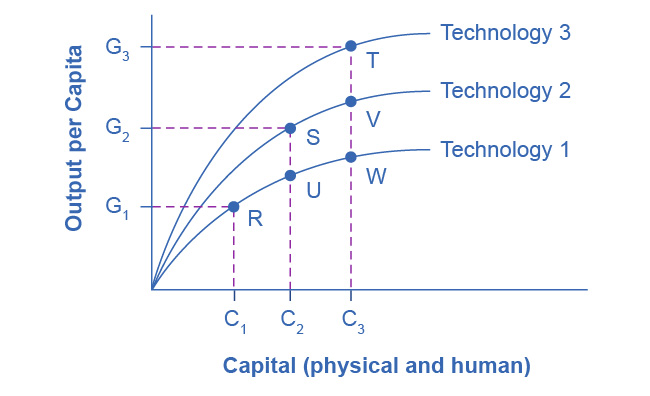

Figure 20.7図 20.7
Imagine that the economy starts at point R, with the level of physical and human capital C1 and the output per capita at G1. If the economy relies only on capital deepening, while remaining at the technology level shown by the Technology 1 line, then it would face diminishing marginal returns as it moved from point R to point U to point W. However, now imagine that capital deepening is combined with improvements in technology. Then, as capital deepens from C1 to C2, technology improves from Technology 1 to Technology 2, and the economy moves from R to S. Similarly, as capital deepens from C2 to C3, technology increases from Technology 2 to Technology 3, and the economy moves from S to T. With improvements in technology, there is no longer any reason that economic growth must necessarily slow down.
英語のヒント
経済が点Rから出発し、物的資本と人的資本の水準がC1、一人当たり生産がG1であるとしよう。経済が「技術1」の線で示される技術水準にとどまり、資本深化だけに頼るなら、点Rから点U、点Wへ移るにつれて限界収穫逓減に直面する。しかし今度は、資本深化が技術の改善と組み合わされると考えよう。すると、資本がC1からC2へ深化するにつれて、技術は技術1から技術2へ改善し、経済はRからSへ移る。同様に、資本がC2からC3へ深化するにつれて、技術は技術2から技術3へ進歩し、経済はSからTへ移る。技術の改善があれば、経済成長が必ず鈍化しなければならない理由はなくなる。
Now, bring improvements in technology into the picture. Improved technology means that with a given set of inputs, more output is possible. The production function labeled Technology 1 in the figure is based on one level of technology, but Technology 2 is based on an improved level of technology, so for every level of capital deepening on the horizontal axis, it produces a higher level of output on the vertical axis. In turn, production function Technology 3 represents a still higher level of technology, so that for every level of inputs on the horizontal axis, it produces a higher level of output on the vertical axis than either of the other two aggregate production functions.
英語のヒント
ここで、技術の改善を考慮に入れよう。技術の改善は、一定の投入要素の組合せから、より多くの生産が可能になることを意味する。図の「技術1」という生産関数はある技術水準に基づくが、「技術2」は改善された技術水準に基づく。そのため、横軸のどの資本深化の水準においても、縦軸でより高い生産水準を生み出す。さらに生産関数「技術3」は、いっそう高い技術水準を表すため、横軸のどの投入水準に対しても、他の二つの集計的生産関数のいずれよりも、縦軸で高い生産水準を生み出す。
Most healthy, growing economies are deepening their human and physical capital and increasing technology at the same time. As a result, the economy can move from a choice like point R on the Technology 1 aggregate production line to a point like S on Technology 2 and a point like T on the still higher aggregate production line (Technology 3). With the combination of technology and capital deepening, the rise in GDP per capita in high-income countries does not need to fade away because of diminishing returns. The gains from technology can offset the diminishing returns involved with capital deepening.
英語のヒント
健全に成長する経済の多くは、人的資本と物的資本を深化させると同時に技術を進歩させている。その結果、経済は集計的生産曲線「技術1」上の点Rのような選択から、「技術2」上の点S、さらに高い集計的生産曲線「技術3」上の点Tへ移ることができる。技術と資本深化が組み合わされれば、高所得国の一人当たりGDPの上昇が収穫逓減によって消えていく必要はない。技術から得られる利益が、資本深化に伴う収穫逓減を相殺できる。
Will technological improvements themselves run into diminishing returns over time? That is, will it become continually harder and more costly to discover new technological improvements? Perhaps someday, but, at least over the last two centuries since the beginning of the Industrial Revolution, improvements in technology have not run into diminishing marginal returns. Modern inventions, like the internet or discoveries in genetics or materials science, do not seem to provide smaller gains to output than earlier inventions like the steam engine or the railroad. One reason that technological ideas do not seem to run into diminishing returns is that we often can apply widely the ideas of new technology at a marginal cost that is very low or even zero. A specific worker or group of workers must use a specific additional machine, or an additional year of education. Many workers across the economy can use a new technology or invention at very low marginal cost.
英語のヒント
技術の改善そのものは、時間がたつと収穫逓減に直面するだろうか。つまり、新たな技術の改善を発見することが、次第に難しく、費用のかかるものになるだろうか。いつかそうなるかもしれないが、少なくとも産業革命の始まりから過去2世紀の間、技術の改善は限界収穫逓減に直面してこなかった。インターネットや遺伝学・材料科学における発見などの現代の発明は、蒸気機関や鉄道といった以前の発明よりも、生産への寄与が小さいようにはみえない。技術的なアイデアが収穫逓減に直面しないようにみえる理由の一つは、新技術のアイデアを非常に低い、あるいはゼロの限界費用で広く応用できることが多い点にある。特定の追加の機械や、追加の1年間の教育は、特定の労働者や労働者集団が利用する必要がある。一方、新しい技術や発明は、経済全体の多くの労働者が非常に低い限界費用で利用できる。
The argument that it is easier for a low-income country to copy and adapt existing technology than it is for a high-income country to invent new technology is not necessarily true, either. When it comes to adapting and using new technology, a society’s performance is not necessarily guaranteed, but is the result of whether the country's economic, educational, and public policy institutions are supportive. In theory, perhaps, low-income countries have many opportunities to copy and adapt technology, but if they lack the appropriate supportive economic infrastructure and institutions, the theoretical possibility that backwardness might have certain advantages is of little practical relevance.
英語のヒント
低所得国が既存技術を模倣・適応させる方が、高所得国が新技術を発明するより容易だという議論も、必ずしも正しくはない。新技術の適応と利用に関して、社会の成果は必ずしも保証されておらず、その国の経済、教育、公共政策の制度が支援的かどうかの結果である。理論上は、低所得国には技術を模倣・適応させる機会が多いかもしれない。しかし、それを適切に支える経済インフラや制度がなければ、後発性が一定の利点をもつという理論上の可能性は、実際にはほとんど意味をもたない。