第20章経済成長
20.2 Labor Productivity and Economic Growth20.2 労働生産性と経済成長
Learning Objectives学習目標
Learning Objectives学習目標
By the end of this section, you will be able to:
英語のヒント
この節を学ぶと、次のことができるようになる。
- Identify the role of labor productivity in promoting economic growth
英語のヒント
経済成長を促進する労働生産性の役割を特定する。 - Analyze the sources of economic growth using the aggregate production function
英語のヒント
総生産関数を用いて経済成長の源泉を分析する。 - Measure an economy’s rate of productivity growth
英語のヒント
一国の生産性上昇率を測る。 - Evaluate the power of sustained growth
英語のヒント
持続的な成長の力を検討する。
Sustained long-term economic growth comes from increases in worker productivity, which essentially means how well we do things. In other words, how efficient is your nation with its time and workers? Labor productivity is the value that each employed person creates per unit of their input. The easiest way to comprehend labor productivity is to imagine a Canadian worker who can make 10 loaves of bread in an hour versus a U.S. worker who in the same hour can make only two loaves of bread. In this fictional example, the Canadians are more productive. More productivity essentially means you can do more in the same amount of time. This in turn frees up resources for workers to use elsewhere.
英語のヒント
持続的な長期の経済成長は、労働者の生産性の上昇から生まれる。生産性とは、要するに物事をどれだけうまく行うかである。言い換えれば、その国は時間と労働者をどれほど効率的に使っているのか。労働生産性とは、各就業者が投入1単位当たりに生み出す価値である。理解するには、一時間にパン10個を作れるカナダの労働者と、同じ時間に2個しか作れない米国の労働者を想像するとよい。この架空の例では、カナダの労働者のほうが生産性が高い。生産性の上昇は、本質的には同じ時間により多くのことができることを意味する。その結果、労働者が別の場所で使える資源が生まれる。
What determines how productive workers are? The answer is pretty intuitive. The first determinant of labor productivity is human capital. Human capital is the accumulated knowledge (from education and experience), skills, and expertise that the average worker in an economy possesses. Typically the higher the average level of education in an economy, the higher the accumulated human capital and the higher the labor productivity.
英語のヒント
労働者の生産性の高さを決めるのは何か。答えはかなり直感的である。労働生産性の第一の決定要因は人的資本である。人的資本とは、その経済の平均的な労働者が持つ、教育と経験を通じて蓄積した知識、技能、専門能力のことである。通常、経済の平均教育水準が高いほど、蓄積された人的資本も大きく、労働生産性も高い。
The second factor that determines labor productivity is technological change. Technological change is a combination of invention—advances in knowledge—and innovation, which is putting those advances to use in a new product or service. For example, the transistor was invented in 1947. It allowed us to miniaturize the footprint of electronic devices and use less power than the tube technology that came before it. Innovations since then have produced smaller and better transistors that are ubiquitous in products as varied as smart-phones, computers, and escalators. Developing the transistor has allowed workers to be anywhere with smaller devices. People can use these devices to communicate with other workers, measure product quality or do any other task in less time, improving worker productivity.
英語のヒント
労働生産性を決める第二の要因は技術変化である。技術変化は、知識の進歩である発明と、その進歩を新しい製品やサービスに応用するイノベーションの組み合わせである。例えばトランジスタは1947年に発明された。それにより、電子機器の占有面積を小さくし、それ以前の真空管技術より消費電力を抑えられるようになった。その後のイノベーションは、より小さく優れたトランジスタを生み、スマートフォン、コンピューター、エスカレーターなど、多様な製品の至る所に使われるようになった。トランジスタの開発により、労働者は小さな機器を持ってどこへでも行けるようになった。人々はその機器を使って、他の労働者との連絡、製品の品質測定、その他の作業を短時間で行え、労働生産性が高まる。
The third factor that determines labor productivity is economies of scale. Recall that economies of scale are the cost advantages that industries obtain due to size. (Read more about economies of scale in Production, Cost and Industry Structure.) Consider again the case of the fictional Canadian worker who could produce 10 loaves of bread in an hour. If this difference in productivity was due only to economies of scale, it could be that the Canadian worker had access to a large industrial-size oven while the U.S. worker was using a standard residential size oven.
英語のヒント
労働生産性を決める第三の要因は、規模の経済である。規模の経済とは、産業がその大きさによって得る費用面の優位であることを思い出そう。(詳しくは「生産・費用・産業構造」を参照。)一時間にパン10個を作れる架空のカナダの労働者を、もう一度考えよう。生産性の差が規模の経済だけによるものなら、カナダの労働者は大型の業務用オーブンを使える一方、米国の労働者は標準的な家庭用オーブンを使っていたのかもしれない。
Now that we have explored the determinants of worker productivity, let’s turn to how economists measure economic growth and productivity.
英語のヒント
労働生産性の決定要因を検討したので、次は経済学者が経済成長と生産性をどう測るかを見よう。
Sources of Economic Growth: The Aggregate Production Function経済成長の源泉:総生産関数
To analyze the sources of economic growth, it is useful to think about a production function, which is the technical relationship by which economic inputs like labor, machinery, and raw materials are turned into outputs like goods and services that consumers use. A microeconomic production function describes a firm's or perhaps an industry's inputs and outputs. In macroeconomics, we call the connection from inputs to outputs for the entire economy an aggregate production function.
英語のヒント
経済成長の源泉を分析するには、生産関数を考えるとよい。生産関数とは、労働、機械、原材料などの経済的な投入物が、消費者の使う財・サービスなどの産出物へ変わる技術的な関係である。ミクロ経済の生産関数は、一つの企業、あるいは産業の投入と産出を記述する。マクロ経済学では、経済全体の投入から産出へのつながりを総生産関数という。
Components of the Aggregate Production Function総生産関数の構成要素
Economists construct different production functions depending on the focus of their studies. Figure 20.2 presents two examples of aggregate production functions. In the first production function in Figure 20.2 (a), the output is GDP. The inputs in this example are workforce, human capital, physical capital, and technology. We discuss these inputs further in the module, Components of Economic Growth.
英語のヒント
Aggregate Production Functions総生産関数
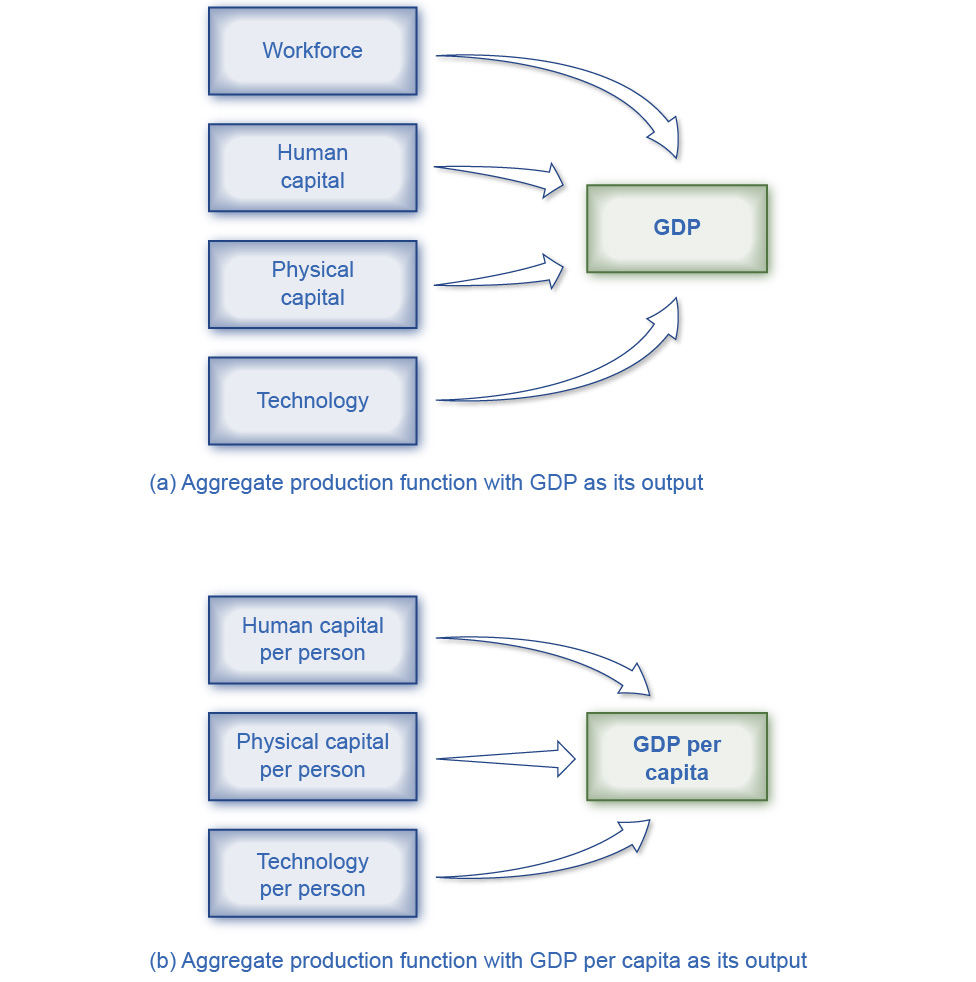

Figure 20.2図 20.2
An aggregate production function shows what goes into producing the output for an overall economy. (a) This aggregate production function has GDP as its output. (b) This aggregate production function has GDP per capita as its output. Because we calculate it on a per-person basis, we already figure the labor input into the other factors and we do not need to list it separately.
英語のヒント
総生産関数は、経済全体の産出を生み出す際に何を投入するかを示す。(a)この総生産関数の産出はGDPである。(b)この総生産関数の産出は一人当たりGDPである。一人当たりで計算しているので、労働投入はすでに他の要素に織り込まれており、別に挙げる必要はない。