第17章金融市場
17.2 How Households Supply Financial Capital17.2 家計はどのように金融資本を供給するか
Learning Objectives学習目標
Learning Objectives学習目標
By the end of this section, you will be able to:
英語のヒント
この節を学ぶと、次のことができるようになる。
- Show the relationship between savers, banks, and borrowers
英語のヒント
貯蓄者、銀行、借り手の関係を示す。 - Calculate bond yield
英語のヒント
債券利回りを計算する。 - Contrast bonds, stocks, mutual funds, and assets
英語のヒント
債券、株式、投資信託、資産を比較する。 - Explain the tradeoffs between return and risk
英語のヒント
収益とリスクのトレードオフを説明する。
The ways in which firms would prefer to raise funds are only half the story of financial markets. The other half is what those households and individuals who supply funds desire, and how they perceive the available choices. The focus of our discussion now shifts from firms on the demand side of financial capital markets to households on the supply side of those markets. We can divide the mechanisms for savings available to households into several categories: deposits in bank accounts; bonds; stocks; money market mutual funds; stock and bond mutual funds; and housing and other tangible assets like owning gold. We need to analyze each of these investments in terms of three factors: (1) the expected rate of return it will pay; (2) the risk that the return will be much lower or higher than expected; and (3) the investment's liquidity, which refers to how easily one can exchange money or financial assets for a good or service. We will do this analysis as we discuss each of these investments in the sections below. First, however, we need to understand the difference between expected rate of return, risk, and actual rate of return.
英語のヒント
企業が好む資金調達方法は、金融市場の話の半分にすぎない。残りの半分は、資金を供給する家計や個人が何を望み、利用できる選択肢をどう見るかである。ここから議論の焦点を、金融資本市場の需要側の企業から、供給側の家計へ移す。家計が使える貯蓄の仕組みは、銀行預金、債券、株式、マネー・マーケット・ファンド、株式や債券の投資信託、住宅や金のような有形資産に分けられる。各投資を、(1)期待収益率、(2)収益が期待より大幅に低くなったり高くなったりするリスク、(3)貨幣や金融資産を財・サービスと交換する容易さを意味する流動性、の三つから分析する必要がある。以下で各投資を論じながら分析する。その前に、期待収益率、リスク、実現収益率の違いを理解する必要がある。
Expected Rate of Return, Risk, and Actual Rate of Return期待収益率、リスク、実現収益率
The expected rate of return refers to how much a project or an investment is expected to return to the investor, either in future interest payments, capital gains, or increased profitability. It is usually the average return over a period of time, usually in years or even decades. We normally measure it as a percentage rate. Risk measures the uncertainty of that project’s profitability. There are several types of risk, including default risk and interest rate risk. Default risk, as its name suggests, is the risk that the borrower fails to pay back the bond or loan. Interest rate risk is the danger that you might buy a long term bond at a 6% interest rate right before market rates suddenly rise, so had you waited, you could have received a similar bond that paid 9%. A high-risk investment is one for which a wide range of potential payoffs is reasonably probable. A low-risk investment may have actual returns that are fairly close to its expected rate of return year after year. A high-risk investment will have actual returns that are much higher than the expected rate of return in some months or years and much lower in other months or years. The actual rate of return refers to the total rate of return, including capital gains and interest paid on an investment at the end of a time period.
英語のヒント
期待収益率は、将来の利払い、キャピタルゲイン、収益性の向上などを通じて、事業や投資が投資家にどれだけの収益をもたらすと予想されるかを指す。通常は何年、時には何十年という期間の平均収益で、一般に百分率で測る。リスクは事業の収益性の不確実さを測る。債務不履行リスク、金利リスクなど、いくつもの種類がある。債務不履行リスクは、その名のとおり借り手が債券や融資を返済しないリスクである。金利リスクは、市場金利が突然上がる直前に6%の長期債を買い、待てば9%の同様の債券を買えたというような危険である。高リスク投資では、幅広い収益の可能性が相応の確率で存在する。低リスク投資では、毎年の実現収益が期待収益率にかなり近いことがある。高リスク投資は、ある月や年には実現収益が期待を大きく上回り、別の月や年には大きく下回る。実現収益率とは、期間の終わりにおけるキャピタルゲインと投資から支払われた利子を含む総収益率である。
Bank Accounts銀行口座
An intermediary is one who stands between two other parties. For example, a person who arranges a blind date between two other people is one kind of intermediary. In financial capital markets, banks are an example of a financial intermediary—that is, an institution that operates between a saver who deposits funds in a bank and a borrower who receives a loan from that bank. When a bank serves as a financial intermediary, unlike the situation with a couple on a blind date, the saver and the borrower never meet. In fact, it is not even possible to make direct connections between those who deposit funds in banks and those who borrow from banks, because all deposited funds end up in one big pool, which the financial institution then lends out.
英語のヒント
仲介者とは、二者の間に立つ者である。たとえば、面識のない二人のデートを手配する人も一種の仲介者である。金融資本市場では銀行が金融仲介機関の一例であり、銀行に資金を預ける貯蓄者と、その銀行から融資を受ける借り手の間で活動する。銀行が金融仲介機関となる場合、初対面でデートする二人とは違い、貯蓄者と借り手は顔を合わせない。実際、預けた資金はすべて大きな資金の集まりに入り、金融機関がそこから貸し出すので、銀行に預ける人と借りる人を直接結びつけることさえできない。
Figure 17.3 illustrates the position of banks as a financial intermediary, with a pattern of deposits flowing into a bank and loans flowing out, and then repayment of the loans flowing back to the bank, with interest payments for the original savers.
英語のヒント
図17.3は金融仲介機関としての銀行の位置を示す。預金が銀行に入り、融資が流れ出し、その返済が銀行に戻り、元の貯蓄者へ利子が支払われる。
Banks as Financial Intermediaries金融仲介機関としての銀行
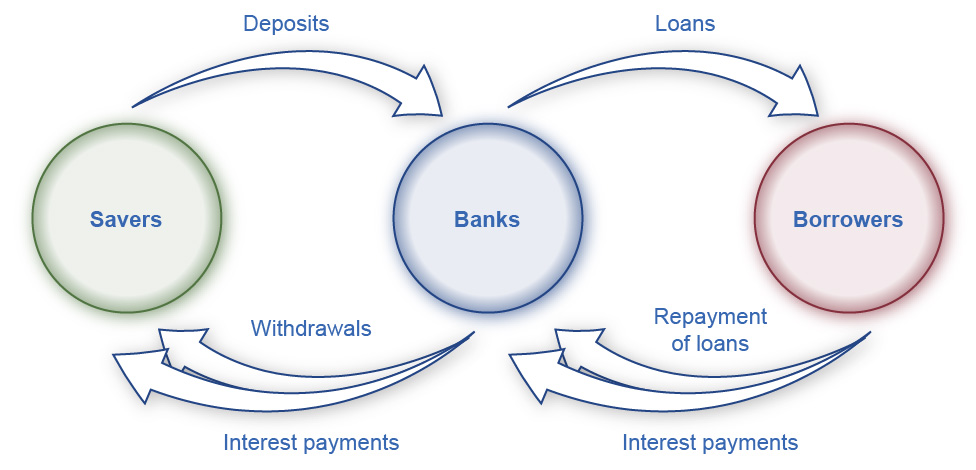
Figure 17.3図 17.3
Banks are a financial intermediary because they stand between savers and borrowers. Savers place deposits with banks, and then receive interest payments and withdraw money. Borrowers receive loans from banks, and repay the loans with interest.
英語のヒント
銀行は貯蓄者と借り手の間に立つため、金融仲介機関である。貯蓄者は銀行に預金し、利子を受け取り、お金を引き出す。借り手は銀行から融資を受け、利子を付けて返済する。
Banks offer a range of accounts to serve different needs. A checking account typically pays little or no interest, but it facilitates transactions by giving you easy access to your money, either by writing a check or by using a debit card (that is, a card which works like a credit card, except that purchases are immediately deducted from your checking account rather than billed separately through a credit card company). A savings account typically pays some interest rate, but getting the money typically requires you to make a trip to the bank or an automatic teller machine (or you can access the funds electronically). The lines between checking and savings accounts have blurred in the last couple of decades, as many banks offer checking accounts that will pay an interest rate similar to a savings account if you keep a certain minimum amount in the account, or conversely, offer savings accounts that allow you to write at least a few checks per month.
英語のヒント
銀行はさまざまな必要に応じた口座を提供する。当座預金は通常、利子が少ないか付かないが、小切手やデビットカードでお金を簡単に使えるため取引を容易にする。デビットカードはクレジットカードに似ているが、購入額をカード会社が別途請求する代わりに、当座預金から直ちに引き落とす。貯蓄預金は通常ある程度の利子が付くが、引き出すには一般に銀行や現金自動預払機へ行く必要がある(電子的に資金を使うこともできる)。この数十年、当座預金と貯蓄預金の境界は曖昧になった。一定の最低残高を保てば貯蓄預金並みの利子を払う当座預金や、逆に月に数枚は小切手を振り出せる貯蓄預金を、多くの銀行が提供するためである。
Another way to deposit savings at a bank is to use a certificate of deposit (CD). With a CD, you agree to deposit a certain amount of money, often measured in thousands of dollars, in the account for a stated period of time, typically ranging from a few months to several years. In exchange, the bank agrees to pay a higher interest rate than for a regular savings account. While you can withdraw the money before the allotted time, as the advertisements for CDs always warn, there is “a substantial penalty for early withdrawal.”
英語のヒント
銀行に貯蓄を預けるもう一つの方法は、譲渡性預金(CD)を使うことである。CDでは、通常数千ドル単位の一定額を、数か月から数年という指定期間、口座に預けることに同意する。代わりに銀行は通常の貯蓄預金より高い利子率を約束する。指定期間より前でも引き出せるが、CDの広告が必ず警告するように、「中途解約には多額の違約金」がある。
Figure 17.4 shows the annual rate of interest paid on a six-month, one-year, and five-year CD since 1984, as reported by Bankrate.com. The interest rates that savings accounts pay are typically a little lower than the CD rate, because financial investors need to receive a slightly higher rate of interest as compensation for promising to leave deposits untouched for a period of time in a CD, and thus forfeiting some liquidity.
英語のヒント
図17.4は、Bankrate.comが報告した1984年以降の6か月、1年、5年CDの年利率を示す。貯蓄預金の利子率は通常、CDより少し低い。CDでは一定期間預金を動かさず流動性の一部を手放すと約束するため、投資家はその対価として少し高い利子率を必要とするからである。
Interest Rates on Six-Month, One-Year, and Five-Year Certificates of Deposit6か月、1年、5年の譲渡性預金の金利
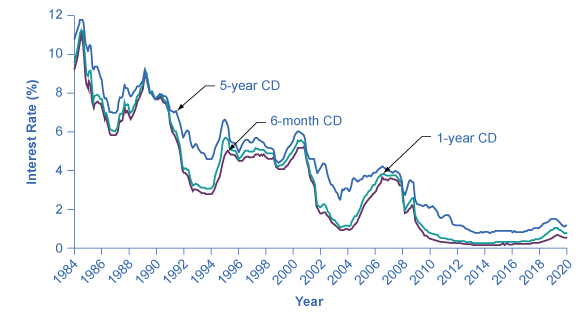


Figure 17.4図 17.4
The interest rates on certificates of deposit have fluctuated over time. The high interest rates of the early 1980s are indicative of the relatively high inflation rate in the United States at that time. Interest rates fluctuate with the business cycle, typically increasing during expansions and decreasing during a recession. Note the steep decline in CD rates since 2008, the beginning of the Great Recession.
英語のヒント
譲渡性預金の金利は時間とともに変動してきた。1980年代初めの高金利は、当時の米国の比較的高いインフレ率を示している。金利は景気循環とともに変動し、通常は拡大期に上昇、後退期に低下する。大不況が始まった2008年以降のCD金利の急落に注目しよう。
The great advantages of bank accounts are that financial investors have very easy access to their money, and also money in bank accounts is extremely safe. In part, this safety arises because a bank account offers more security than keeping a few thousand dollars in the toe of a sock in your underwear drawer. In addition, the Federal Deposit Insurance Corporation (FDIC) protects the savings of the average person. Every bank is required by law to pay a fee to the FDIC, based on the size of its deposits. Then, if a bank should go bankrupt and not be able to repay depositors, the FDIC guarantees that all customers will receive their deposits back up to $250,000.
英語のヒント
銀行口座の大きな利点は、投資家が非常に簡単に資金を使え、口座の資金が極めて安全なことである。安全性の一部は、下着の引き出しの靴下のつま先に数千ドルを入れておくより、銀行口座のほうが安全だということによる。さらに連邦預金保険公社(FDIC)が一般の人の貯蓄を保護する。各銀行は預金規模に応じた保険料をFDICへ払うことを法律で義務づけられる。銀行が倒産して預金者に返せなくなれば、FDICはすべての顧客に25万ドルまでの預金返還を保証する。
The bottom line on bank accounts looks like this: low risk means low rate of return but high liquidity.
英語のヒント
銀行口座をまとめると、低リスクは低収益率を意味するが、流動性は高い。