第17章金融市場
Mutual Funds投資信託
Buying stocks or bonds issued by a single company is always somewhat risky. An individual firm may find itself buffeted by unfavorable supply and demand conditions or hurt by unlucky or unwise managerial decisions. Thus, a standard recommendation from financial investors is diversification, which means buying stocks or bonds from a wide range of companies. A saver who diversifies is following the old proverb: “Don’t put all your eggs in one basket.” In any broad group of companies, some firms will do better than expected and some will do worse—but the diversification has a tendency to cancel out extreme increases and decreases in value.
英語のヒント
1社だけの株式や債券を買うことには、常にある程度のリスクがある。その企業が不利な需要・供給条件に翻弄されたり、不運または賢明でない経営判断で損害を被ったりするかもしれない。そこで金融投資家が一般に勧めるのが、幅広い企業の株式や債券を買う分散投資である。分散する貯蓄者は、「すべての卵を一つのかごに入れるな」という古いことわざに従っている。幅広い企業群には、期待よりよくいく企業も悪くなる企業もあるが、分散は極端な値上がりと値下がりを打ち消しやすい。
Purchasing a diversified group of stocks or bonds has become easier in the internet age, but it remains something of a task. To simplify the process, companies offer mutual funds, which consist of a variety of stocks or bonds from different companies. The financial investor buys mutual fund shares, and then receives a return based on how the fund as a whole performs. In 2021, according to the Investment Company Factbook, just over 47% of U.S. households had a financial investment in a mutual fund—including many people who have their retirement savings or pension money invested in this way.
英語のヒント
インターネット時代には、分散した株式や債券の購入は容易になったが、依然として手間がかかる。手続きを簡単にするため、企業は異なる会社のさまざまな株式や債券で構成する投資信託を提供する。投資家は投資信託の持分を買い、基金全体の実績に応じた収益を受け取る。『Investment Company Factbook』によると、2021年には米国家計の47%強が投資信託に投資していた。退職後の貯蓄や年金資金をこの方法で運用する人も多く含まれる。
Mutual funds can focus in certain areas: one mutual fund might invest only in company stocks based in Indonesia, or only in bonds issued by large manufacturing companies, or only in biotechnology companies' stock. At the other end of the spectrum, a mutual fund might be quite broad. At the extreme, some mutual funds own a tiny share of every firm in the stock market, and thus the mutual fund's value will fluctuate with the overall stock market's average. We call a mutual fund that seeks only to mimic the market's overall performance an index fund.
英語のヒント
投資信託は特定の分野に集中できる。インドネシアの企業の株式だけ、大規模製造業者の債券だけ、バイオテクノロジー企業の株式だけに投資するものもある。他方、非常に幅広いものもある。極端な例では、市場の全企業の株式を少しずつ保有し、投資信託の価値が株式市場全体の平均とともに変動するものもある。市場全体の実績に連動することだけを目指す投資信託を、インデックスファンドと呼ぶ。
Diversification can offset some of the risks of individual stocks rising or falling. Even investors who buy an indexed mutual fund designed to mimic some measure of the broad stock market, like the Standard & Poor’s 500, had better prepare against some ups and downs, like those the stock market experienced in the first decade of the 2000s. In 2008 average U.S. stock funds declined 38%, reducing individual and household wealth. This steep drop in value hit hardest those who were close to retirement and were counting on their stock funds to supplement retirement income.
英語のヒント
分散投資は、個別株の上昇・下落のリスクを一部相殺できる。しかしS&P 500のような幅広い株価指標に連動するよう設計されたインデックス型投資信託を買う人でさえ、2000年代最初の10年に市場が経験したような上下に備えたほうがよい。2008年、米国の株式投資信託は平均38%下落し、個人や家計の富を減らした。この急落が最も大きな打撃を与えたのは、退職が近く、退職後の所得を補うために株式投資信託を当てにしていた人々である。
The bottom line on investing in mutual funds is that the rate of return over time will be high. The risks are also high, but the risks and returns for an individual mutual fund will be lower than those for an individual stock. As with stocks, liquidity is also high provided the mutual fund or stock index fund is readily traded.
英語のヒント
投資信託をまとめると、長期の収益率は高い。リスクも高いが、一つの投資信託のリスクと収益は個別株より低くなる。株式と同じく、投資信託や株価指数型ファンドが容易に取引できるなら流動性も高い。
Housing and Other Tangible Assets住宅とその他の有形資産
Households can also seek a rate of return by purchasing tangible assets, especially housing. About two-thirds of U.S. households own their own home. An owner’s equity in a house is the monetary value the owner would have after selling the house and repaying any outstanding bank loans they used to buy the house. For example, imagine that you buy a house for $200,000, paying 10% of the price as a down payment and taking out a bank loan for the remaining $180,000. Over time, you pay off some of your bank loan, so that only $100,000 remains, and the house's value on the market rises to $250,000. At that point, your equity in the home is the value of the home minus the value of the loan outstanding, which is $150,000. For many middle-class Americans, home equity is their single greatest financial asset. The total value of all home equity held by U.S. households was $23.6 trillion as of the middle of 2021, according to Federal Reserve data.
英語のヒント
家計は、特に住宅などの有形資産を買うことでも収益率を求められる。米国家計の約3分の2が持ち家を所有する。住宅の純資産とは、家を売り、購入時の銀行融資の残額をすべて返した後に所有者の手元に残る金銭的価値である。たとえば20万ドルの家を、10%の頭金と残り18万ドルの銀行融資で買うとする。時間とともに融資の一部を返して残りが10万ドルとなり、家の市場価値が25万ドルに上昇した。その時点の住宅純資産は、住宅価値から融資残額を引いた15万ドルである。多くの米国中間層にとって、住宅純資産は最大の単一金融資産である。連邦準備制度のデータによれば、2021年半ばの米国家計の住宅純資産総額は23兆6000億ドルだった。
Investment in a house is tangibly different from bank accounts, stocks, and bonds because a house offers both a financial and a nonfinancial return. If you buy a house to live in, part of the return on your investment occurs from your consumption of “housing services”—that is, having a place to live. (Of course, if you buy a home and rent it out, you receive rental payments for the housing services you provide, which would offer a financial return.) Buying a house to live in also offers the possibility of a capital gain from selling the house in the future for more than you paid for it. There can, however, be different outcomes, as the Clear It Up on the housing market shows.
英語のヒント
住宅投資は、金銭的収益と非金銭的収益の両方を与えるため、銀行口座、株式、債券と明確に異なる。自分が住む家を買う場合、投資収益の一部は「住宅サービス」、すなわち住む場所を消費することから生じる。(家を買って貸せば、提供する住宅サービスに対して家賃を受け取り、金銭的収益となる。)住むための家を買うことには、将来購入額より高く売ってキャピタルゲインを得る可能性もある。しかし、住宅市場についての「疑問を解く」が示すように、異なる結果もありうる。
Housing prices have usually risen steadily over time. For example, the median sales price for an existing one-family home was $122,900 in 1990, but 232,000 at the end of December 2016, according to FRED® Economic Data. Over these 24 years, home prices increased an average of 3.1% per year, which is an average financial return over this time. Figure 17.7 shows U.S. Census data for the average sales price of a new home in the United States from 1965 to 2021.
英語のヒント
住宅価格は通常、時間とともに着実に上昇してきた。たとえばFRED®経済データによると、中古一戸建て住宅の販売価格の中央値は1990年の12万2900ドルから、2016年12月末には23万2000ドルとなった。この24年間、住宅価格は年平均3.1%上昇し、これがこの間の平均的な金銭的収益となる。図17.7は、1965年から2021年までの米国の新築住宅の平均販売価格について、国勢調査局のデータを示す。
Additional Resources追加教材
However, the possible capital gains from rising housing prices are riskier than these national price averages. Certain regions of the country or metropolitan areas have seen drops in housing prices over time. The median housing price for the United States as a whole fell almost 7% in 2008 and again in 2009, dropping the median price from $247,900 to $216,700. As of 2016, home values had recovered and even exceeded their pre-recession levels, and they have continued to increase into the early 2020s.
英語のヒント
しかし、住宅価格の上昇によるキャピタルゲインの可能性は、こうした全国平均価格が示すよりもリスクが高い。国内の特定地域や都市圏では、時間とともに住宅価格が低下した。米国全体の住宅価格の中央値は2008年にほぼ7%、2009年にも再び下がり、24万7900ドルから21万6700ドルになった。2016年には住宅価値は回復し、景気後退前の水準も上回り、2020年代初めにも上昇し続けた。
Additional Resources追加教材
The Median Average Sales Price for New Single-Family Homes, 1990–2015新築一戸建て住宅の販売価格の中央値、1990〜2015年
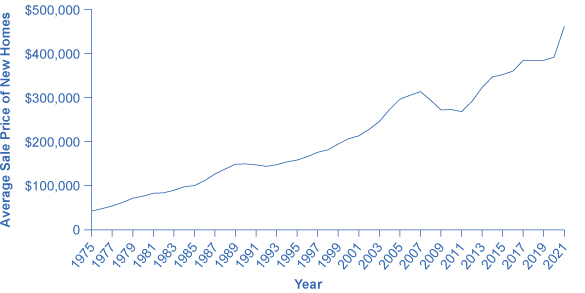

Figure 17.7図 17.7
The median price is the price where half of sales prices are higher and half are lower. The median sales price for a new one-family home was $122,900 in 1990. It rose as high as $248,000 in 2007, before falling to $232,000 in 2008. In 2015, the median sales price was $294,000. Of course, this national figure conceals many local differences, like the areas where housing prices are higher or lower, or how housing prices have risen or fallen at certain times. (Source: U.S. Census)
英語のヒント
中央値は、販売価格の半数がそれより高く、半数が低い価格である。新築一戸建て住宅の中央値は1990年に12万2900ドルだった。2007年には24万8000ドルまで上がり、2008年には23万2000ドルへ下がった。2015年は29万4000ドルだった。この全国値には、住宅価格の高い・低い地域や、特定の時期の上昇・下落など、多くの地域差が隠れている。(出典:米国国勢調査)
Investors can also put money into other tangible assets such as gold, silver, and other precious metals, or in duller commodities like sugar, cocoa, coffee, orange juice, oil, and natural gas. The return on these investments derives from the saver’s hope of buying low, selling high, and receiving a capital gain. Investing in, say, gold or coffee offers relatively little in the way of nonfinancial benefits to the user (unless the investor likes to caress gold or gaze upon a warehouse full of coffee). Typically, investors in these commodities never even see the physical good. Instead, they sign a contract that takes ownership of a certain quantity of these commodities, which are stored in a warehouse, and later they sell the ownership to someone else. As one example, from 1981 to 2005, the gold prices generally fluctuated between about $300 and $500 per ounce, but then rose sharply to over $1,100 per ounce by early 2010. In January 2017, prices were hovering around $1,191 per ounce, and they have since increased, reaching over $1,900 by early 2022.
英語のヒント
投資家は、金、銀、その他の貴金属、あるいは砂糖、ココア、コーヒー、オレンジジュース、石油、天然ガスといった地味な商品にも資金を投じられる。こうした投資の収益は、安く買い、高く売り、キャピタルゲインを得るという期待から生じる。たとえば金やコーヒーへの投資が利用者にもたらす非金銭的便益は比較的小さい(投資家が金をなでたり、コーヒーでいっぱいの倉庫を眺めたりするのが好きでない限り)。通常、こうした商品の投資家は実物を見ることさえない。倉庫に保管された一定量の商品の所有権を得る契約を結び、後にその所有権を他人に売る。一例として、金価格は1981年から2005年まで通常1オンス約300〜500ドルで変動したが、2010年初めには1100ドル超へ急上昇した。2017年1月には1191ドル前後で推移し、その後さらに上がり、2022年初めには1900ドルを超えた。
A final area of tangible assets consists of “collectibles” like paintings, fine wine, jewelry, antiques, or even baseball cards. Most collectibles provide returns both in the form of services or of a potentially higher selling price in the future. You can use paintings by hanging them on the wall; jewelry by wearing it; baseball cards by displaying them. You can also hope to sell them someday for more than you paid for them. However, the evidence on prices of collectibles, while scanty, is that while they may go through periods where prices skyrocket for a time, you should not expect to make a higher-than-average rate of return over a sustained period of time from investing in this way.
英語のヒント
有形資産の最後の分野は、絵画、高級ワイン、宝飾品、骨董品、さらには野球カードなどの「収集品」である。多くの収集品は、サービスと将来高値で売れる可能性の両方で収益を与える。絵画は壁に掛け、宝飾品は身に着け、野球カードは展示して利用できる。いつか購入価格以上で売ることも期待できる。しかし収集品の価格についての乏しい証拠によれば、一時的に価格が急騰することはあっても、この投資方法で長期にわたり平均を上回る収益率を得られるとは期待すべきでない。
The bottom line on investing in tangible assets: rate of return—moderate, especially if you can receive nonfinancial benefits from, for example, living in the house; risk—moderate for housing or high if you buy gold or baseball cards; liquidity—low, because it often takes considerable time and energy to sell a house or a piece of fine art and turn your capital gain into cash. The next Clear It Up feature explains the issues in the recent U.S. housing market crisis.
英語のヒント
有形資産への投資をまとめると、収益率は、特に家に住むなどの非金銭的便益を得られるなら中程度。リスクは住宅なら中程度、金や野球カードなら高い。家や美術品を売ってキャピタルゲインを現金に変えるには、相当な時間と労力がかかることが多いため、流動性は低い。次の「疑問を解く」では、近年の米国住宅市場危機の問題を説明する。