第24章総需要・総供給モデル
The Aggregate Demand Curve総需要曲線
Aggregate demand (AD) refers to the amount of total spending on domestic goods and services in an economy. (Strictly speaking, AD is what economists call total planned expenditure. We will further explain this distinction in the appendix The Expenditure-Output Model . For now, just think of aggregate demand as total spending.) It includes all four components of demand: consumption, investment, government spending, and net exports (exports minus imports). This demand is determined by a number of factors, but one of them is the price level—recall though, that the price level is an index number such as the GDP deflator that measures the average price of the things we buy. The aggregate demand (AD) curve shows the total spending on domestic goods and services at each price level.
英語のヒント
総需要(AD)とは、経済における国内の財とサービスへの総支出額を指す。(厳密には、ADは経済学者が総計画支出と呼ぶものである。この区別は付録「支出・生産モデル」でさらに説明する。今は総需要を総支出と考えればよい。)需要を構成する、消費、投資、政府支出、純輸出(輸出から輸入を引いた額)の四つをすべて含む。この需要は複数の要因で決まるが、その一つは物価水準である。ただし、物価水準はGDPデフレーターのように、私たちが買うものの平均価格を測る指数であることを思い出そう。総需要(AD)曲線は、各物価水準での国内の財とサービスへの総支出を示す。
Figure 24.4 presents an aggregate demand (AD) curve. Just like the aggregate supply curve, the horizontal axis shows real GDP and the vertical axis shows the price level. The AD curve slopes down, which means that increases in the price level of outputs lead to a lower quantity of total spending. The reasons behind this shape are related to how changes in the price level affect the different components of aggregate demand. The following components comprise aggregate demand: consumption spending (C), investment spending (I), government spending (G), and spending on exports (X) minus imports (M): C + I + G + X – M.
英語のヒント
図24.4は総需要(AD)曲線を示す。総供給曲線と同様、横軸は実質GDP、縦軸は物価水準である。AD曲線は右下がりであり、生産物の物価水準が上がると総支出量が減ることを意味する。この形の理由は、物価水準の変化が総需要の各構成部分にどう影響するかに関係する。総需要を構成するのは、消費支出(C)、投資支出(I)、政府支出(G)、輸出(X)から輸入(M)を引いた支出である。すなわち、C + I + G + X − Mとなる。
The Aggregate Demand Curve総需要曲線
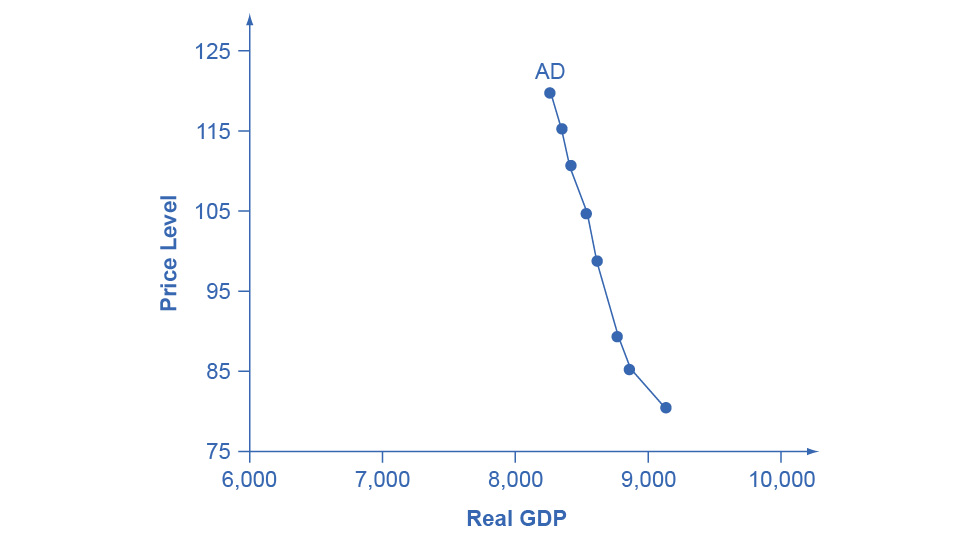

Figure 24.4図 24.4
Aggregate demand (AD) slopes down, showing that, as the price level rises, the amount of total spending on domestic goods and services declines.
英語のヒント
総需要(AD)は右下がりで、物価水準が上がるにつれて国内の財とサービスへの総支出額が減ることを示す。
The wealth effect holds that as the price level increases, the buying power of savings that people have stored up in bank accounts and other assets will diminish, eaten away to some extent by inflation. Because a rise in the price level reduces people’s wealth, consumption spending will fall as the price level rises.
英語のヒント
資産効果とは、物価水準が上がるにつれて、銀行口座やその他の資産に蓄えてきた貯蓄の購買力が、インフレにある程度侵食されて減ることである。物価水準の上昇は人々の富を減らすため、物価水準が上がるにつれて消費支出は減る。
The interest rate effect is that as prices for outputs rise, the same purchases will take more money or credit to accomplish. This additional demand for money and credit will push interest rates higher. In turn, higher interest rates will reduce borrowing by businesses for investment purposes and reduce borrowing by households for homes and cars—thus reducing consumption and investment spending.
英語のヒント
利子率効果とは、生産物の価格が上がると、同じ購入により多くのお金や信用が必要になることである。この貨幣と信用への追加需要が、利子率を押し上げる。その結果、高い利子率は企業の投資目的の借入を減らし、家計の住宅や自動車のための借入も減らし、消費支出と投資支出を減らす。
The foreign price effect points out that if prices rise in the United States while remaining fixed in other countries, then goods in the United States will be relatively more expensive compared to goods in the rest of the world. U.S. exports will be relatively more expensive, and the quantity of exports sold will fall. U.S. imports from abroad will be relatively cheaper, so the quantity of imports will rise. Thus, a higher domestic price level, relative to price levels in other countries, will reduce net export expenditures.
英語のヒント
外国価格効果は、他国の価格が一定のまま米国の価格が上がれば、世界の他の地域の財に比べ、米国の財が相対的に高価になることを指摘する。米国の輸出品は相対的に高くなり、輸出の販売量は減る。海外からの米国の輸入品は相対的に安くなるため、輸入量は増える。したがって、他国の物価水準に比べて国内の物価水準が高まると、純輸出支出は減る。
Among economists all three of these effects are controversial, in part because they do not seem to be very large. For this reason, the aggregate demand curve in Figure 24.4 slopes downward fairly steeply. The steep slope indicates that a higher price level for final outputs reduces aggregate demand for all three of these reasons, but that the change in the quantity of aggregate demand as a result of changes in price level is not very large.
英語のヒント
経済学者の間では、これら三つの効果はいずれも議論がある。その理由の一部は、効果があまり大きくないように見えることにある。そのため、図24.4の総需要曲線はかなり急な右下がりになっている。その急な傾きは、最終生産物の物価水準の上昇が、これら三つの理由すべてによって総需要を減らすが、物価水準の変化による総需要量の変化はあまり大きくないことを示す。
Read the following Work It Out feature to learn how to interpret the AD/AS model. In this example, aggregate supply, aggregate demand, and the price level are given for the imaginary country of Xurbia.
英語のヒント
AD/ASモデルの読み取り方を学ぶため、次の「計算してみよう」を読もう。この例では、架空の国ザービアの総供給、総需要、物価水準が与えられている。