第24章総需要・総供給モデル
24.6 Keynes’ Law and Say’s Law in the AD/AS Model24.6 AD/ASモデルにおけるケインズの法則とセイの法則
Learning Objectives学習目標
Learning Objectives学習目標
By the end of this section, you will be able to:
英語のヒント
この節を学ぶと、次のことができるようになる。
- Identify the neoclassical zone, the intermediate zone, and the Keynesian zone in the aggregate demand/aggregate supply model
英語のヒント
総需要・総供給モデルで、新古典派領域、中間領域、ケインズ派領域を特定する - Use an aggregate demand/aggregate supply model as a diagnostic test to understand the current state of the economy
英語のヒント
総需要・総供給モデルを、経済の現状を理解する診断検査として使う
We can use the AD/AS model to illustrate both Say’s law that supply creates its own demand and Keynes’ law that demand creates its own supply. Consider the SRAS curve's three zones which Figure 24.11 identifies: the Keynesian zone, the neoclassical zone, and the intermediate zone.
英語のヒント
AD/ASモデルを使うと、供給はそれ自らの需要を生み出すというセイの法則も、需要はそれ自らの供給を生み出すというケインズの法則も示せる。図24.11が示すSRAS曲線の三つの領域、ケインズ派領域、新古典派領域、中間領域を考えよう。
Keynes, Neoclassical, and Intermediate Zones in the Aggregate Supply Curve総供給曲線のケインズ派領域、新古典派領域、中間領域
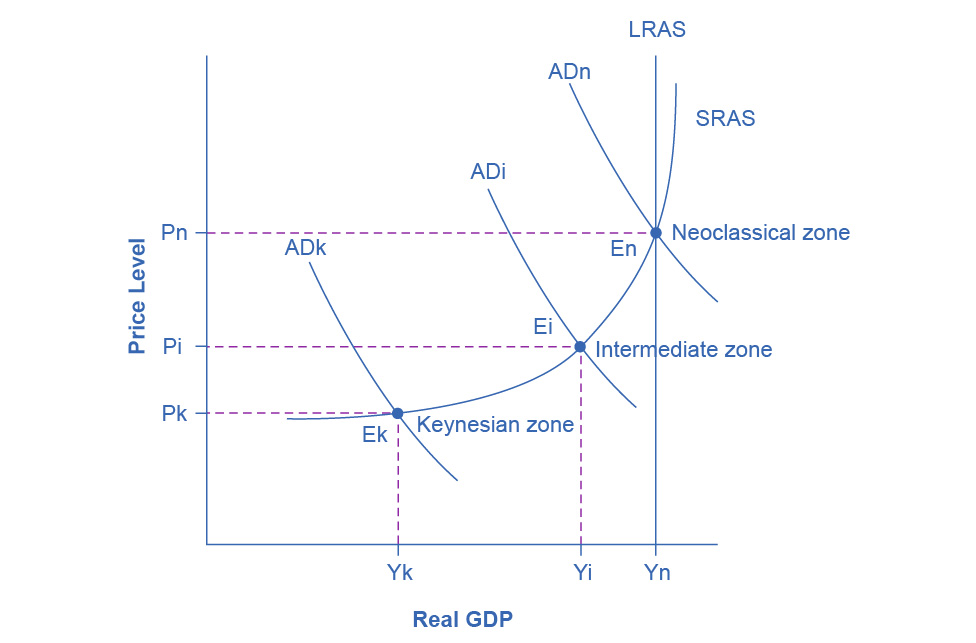

Figure 24.11図 24.11
Near the equilibrium Ek, in the Keynesian zone at the far left of the SRAS curve, small shifts in AD, either to the right or the left, will affect the output level Yk, but will not much affect the price level. In the Keynesian zone, AD largely determines the quantity of output. Near the equilibrium En, in the neoclassical zone at the SRAS curve's far right, small shifts in AD, either to the right or the left, will have relatively little effect on the output level Yn, but instead will have a greater effect on the price level. In the neoclassical zone, the near-vertical SRAS curve close to the level of potential GDP largely determines the quantity of output. In the intermediate zone around equilibrium Ei, movement in AD to the right will increase both the output level and the price level, while a movement in AD to the left would decrease both the output level and the price level.
英語のヒント
SRAS曲線の左端にあるケインズ派領域の均衡Ek付近では、ADが右または左へ少しシフトすると、生産水準Ykは変わるが、物価水準はあまり変わらない。ケインズ派領域では、生産量は主にADで決まる。SRAS曲線の右端にある新古典派領域の均衡En付近では、ADが右または左へ少しシフトしても、生産水準Ynへの効果は比較的小さく、物価水準への効果の方が大きい。新古典派領域では、潜在GDP水準の近くにあるほぼ垂直なSRAS曲線が、主に生産量を決める。均衡Ei周辺の中間領域では、ADの右方移動は生産水準と物価水準の両方を上げ、左方移動は両方を下げる。
Focus first on the Keynesian zone, that portion of the SRAS curve on the far left which is relatively flat. If the AD curve crosses this portion of the SRAS curve at an equilibrium point like Ek, then certain statements about the economic situation will follow. In the Keynesian zone, the equilibrium level of real GDP is far below potential GDP, the economy is in recession, and cyclical unemployment is high. If aggregate demand shifted to the right or left in the Keynesian zone, it will determine the resulting level of output (and thus unemployment). However, inflationary price pressure is not much of a worry in the Keynesian zone, since the price level does not vary much in this zone.
英語のヒント
まずケインズ派領域、すなわちSRAS曲線の左端の比較的平坦な部分に注目しよう。AD曲線がSRAS曲線のこの部分で、Ekのような均衡点で交わるなら、経済状況についていくつかのことが言える。ケインズ派領域では、実質GDPの均衡水準は潜在GDPを大きく下回り、経済は景気後退中で、循環的失業が多い。ケインズ派領域で総需要が右または左へシフトすると、その結果の生産水準、したがって失業が決まる。しかし、この領域では物価水準があまり変わらないため、インフレ的な価格圧力は大きな心配ではない。
Now, focus your attention on the neoclassical zone of the SRAS curve, which is the near-vertical portion on the right-hand side. If the AD curve crosses this portion of the SRAS curve at an equilibrium point like En where output is at or near potential GDP, then the size of potential GDP pretty much determines the level of output in the economy. Since the equilibrium is near potential GDP, cyclical unemployment is low in this economy, although structural unemployment may remain an issue. In the neoclassical zone, shifts of aggregate demand to the right or the left have little effect on the level of output or employment. The only way to increase the size of the real GDP in the neoclassical zone is for AS to shift to the right. However, shifts in AD in the neoclassical zone will create pressures to change the price level.
英語のヒント
次に、SRAS曲線の新古典派領域、すなわち右側のほぼ垂直な部分に注目しよう。AD曲線がSRAS曲線のこの部分で、生産が潜在GDPまたはその近くにあるEnのような均衡点で交わるなら、経済の生産水準はほぼ潜在GDPの大きさで決まる。均衡が潜在GDPに近いので、この経済では循環的失業は少ないが、構造的失業が問題として残ることはある。新古典派領域では、総需要の右または左へのシフトは、生産や雇用の水準にほとんど影響しない。新古典派領域で実質GDPを増やす唯一の方法は、ASが右へシフトすることである。しかし、新古典派領域でADがシフトすると、物価水準を変える圧力が生まれる。
Finally, consider the SRAS curve's intermediate zone in Figure 24.11. If the AD curve crosses this portion of the SRAS curve at an equilibrium point like Ei, then we might expect unemployment and inflation to move in opposing directions. For instance, a shift of AD to the right will move output closer to potential GDP and thus reduce unemployment, but will also lead to a higher price level and upward pressure on inflation. Conversely, a shift of AD to the left will move output further from potential GDP and raise unemployment, but will also lead to a lower price level and downward pressure on inflation.
英語のヒント
最後に、図24.11のSRAS曲線の中間領域を考えよう。AD曲線がSRAS曲線のこの部分で、Eiのような均衡点で交わるなら、失業とインフレは反対方向に動くと予想できる。例えばADの右方シフトは、生産を潜在GDPへ近づけ、失業を減らすが、物価水準も上げ、インフレに上昇圧力をかける。反対に、ADの左方シフトは、生産を潜在GDPから遠ざけ、失業を増やすが、物価水準も下げ、インフレに低下圧力をかける。
This approach of dividing the SRAS curve into different zones works as a diagnostic test that we can apply to an economy, like a doctor checking a patient for symptoms. First, figure out in what zone the economy is. This will clarify the economic issues, tradeoffs, and policy choices. Some economists believe that the economy is strongly predisposed to be in one zone or another. Thus, hard-line Keynesian economists believe that the economies are in the Keynesian zone most of the time, and so they view the neoclassical zone as a theoretical abstraction. Conversely, hard-line neoclassical economists argue that economies are in the neoclassical zone most of the time and that the Keynesian zone is a distraction. The Keynesian Perspective and The Neoclassical Perspective should help to clarify the underpinnings and consequences of these contrasting views of the macroeconomy.
英語のヒント
SRAS曲線を異なる領域に分けるこの方法は、医師が患者の症状を調べるように、経済に適用できる診断検査として働く。まず、経済がどの領域にあるかを見極める。これによって、経済の課題、トレードオフ、政策の選択が明確になる。経済は特定の領域にある強い傾向を持つと考える経済学者もいる。そのため、強硬なケインズ派の経済学者は、経済はほとんどの時間ケインズ派領域にあると考え、新古典派領域を理論上の抽象とみなす。反対に、強硬な新古典派の経済学者は、経済はほとんどの時間新古典派領域にあり、ケインズ派領域は注意をそらすものだと主張する。「ケインズ派の見方」と「新古典派の見方」は、マクロ経済に対するこれらの対照的な見方の基礎と帰結を明らかにする助けとなるだろう。