第31章土壌と植物の栄養
31.3 Nutritional Adaptations of Plants31.3 植物の栄養に関する適応
Learning Objectives学習目標
By the end of this section, you will be able to do the following:
この節を学ぶと、次のことができるようになる。
- Understand the nutritional adaptations of plants植物の栄養に関する適応を理解する。
- Describe mycorrhizae菌根を説明する。
- Explain nitrogen fixation窒素固定を説明する。
Plants obtain food in two different ways. Autotrophic plants can make their own food from inorganic raw materials, such as carbon dioxide and water, through photosynthesis in the presence of sunlight. Green plants are included in this group. Some plants, however, are heterotrophic: they are totally parasitic and lacking in chlorophyll. These plants, referred to as holo-parasitic plants, are unable to synthesize organic carbon and draw all of their nutrients from the host plant.
英語のヒント
植物は、二つの異なる方法で食物を得る。独立栄養植物は、太陽光があるとき、二酸化炭素や水などの無機原料から光合成によって自ら食物を作ることができる。緑色植物はこの群に含まれる。しかし、一部の植物は従属栄養であり、完全に寄生生活を送り、クロロフィルを欠いている。全寄生植物と呼ばれるこれらの植物は、有機炭素を合成できず、すべての栄養分を宿主植物から得る。
Plants may also enlist the help of microbial partners in nutrient acquisition. Particular species of bacteria and fungi have evolved along with certain plants to create a mutualistic symbiotic relationship with roots. This improves the nutrition of both the plant and the microbe. The formation of nodules in legume plants and mycorrhization can be considered among the nutritional adaptations of plants. However, these are not the only type of adaptations that we may find; many plants have other adaptations that allow them to thrive under specific conditions.
英語のヒント
植物は、栄養分を得る際に微生物の相手の助けを借りることもある。特定の細菌や菌類の種は、特定の植物とともに進化し、その根と相利共生関係を築いてきた。これによって、植物と微生物の両方の栄養状態が改善される。マメ科植物の根粒形成や菌根の形成は、植物の栄養に関する適応に数えられる。しかし、適応はこれだけではない。多くの植物は、特定の条件下でよく育つための、ほかの適応も備えている。
Nitrogen Fixation: Root and Bacteria Interactions窒素固定:根と細菌の相互作用
Nitrogen is an important macronutrient because it is part of nucleic acids and proteins. Atmospheric nitrogen, which is the diatomic molecule N2, or dinitrogen, is the largest pool of nitrogen in terrestrial ecosystems. However, plants cannot take advantage of this nitrogen because they do not have the necessary enzymes to convert it into biologically useful forms. However, nitrogen can be “fixed,” which means that it can be converted to ammonia (NH3) through biological, physical, or chemical processes. As you have learned, biological nitrogen fixation (BNF) is the conversion of atmospheric nitrogen (N2) into ammonia (NH3), exclusively carried out by prokaryotes such as soil bacteria or cyanobacteria. Biological processes contribute 65 percent of the nitrogen used in agriculture. The following equation represents the process:
窒素は、核酸やタンパク質の一部となる重要な多量必須元素である。大気中の窒素は、二原子分子N2,、すなわち二窒素として存在し、陸上生態系で最大の窒素の貯蔵庫となっている。しかし植物は、それを生物学的に利用できる形へ変えるのに必要な酵素をもたないため、この窒素を活用できない。ただし、窒素は「固定」できる。これは、生物的、物理的、化学的な過程を通して、アンモニア(NH3)へ変換できるという意味である。すでに学んだように、生物的窒素固定(BNF)とは、大気中の窒素(N2)をアンモニア(NH3)へ変換することで、土壌細菌やシアノバクテリアなどの原核生物だけが行う。農業で使われる窒素の65%は、生物的な過程によって供給される。次の式はその過程を表す。
The most important source of BNF is the symbiotic interaction between soil bacteria and legume plants, including many crops important to humans (Figure 31.10). The NH3 resulting from fixation can be transported into plant tissue and incorporated into amino acids, which are then made into plant proteins. Some legume seeds, such as soybeans and peanuts, contain high levels of protein, and serve among the most important agricultural sources of protein in the world.
BNFのもっとも重要な供給源は、土壌細菌とマメ科植物の共生的な相互作用である。マメ科には、人間にとって重要な多くの作物が含まれる(図31.10)。固定によって生じたNH3は植物組織へ運ばれ、アミノ酸に組み込まれてから、植物のタンパク質になる。ダイズやラッカセイなど、一部のマメ科植物の種子はタンパク質を多く含み、世界でもっとも重要な農業由来のタンパク質源の一つとなっている。
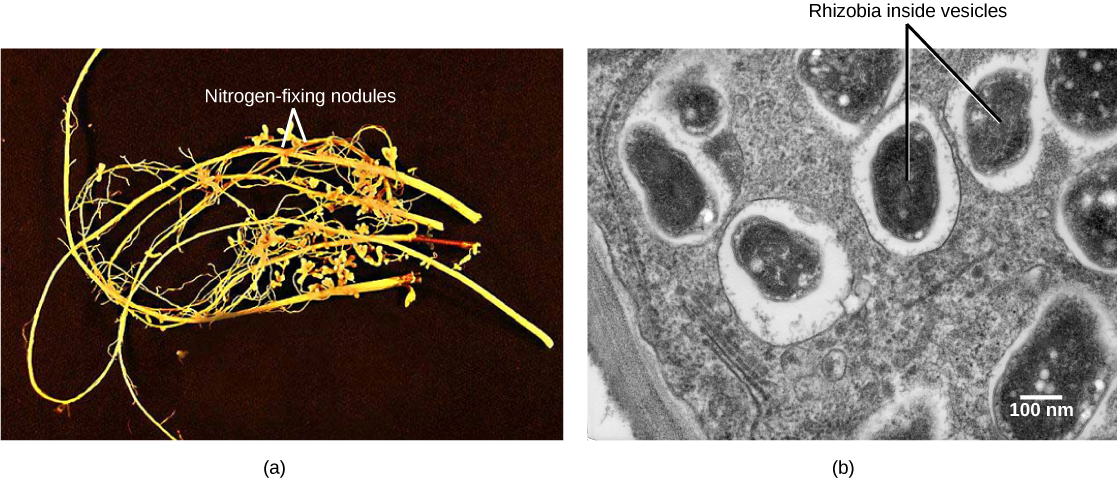
Soil bacteria, collectively called rhizobia, symbiotically interact with legume roots to form specialized structures called nodules, in which nitrogen fixation takes place. This process entails the reduction of atmospheric nitrogen to ammonia, by means of the enzyme nitrogenase. Therefore, using rhizobia is a natural and environmentally friendly way to fertilize plants, as opposed to chemical fertilization that uses a nonrenewable resource, such as natural gas. Through symbiotic nitrogen fixation, the plant benefits from using an endless source of nitrogen from the atmosphere. The process simultaneously contributes to soil fertility because the plant root system leaves behind some of the biologically available nitrogen. As in any symbiosis, both organisms benefit from the interaction: the plant obtains ammonia, and bacteria obtain carbon compounds generated through photosynthesis, as well as a protected niche in which to grow (Figure 31.11).
英語のヒント
根粒菌と総称される土壌細菌は、マメ科植物の根と共生的に相互作用して、根粒という特殊な構造を作る。窒素固定はその中で起こる。この過程では、ニトロゲナーゼという酵素によって、大気中の窒素がアンモニアへ還元される。天然ガスのような再生不可能な資源を使う化学的な施肥に対し、根粒菌を使うことは、植物へ肥料を供給する自然で環境に優しい方法である。共生的窒素固定によって、植物は大気中の尽きることのない窒素源を利用できる。また、植物の根系が、生物の利用できる窒素を一部残すため、この過程は土壌の肥沃度にも寄与する。ほかの共生と同じく、両者が相互作用から利益を得る。植物はアンモニアを得て、細菌は光合成で作られた炭素化合物と、保護された生育場所を得る(図31.11)。
OpenStax, Rice University; Biology 2e. (credit a: modification of work by USDA; credit b: modification of work by Louisa Howard, Dartmouth Electron Microscope Facility; scale-bar data from Matt Russell) · CC BY 4.0 · Source出典

Figure 31.11図 31.11
Soybean roots contain (a) nitrogen-fixing nodules. Cells within the nodules are infected with Bradyrhyzobium japonicum, a rhizobia or “root-loving” bacterium. The bacteria are encased in (b) vesicles inside the cell, as can be seen in this transmission electron micrograph. (credit a: modification of work by USDA; credit b: modification of work by Louisa Howard, Dartmouth Electron Microscope Facility; scale-bar data from Matt Russell)
ダイズの根には、(a)窒素固定を行う根粒がある。根粒内の細胞には、根粒菌、すなわち「根を好む」細菌である Bradyrhyzobium japonicum が感染している。この透過型電子顕微鏡像に見られるように、細菌は細胞内の(b)小胞に包まれている。(クレジットa:USDAの作品を改変;b:Louisa Howard, Dartmouth Electron Microscope Facilityの作品を改変;スケールバーのデータ:Matt Russell)