第31章土壌と植物の栄養
31.1 Nutritional Requirements of Plants31.1 植物の栄養要求
Learning Objectives学習目標
By the end of this section, you will be able to do the following:
この節を学ぶと、次のことができるようになる。
- Describe how plants obtain nutrients植物が栄養分を得る方法を述べる。
- List the elements and compounds required for proper plant nutrition植物の適切な栄養に必要な元素と化合物を挙げる。
- Describe an essential nutrient必須栄養素とは何かを述べる。
Plants are unique organisms that can absorb nutrients and water through their root system, as well as carbon dioxide from the atmosphere. Soil quality and climate are the major determinants of plant distribution and growth. The combination of soil nutrients, water, and carbon dioxide, along with sunlight, allows plants to grow.
植物は、根系を通じて栄養分と水を吸収し、大気からは二酸化炭素を取り込むことができる独特な生物である。土壌の質と気候は、植物の分布と成長を決める主な要因である。土壌の栄養分、水、二酸化炭素に太陽光が組み合わさることで、植物は成長できる。
The Chemical Composition of Plants植物の化学組成
Since plants require nutrients in the form of elements such as carbon and potassium, it is important to understand the chemical composition of plants. The majority of volume in a plant cell is water; it typically comprises 80 to 90 percent of the plant’s total weight. Soil is the water source for land plants, and can be an abundant source of water, even if it appears dry. Plant roots absorb water from the soil through root hairs and transport it up to the leaves through the xylem. As water vapor is lost from the leaves, the process of transpiration and the polarity of water molecules (which enables them to form hydrogen bonds) draws more water from the roots up through the plant to the leaves (Figure 31.2). Plants need water to support cell structure, for metabolic functions, to carry nutrients, and for photosynthesis.
英語のヒント
植物は炭素やカリウムなどの元素として栄養分を必要とするので、その化学組成を理解することが重要である。植物細胞の体積の大部分は水であり、通常、水は植物の総重量の80~90%を占める。土壌は陸上植物の水源であり、見た目が乾いていても、豊富な水を供給できることがある。植物の根は根毛を通して土壌から水を吸収し、木部を通して葉まで運ぶ。葉から水蒸気が失われると、蒸散の過程と、水分子が水素結合を形成できるもととなる極性によって、さらに水が根から植物体内を上昇して葉へ引き上げられる(図31.2)。植物は、細胞構造の維持、代謝機能、栄養分の輸送、光合成のために水を必要とする。
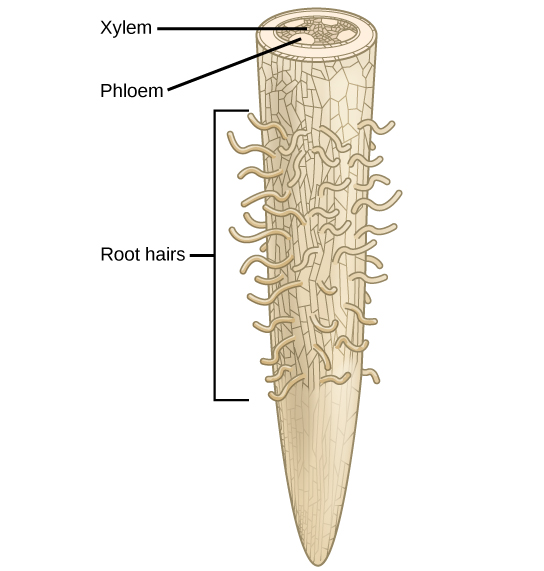
Figure 31.2図 31.2
Water is absorbed through the root hairs and moves up the xylem to the leaves.
水は根毛を通して吸収され、木部を上昇して葉へ移動する。
Plant cells need essential substances, collectively called nutrients, to sustain life. Plant nutrients may be composed of either organic or inorganic compounds. An organic compound is a chemical compound that contains carbon, such as carbohydrates, lipids, proteins, and nucleic acids and is made by a living organism. Carbon that was obtained from atmospheric CO2 is incorporated into organic molecules by plants and as such, composes the majority of the dry mass within most plants. An inorganic compound does not contain carbon (except CO2) and is not part of, or produced by, a living organism. Inorganic substances, which form the majority of the soil solution, are commonly called minerals: those required by plants include nitrogen (N) and potassium (K) for structure and regulation.
植物細胞が生命を維持するには、総称して栄養素と呼ばれる必須の物質が必要である。植物の栄養素は、有機化合物または無機化合物からなる。有機化合物は、炭水化物、脂質、タンパク質、核酸など、炭素を含み、生物によって作られる化合物である。大気中のCO2から得られた炭素は、植物によって有機分子へ組み込まれ、そのような形で多くの植物の乾燥質量の大部分を占める。無機化合物は、CO2を除いて炭素を含まず、生物の一部でも、生物が作り出すものでもない。土壌溶液の大部分を構成する無機物は、一般に無機栄養分と呼ばれる。植物が必要とするものには、構造や調節に関わる窒素(N)やカリウム(K)が含まれる。
Essential Nutrients必須栄養素
Plants require only light, water, and about 20 elements to support all their biochemical needs: these 20 elements are called essential nutrients (Table 31.1). For an element to be regarded as essential, three criteria are required: 1) a plant cannot complete its life cycle without the element; 2) no other element can perform the function of the element; and 3) the element is directly involved in plant nutrition.
英語のヒント
植物は、光、水、約20種類の元素だけで、生化学上の必要をすべて満たすことができる。この20種類の元素を必須栄養素という(表31.1)。ある元素を必須とみなすには、三つの基準を満たす必要がある。すなわち、1)その元素がなければ植物は生活環を完結できないこと、2)ほかの元素ではその機能を代替できないこと、3)その元素が植物の栄養に直接関与していることである。
Essential Elements for Plant Growth 植物の成長に必須の元素 |
|
|---|---|
Macronutrients 多量必須元素 |
Micronutrients 微量必須元素 |
Carbon (C) 炭素(C) |
Iron (Fe) 鉄(Fe) |
Hydrogen (H) 水素(H) |
Manganese (Mn) マンガン(Mn) |
Oxygen (O) 酸素(O) |
Boron (B) ホウ素(B) |
Nitrogen (N) 窒素(N) |
Molybdenum (Mo) モリブデン(Mo) |
Phosphorus (P) リン(P) |
Copper (Cu) 銅(Cu) |
Potassium (K) カリウム(K) |
Zinc (Zn) 亜鉛(Zn) |
Calcium (Ca) カルシウム(Ca) |
Chlorine (Cl) 塩素(Cl) |
Magnesium (Mg) マグネシウム(Mg) |
Nickel (Ni) ニッケル(Ni) |
Sulfur (S) 硫黄(S) |
Cobalt (Co) コバルト(Co) |
Sodium (Na) ナトリウム(Na) |
|
Silicon (Si) ケイ素(Si) |
|
Macronutrients and Micronutrients多量必須元素と微量必須元素
The essential elements can be divided into two groups: macronutrients and micronutrients. Nutrients that plants require in larger amounts are called macronutrients. About half of the essential elements are considered macronutrients: carbon, hydrogen, oxygen, nitrogen, phosphorus, potassium, calcium, magnesium and sulfur. The first of these macronutrients, carbon (C), is required to form carbohydrates, proteins, nucleic acids, and many other compounds; it is therefore present in all macromolecules. On average, the dry weight (excluding water) of a cell is 45 percent carbon. As shown in Figure 31.3, carbon is a key part of plant biomolecules, followed by oxygen (45 percent) and hydrogen (6 percent), which are the next two most abundant elements in plants.
必須元素は、多量必須元素と微量必須元素の二つの群に分けられる。植物が比較的多く必要とする栄養素を多量必須元素という。必須元素の約半数、すなわち炭素、水素、酸素、窒素、リン、カリウム、カルシウム、マグネシウム、硫黄がこれに当たる。最初に挙げた炭素(C)は、炭水化物、タンパク質、核酸、その他多くの化合物の形成に必要であり、そのためすべての高分子に含まれる。平均すると、細胞の乾燥重量(水を除いた重量)の45%を炭素が占める。図31.3に示すように、炭素は植物の生体分子の主要な構成要素であり、それに続いて植物中に多い元素が酸素(45%)と水素(6%)である。
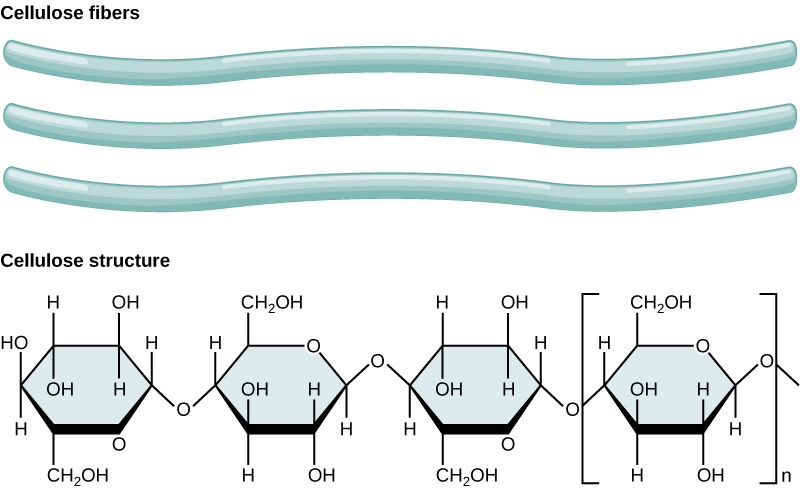


Figure 31.3図 31.3
Cellulose, the main structural component of the plant cell wall, makes up over thirty percent of plant matter. It is the most abundant organic compound on earth.
植物細胞壁の主な構造成分であるセルロースは、植物体の物質の30%以上を占める。地球上でもっとも豊富な有機化合物である。
The third most abundant element in plant cells is nitrogen (N); it is part of proteins and nucleic acids. Nitrogen is also used in the synthesis of some vitamins. In addition to being macronutrients that are part of many organic compounds, hydrogen and oxygen also form water. Oxygen is necessary for cellular respiration; plants use oxygen to store energy in the form of ATP. Phosphorus (P), another macromolecule, is necessary to synthesize nucleic acids and phospholipids. As part of ATP, phosphorus enables food energy to be converted into chemical energy through oxidative phosphorylation. Likewise, light energy is converted into chemical energy during photophosphorylation in photosynthesis, and into chemical energy to be extracted during respiration. Sulfur is part of certain amino acids, such as cysteine and methionine, and is present in several coenzymes. Sulfur also plays a role in photosynthesis as part of the electron transport chain, where hydrogen gradients play a key role in the conversion of light energy into ATP. Potassium (K) is important because of its role in regulating stomatal opening and closing. As the openings for gas exchange, stomata help maintain a healthy water balance; a potassium ion pump supports this process.
植物細胞で3番目に多い元素は窒素(N)であり、タンパク質と核酸の構成要素となる。また、一部のビタミンの合成にも使われる。水素と酸素は、多くの有機化合物を構成する多量必須元素であるとともに、水も形成する。酸素は細胞呼吸に必要で、植物は酸素を使ってATPの形でエネルギーを蓄える。別の高分子であるリン(P)は、核酸とリン脂質の合成に必要である。ATPの一部となるリンは、酸化的リン酸化を通じて食物のエネルギーを化学エネルギーへ変換できるようにする。同様に、光エネルギーは光合成の光リン酸化で化学エネルギーへ変換され、呼吸時に取り出される化学エネルギーとなる。硫黄はシステインやメチオニンなど特定のアミノ酸の一部であり、いくつかの補酵素にも含まれる。また、電子伝達系の一部として光合成にも関わる。この系では、水素の勾配が光エネルギーをATPに変換するうえで重要な役割を果たす。カリウム(K)は、気孔の開閉を調節する役割をもつため重要である。気孔はガス交換の開口部として、適切な水分バランスの維持を助ける。カリウムイオンのポンプがこの過程を支えている。
Magnesium (Mg) and calcium (Ca) are also important macronutrients. The role of calcium is twofold: to regulate nutrient transport, and to support many enzyme functions. Magnesium is important to the photosynthetic process. These minerals, along with the micronutrients, which are described below, also contribute to the plant’s ionic balance.
マグネシウム(Mg)とカルシウム(Ca)も、重要な多量必須元素である。カルシウムの役割は二つあり、栄養分の輸送を調節することと、多くの酵素の機能を支えることである。マグネシウムは光合成の過程にとって重要である。これらの無機栄養分は、後述の微量必須元素とともに、植物のイオンバランスにも寄与する。
In addition to macronutrients, organisms require various elements in small amounts. These micronutrients, or trace elements, are present in very small quantities. They include boron (B), chlorine (Cl), manganese (Mn), iron (Fe), zinc (Zn), copper (Cu), molybdenum (Mo), nickel (Ni), silicon (Si), and sodium (Na).
生物は多量必須元素に加え、さまざまな元素を少量必要とする。これらの微量必須元素、すなわち微量元素は、ごくわずかな量で存在する。ホウ素(B)、塩素(Cl)、マンガン(Mn)、鉄(Fe)、亜鉛(Zn)、銅(Cu)、モリブデン(Mo)、ニッケル(Ni)、ケイ素(Si)、ナトリウム(Na)が含まれる。
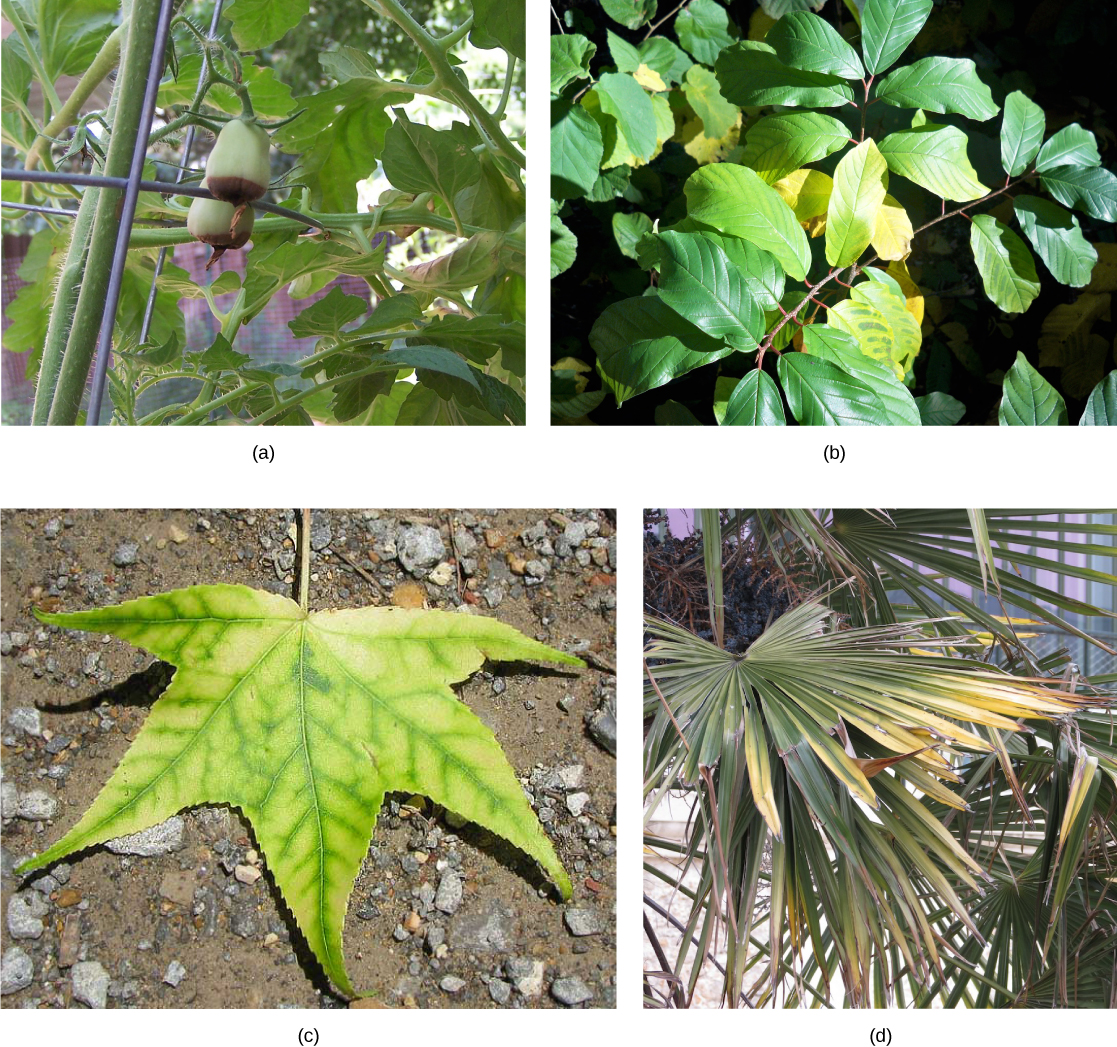
Deficiencies in any of these nutrients—particularly the macronutrients—can adversely affect plant growth (Figure 31.4); depending on the specific nutrient, a lack can cause stunted growth, slow growth, or chlorosis (yellowing of the leaves). Extreme deficiencies may result in leaves showing signs of cell death.
英語のヒント
これらの栄養素、とくに多量必須元素が不足すると、植物の成長に悪影響が出る可能性がある(図31.4)。どの栄養素が不足するかによって、成長の抑制、成長の遅れ、クロロシス(葉の黄化)が起こる。欠乏が著しい場合は、葉に細胞死の兆候が現れることもある。
OpenStax, Rice University; Biology 2e. (credit c: modification of work by Jim Conrad; credit d: modification of work by Malcolm Manners) · CC BY 4.0 · Source出典

Figure 31.4図 31.4
Nutrient deficiency is evident in the symptoms these plants show. This (a) grape tomato suffers from blossom end rot caused by calcium deficiency. The yellowing in this (b) Frangula alnus results from magnesium deficiency. Inadequate magnesium also leads to (c) interveinal chlorosis, seen here in a sweetgum leaf. This (d) palm is affected by potassium deficiency. (credit c: modification of work by Jim Conrad; credit d: modification of work by Malcolm Manners)
これらの植物の症状には、栄養素の欠乏がはっきり現れている。(a)このグレープトマトには、カルシウム欠乏による尻腐れが起きている。(b)このセイヨウイソノキ(Frangula alnus)の黄化は、マグネシウム欠乏による。マグネシウム不足は、(c)このモミジバフウの葉に見られるような葉脈間クロロシスも引き起こす。(d)このヤシはカリウム欠乏の影響を受けている。(クレジットc:Jim Conradの作品を改変;d:Malcolm Mannersの作品を改変)