第31章土壌と植物の栄養
Climate気候
Temperature, moisture, and wind cause different patterns of weathering and therefore affect soil characteristics. The presence of moisture and nutrients from weathering will also promote biological activity: a key component of a quality soil.
温度、水分、風は風化の起こり方を変え、土壌の性質に影響する。水分と、風化によって供給された栄養分があれば、良質な土壌の重要な要素である生物活動も促進される。
Topography地形
Regional surface features (familiarly called “the lay of the land”) can have a major influence on the characteristics and fertility of a soil. Topography affects water runoff, which strips away parent material and affects plant growth. Steeps soils are more prone to erosion and may be thinner than soils that are relatively flat or level.
地域の地表の特徴、一般に「土地の起伏」と呼ばれるものは、土壌の性質や肥沃度に大きな影響を与えることがある。地形は水の流出に影響し、流出水は母材を削り取って植物の成長に影響する。急斜面の土壌は侵食を受けやすく、比較的平坦な場所の土壌より薄いことがある。
Biological factors生物的要因
The presence of living organisms greatly affects soil formation and structure. Animals and microorganisms can produce pores and crevices, and plant roots can penetrate into crevices to produce more fragmentation. Plant secretions promote the development of microorganisms around the root, in an area known as the rhizosphere. Additionally, leaves and other material that fall from plants decompose and contribute to soil composition.
英語のヒント
生物の存在は、土壌の形成と構造に大きく影響する。動物や微生物は孔隙や割れ目を作り、植物の根がその割れ目へ入り込むと、さらに破砕が進む。植物の分泌物は、根圏と呼ばれる根の周囲の領域で微生物の発達を促す。また、植物から落ちた葉やその他の物質が分解され、土壌の組成に寄与する。
Time時間
Time is an important factor in soil formation because soils develop over long periods. Soil formation is a dynamic process. Materials are deposited over time, decompose, and transform into other materials that can be used by living organisms or deposited onto the surface of the soil.
土壌は長い時間をかけて発達するので、時間は土壌形成の重要な要因である。土壌形成は動的な過程である。物質は時間とともに堆積し、分解され、生物が利用できる別の物質や、土壌表面に堆積する別の物質へと変わる。
Physical Properties of the Soil土壌の物理的性質
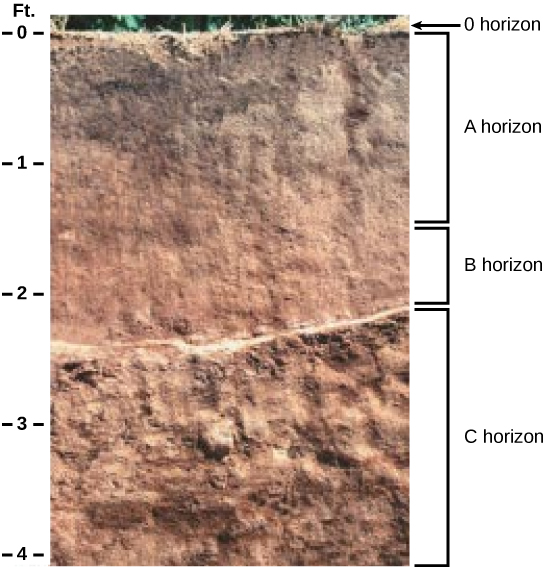
Soils are named and classified based on their horizons. The soil profile has four distinct layers: 1) O horizon; 2) A horizon; 3) B horizon, or subsoil; and 4) C horizon, or soil base (Figure 31.7). The O horizon has freshly decomposing organic matter—humus—at its surface, with decomposed vegetation at its base. Humus enriches the soil with nutrients and enhances soil moisture retention. Topsoil—the top layer of soil—is usually two to three inches deep, but this depth can vary considerably. For instance, river deltas like the Mississippi River delta have deep layers of topsoil. Topsoil is rich in organic material; microbial processes occur there, and it is the “workhorse” of plant production. The A horizon consists of a mixture of organic material with inorganic products of weathering, and it is therefore the beginning of true mineral soil. This horizon is typically darkly colored because of the presence of organic matter. In this area, rainwater percolates through the soil and carries materials from the surface. The B horizon is an accumulation of mostly fine material that has moved downward, resulting in a dense layer in the soil. In some soils, the B horizon contains nodules or a layer of calcium carbonate. The C horizon, or soil base, includes the parent material, plus the organic and inorganic material that is broken down to form soil. The parent material may be either created in its natural place, or transported from elsewhere to its present location. Beneath the C horizon lies bedrock.
英語のヒント
土壌は、その層位に基づいて命名・分類される。土壌断面には、1)O層、2)A層、3)B層(下層土)、4)C層(土壌基底)の四つの明瞭な層がある(図31.7)。O層の表面には、分解が始まったばかりの有機物である腐植があり、その下部には分解された植物体がある。腐植は土壌の栄養分を豊かにし、保水性を高める。最上部の土壌である表土は通常2~3インチの厚さだが、その厚さは大きく異なることがある。たとえばミシシッピ川のデルタのような河川デルタには、厚い表土層がある。表土は有機物に富み、微生物の過程が進む場所で、植物生産を支える「働き手」である。A層は、有機物と無機質の風化生成物が混ざったもので、ここから本来の鉱質土壌が始まる。有機物が存在するため、この層は通常暗い色をしている。この領域では、雨水が土壌へ浸透し、表面の物質を運ぶ。B層には、上から移動してきた主に細かい物質が蓄積し、土壌中に密な層を作る。土壌によっては、B層に炭酸カルシウムの結核や層が含まれる。C層、すなわち土壌基底には、母材と、分解されて土壌を作る有機物・無機物が含まれる。母材はもともとその場所で生じたものの場合も、別の場所から現在の場所へ運ばれたものの場合もある。C層の下には基盤岩がある。
Some soils may have additional layers, or lack one of these layers. The thickness of the layers is also variable, and depends on the factors that influence soil formation. In general, immature soils may have O, A, and C horizons, whereas mature soils may display all of these, plus additional layers (Figure 31.8).
さらに別の層をもつ土壌や、これらの層のいずれかを欠く土壌もある。層の厚さもさまざまで、土壌形成に影響する要因によって決まる。一般に、未成熟な土壌にはO層、A層、C層が見られ、成熟した土壌にはこれらすべてと、さらに追加の層が見られることがある(図31.8)。
OpenStax, Rice University; Biology 2e. (credit: modification of work by USDA) · CC BY 4.0 · Source出典

Figure 31.8図 31.8
The San Joaquin soil profile has an O horizon, A horizon, B horizon, and C horizon. (credit: modification of work by USDA)
サンホアキンの土壌断面には、O層、A層、B層、C層がある。(クレジット:USDAの作品を改変)