第33章国際貿易
Key Concepts and Summary重要概念とまとめ
A large share of global trade happens between high-income economies that are quite similar in having well-educated workers and advanced technology. These countries practice intra-industry trade, in which they import and export the same products at the same time, like cars, machinery, and computers. In the case of intra-industry trade between economies with similar income levels, the gains from trade come from specialized learning in very particular tasks and from economies of scale. Splitting up the value chain means that several stages of producing a good take place in different countries around the world.
英語のヒント
世界貿易の大きな割合は、十分に教育された労働者と先進技術を持つという点でよく似た、高所得経済どうしで起きる。これらの国は産業内貿易を行い、自動車、機械、コンピューターのような同じ製品を、同時に輸入・輸出する。似た所得水準の経済どうしの産業内貿易では、貿易の利益は、非常に特定の仕事についての専門的学習と、規模の経済から生まれる。価値連鎖の分割とは、一つの財のいくつかの生産段階が、世界の異なる国で行われることである。
Self-Check Questions理解度確認問題
Exercises 20–21練習問題 20–21
Exercise 20問題 20
How can there be any economic gains for a country from both importing and exporting the same good, like cars?
英語のヒント
自動車のように同じ財を輸入も輸出もすることで、国はどうして経済的利益を得られるのか。
Solution解き方
There are a number of possible advantages of intra-industry trade. Both nations can take advantage of extreme specialization and learning in certain kinds of cars with certain traits, like gas-efficient cars, luxury cars, sport-utility vehicles, higher- and lower-quality cars, and so on. Moreover, nations can take advantage of economies of scale, so that large companies will compete against each other across international borders, providing the benefits of competition and variety to customers. This same argument applies to trade between U.S. states, where people often buy products made by people of other states, even though a similar product is made within the boundaries of their own state. All states—and all countries—can benefit from this kind of competition and trade.
英語のヒント
産業内貿易には、いくつもの利点がありうる。両国とも、燃費のよい車、高級車、スポーツ用多目的車、品質の高い車や低い車など、特定の特徴を持つある種類の車に、高度に特化して学習することを活用できる。さらに、規模の経済を活用できるため、大企業が国境を越えて互いに競争し、顧客に競争と多様性の便益を提供する。同じ議論は、アメリカの州の間の貿易にも当てはまる。人々は、自分の州内で似た製品が作られていても、他州の人々が作った製品をよく買う。すべての州、そしてすべての国は、この種の競争と貿易から利益を得られる。
Exercise 21問題 21
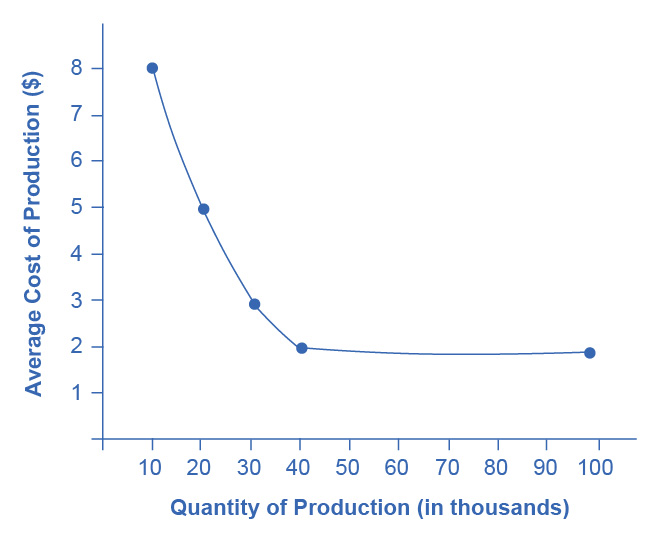
Table 33.15 shows how the average costs of production for semiconductors (the “chips” in computer memories) change as the quantity of semiconductors built at that factory increases.
英語のヒント
表33.15は、その工場で作る半導体(コンピューターメモリーの「チップ」)の量が増えるにつれて、平均生産費用がどう変わるかを示す。
- Based on these data, sketch a curve with quantity produced on the horizontal axis and average cost of production on the vertical axis. How does the curve illustrate economies of scale?
英語のヒント
このデータに基づき、横軸を生産量、縦軸を平均生産費用として、曲線を描きなさい。この曲線は規模の経済をどう示すか。 - If the equilibrium quantity of semiconductors demanded is 90,000, can this economy take full advantage of economies of scale? What about if quantity demanded is 70,000 semiconductors? 50,000 semiconductors? 30,000 semiconductors?
英語のヒント
半導体の均衡需要量が9万個なら、この経済は規模の経済を十分に活用できるか。需要量が7万個ならどうか。5万個ならどうか。3万個ならどうか。 - Explain how international trade could make it possible for even a small economy to take full advantage of economies of scale, while also benefiting from competition and the variety offered by several producers.
英語のヒント
国際貿易によって、小さな経済でも規模の経済を十分に活用しながら、複数の生産者が提供する競争と多様性の便益も得られる仕組みを説明しなさい。
Quantity of Semiconductors 半導体の数量 |
Average Total Cost 平均総費用 |
|---|---|
10,000 |
$8 each 1個8ドル |
20,000 |
$5 each 1個5ドル |
30,000 |
$3 each 1個3ドル |
40,000 |
$2 each 1個2ドル |
100,000 |
$2 each 1個2ドル |
Solution解き方
- Start by plotting the points on a sketch diagram and then drawing a line through them. The following figure illustrates the average costs of production of semiconductors.
英語のヒント
まず略図に点を打ち、その点を通る線を描く。次の図は、半導体の平均生産費用を示す。The curve illustrates economies of scale by showing that as the scale increases—that is, as production at this particular factory goes up—the average cost of production declines. The economies of scale exist up to an output of 40,000 semiconductors; at higher outputs, the average cost of production does not seem to decline any further.英語のヒント
この曲線は、規模が増える、つまりこの工場の生産量が増えると、平均生産費用が下がることによって、規模の経済を示す。規模の経済は半導体4万個の生産量まで存在し、それ以上の生産量では、平均生産費用はそれ以上下がらないように見える。 - At any quantity demanded above 40,000, this economy can take full advantage of economies of scale; that is, it can produce at the lowest cost per unit. Indeed, if the quantity demanded was quite high, like 500,000, then there could be a number of different factories all taking full advantage of economies of scale and competing with each other. If the quantity demanded falls below 40,000, then the economy by itself, without foreign trade, cannot take full advantage of economies of scale.
英語のヒント
需要量が4万個を超えれば、この経済は規模の経済を十分に活用できる。つまり、単位当たりの最低費用で生産できる。実際、需要量が50万個のようにかなり多ければ、多くの異なる工場がすべて規模の経済を十分に活用して、互いに競争することもできる。需要量が4万個を下回れば、その経済は外国貿易なしに自力で、規模の経済を十分に活用することはできない。 - The simplest answer to this question is that the small country could have a large enough factory to take full advantage of economies of scale, but then export most of the output. For semiconductors, countries like Taiwan and Korea have recently fit this description. Moreover, this country could also import semiconductors from other countries which also have large factories, thus getting the benefits of competition and variety. A slightly more complex answer is that the country can get these benefits of economies of scale without producing semiconductors, but simply by buying semiconductors made at low cost around the world. An economy, especially a smaller country, may well end up specializing and producing a few items on a large scale, but then trading those items for other items produced on a large scale, and thus gaining the benefits of economies of scale by trade, as well as by direct production.
英語のヒント
この問いへの最も単純な答えは、小国が、規模の経済を十分に活用できるだけの大きな工場を持ち、生産物の大部分を輸出することである。半導体では、近年の台湾や韓国がこれに当てはまる。さらに、その国は、大工場を持つ他国からも半導体を輸入し、競争と多様性の便益を得られる。少し複雑な答えは、半導体を生産せず、世界中で低費用で作られた半導体を買うだけでも、規模の経済の便益を得られるということである。経済、とくに小国は、いくつかの品目に特化して大規模に生産し、それらを、大規模に生産された他の品目と交換することになりうる。こうして、直接生産するだけでなく、貿易によっても規模の経済の便益を得る。