第33章国際貿易
Economies of Scale, Competition, Variety規模の経済、競争、多様性
A second broad reason that intra-industry trade between similar nations produces economic gains involves economies of scale. The concept of economies of scale, as we introduced in Production, Costs and Industry Structure, means that as the scale of output goes up, average costs of production decline—at least up to a point. Figure 33.5 illustrates economies of scale for a plant producing toaster ovens. The horizontal axis of the figure shows the quantity of production by a certain firm or at a certain manufacturing plant. The vertical axis measures the average cost of production. Production plant S produces a small level of output at 30 units and has an average cost of production of $30 per toaster oven. Plant M produces at a medium level of output at 50 units, and has an average cost of production of $20 per toaster oven. Plant L produces 150 units of output with an average cost of production of only $10 per toaster oven. Although plant V can produce 200 units of output, it still has the same unit cost as Plant L.
英語のヒント
似た国どうしの産業内貿易が経済的利益を生む第二の大きな理由は、規模の経済に関わる。「生産、費用、産業構造」で紹介した規模の経済とは、生産規模が大きくなると、少なくともある点までは、平均生産費用が下がることを意味する。図33.5は、オーブントースターを生産する工場の規模の経済を示す。横軸は、ある企業または製造工場の生産量を示す。縦軸は平均生産費用を測る。生産工場Sは30台という小規模な生産を行い、オーブントースター1台当たりの平均生産費用は30ドルである。工場Mは50台という中規模な生産を行い、1台当たりの平均生産費用は20ドルである。工場Lは150台を生産し、1台当たりの平均生産費用はわずか10ドルである。工場Vは200台を生産できるが、単位費用は工場Lと同じである。
In this example, a small or medium plant, like S or M, will not be able to compete in the market with a large or a very large plant like L or V, because the firm that operates L or V will be able to produce and sell its output at a lower price. In this example, economies of scale operate up to point L, but beyond point L to V, the additional scale of production does not continue to reduce average costs of production.
英語のヒント
この例では、SやMのような小・中規模の工場は、LやVのような大規模・超大規模の工場と市場で競争できない。LやVを運営する企業は、より低い価格で生産・販売できるからである。この例では、規模の経済は点Lまで働くが、点LからVを超えても、生産規模の追加的な拡大は、平均生産費用を下げ続けることはない。
Economies of Scale規模の経済
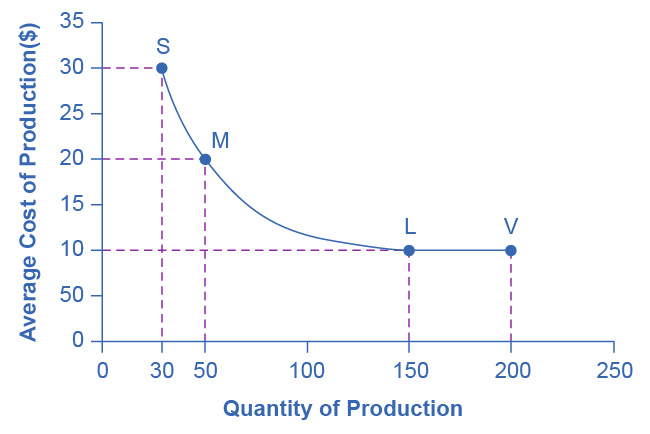

Figure 33.5図 33.5
Production Plant S, has an average cost of production of $30 per toaster oven. Production plant M has an average cost of production of $20 per toaster oven. Production plant L has an average cost of production of only $10 per toaster oven. Production plant V still has an average cost of production of $10 per toaster oven. Thus, production plant M can produce toaster ovens more cheaply than plant S because of economies of scale, and plants L or V can produce more cheaply than S or M because of economies of scale. However, the economies of scale end at an output level of 150. Plant V, despite being larger, cannot produce more cheaply on average than plant L.
英語のヒント
生産工場Sの平均生産費用は、オーブントースター1台当たり30ドルである。工場Mは1台当たり20ドル、工場Lはわずか10ドル、工場Vも1台当たり10ドルである。したがって、規模の経済のために、工場Mは工場Sより安くオーブントースターを生産でき、工場LやVはSやMより安く生産できる。しかし、規模の経済は生産量150で終わる。工場Vは規模が大きいにもかかわらず、平均では工場Lより安く生産できない。
The concept of economies of scale becomes especially relevant to international trade when it enables one or two large producers to supply the entire country. For example, a single large automobile factory could probably supply all the cars consumers purchase in a smaller economy like the United Kingdom or Belgium in a given year. However, if a country has only one or two large factories producing cars, and no international trade, then consumers in that country would have relatively little choice between kinds of cars (other than the color of the paint and other nonessential options). Little or no competition will exist between different car manufacturers.
英語のヒント
規模の経済によって、一つか二つの大きな生産者が国全体に供給できる場合、この概念は国際貿易にとくに関係する。たとえば、一つの大きな自動車工場は、イギリスやベルギーのような小規模経済で、その年に消費者が買う自動車をすべて供給できるだろう。しかし、国内で自動車を生産する大工場が一つか二つしかなく、国際貿易もなければ、その国の消費者には、自動車の種類を選ぶ余地が比較的少ない(塗装の色や他の本質的でないオプションは別として)。異なる自動車メーカー間の競争は、ほとんど、あるいはまったくないだろう。
International trade provides a way to combine the lower average production costs that come from economies of scale and still have competition and variety for consumers. Large automobile factories in different countries can make and sell their products around the world. If General Motors, Ford, and Chrysler were the only players in the U.S. automobile market, the level of competition and consumer choice would be considerably lower than when U.S. carmakers must face competition from Toyota, Honda, Suzuki, Fiat, Mitsubishi, Nissan, Volkswagen, Kia, Hyundai, BMW, Subaru, and others. Greater competition brings with it innovation and responsiveness to what consumers want. America’s car producers make far better cars now than they did several decades ago, and much of the reason is competitive pressure, especially from East Asian and European carmakers.
英語のヒント
国際貿易は、規模の経済による低い平均生産費用と、消費者のための競争や多様性を両立させる方法を提供する。異なる国の大きな自動車工場は、自社製品を作り、世界中で売れる。アメリカの自動車市場の参加者がゼネラル・モーターズ、フォード、クライスラーだけなら、アメリカの自動車メーカーがトヨタ、ホンダ、スズキ、フィアット、三菱、日産、フォルクスワーゲン、起亜、現代、BMW、スバルなどとの競争に直面する場合より、競争と消費者の選択肢の程度はかなり低くなる。競争の増加は、革新と、消費者の望みへの対応をもたらす。アメリカの自動車メーカーは今、数十年前よりはるかに良い車を作っており、その理由の大きな部分は、とくに東アジアやヨーロッパの自動車メーカーからの競争圧力である。
Dynamic Comparative Advantage動態的な比較優位
The sources of gains from intra-industry trade between similar economies—namely, the learning that comes from a high degree of specialization and splitting up the value chain and from economies of scale—do not contradict the earlier theory of comparative advantage. Instead, they help to broaden the concept.
英語のヒント
似た経済どうしの産業内貿易の利益の源、すなわち、高度な特化と価値連鎖の分割から生じる学習、および規模の経済は、先に述べた比較優位の理論と矛盾しない。むしろ、その概念を広げる助けとなる。
In intra-industry trade, climate or geography do not determine the level of worker productivity. Even the general level of education or skill does not determine it. Instead, how firms engage in specific learning about specialized products, including taking advantage of economies of scale determine the level of worker productivity. In this vision, comparative advantage can be dynamic—that is, it can evolve and change over time as one develops new skills and as manufacturers split the value chain in new ways. This line of thinking also suggests that countries are not destined to have the same comparative advantage forever, but must instead be flexible in response to ongoing changes in comparative advantage.
英語のヒント
産業内貿易では、気候や地理が労働者の生産性水準を決めるわけではない。一般的な教育や技能の水準さえ、それを決めない。代わりに、規模の経済の活用を含め、企業が専門化した製品について、どのように具体的な学習を行うかが、労働者の生産性水準を決める。この見方では、比較優位は動態的でありうる。つまり、新しい技能が開発され、製造業者が新たな方法で価値連鎖を分割するにつれて、時間とともに進化し、変化しうる。この考え方はまた、国が永遠に同じ比較優位を持つ運命にあるわけではなく、比較優位の継続的な変化に柔軟に対応しなければならないことを示唆する。