第33章国際貿易
33.2 What Happens When a Country Has an Absolute Advantage in All Goods33.2 ある国がすべての財に絶対優位を持つと、何が起こるか
Learning Objectives学習目標
Learning Objectives学習目標
By the end of this section, you will be able to:
英語のヒント
この節を学ぶと、次のことができるようになる。
- Show the relationship between production costs and comparative advantage
英語のヒント
生産費用と比較優位の関係を示す - Identify situations of mutually beneficial trade
英語のヒント
相互に利益をもたらす貿易の状況を特定する - Identify trade benefits by considering opportunity costs
英語のヒント
機会費用を考慮して貿易の便益を特定する
What happens to the possibilities for trade if one country has an absolute advantage in everything? This is typical for high-income countries that often have well-educated workers, technologically advanced equipment, and the most up-to-date production processes. These high-income countries can produce all products with fewer resources than a low-income country. If the high-income country is more productive across the board, will there still be gains from trade? Good students of Ricardo understand that trade is about mutually beneficial exchange. Even when one country has an absolute advantage in all products, trade can still benefit both sides. This is because gains from trade come from specializing in one’s comparative advantage.
英語のヒント
一つの国がすべてに絶対優位を持つと、貿易の可能性はどうなるだろうか。これは、十分に教育された労働者、技術的に高度な設備、最新の生産工程を持つことが多い高所得国に典型的である。これらの高所得国は、低所得国より少ない資源で、すべての製品を生産できる。高所得国があらゆる面でより生産的なら、それでも貿易の利益はあるだろうか。リカードをよく学んだ人は、貿易とは相互に利益のある交換だと理解している。一国がすべての製品に絶対優位を持っていても、貿易はなお双方に利益をもたらしうる。貿易の利益は、自国の比較優位への特化から生まれるからである。
Production Possibilities and Comparative Advantage生産可能性と比較優位
Consider the example of trade between the United States and Mexico described in Table 33.7. In this example, it takes four U.S. workers to produce 1,000 pairs of shoes, but it takes five Mexican workers to do so. It takes one U.S. worker to produce 1,000 refrigerators, but it takes four Mexican workers to do so. The United States has an absolute advantage in productivity with regard to both shoes and refrigerators; that is, it takes fewer workers in the United States than in Mexico to produce both a given number of shoes and a given number of refrigerators.
英語のヒント
表33.7に記した、アメリカとメキシコの貿易例を考えよう。この例では、靴1,000足の生産にアメリカの労働者は4人必要だが、メキシコの労働者は5人必要である。冷蔵庫1,000台の生産にアメリカの労働者は1人必要だが、メキシコの労働者は4人必要である。アメリカは、靴と冷蔵庫の両方について、生産性の絶対優位を持つ。つまり、一定数の靴でも一定数の冷蔵庫でも、生産に必要な労働者は、メキシコよりアメリカの方が少ない。
Country 国 |
Number of Workers needed to produce 1,000 units — Shoes 1,000単位の生産に必要な労働者数—靴 |
Number of Workers needed to produce 1,000 units — Refrigerators 1,000単位の生産に必要な労働者数—冷蔵庫 |
|---|---|---|
United States アメリカ |
4 workers 労働者4人 |
1 worker 労働者1人 |
Mexico メキシコ |
5 workers 労働者5人 |
4 workers 労働者4人 |
Absolute advantage simply compares the productivity of a worker between countries. It answers the question, “How many inputs do I need to produce shoes in Mexico?” Comparative advantage asks this same question slightly differently. Instead of comparing how many workers it takes to produce a good, it asks, “How much am I giving up to produce this good in this country?” Another way of looking at this is that comparative advantage identifies the good for which the producer’s absolute advantage is relatively larger, or where the producer’s absolute productivity disadvantage is relatively smaller. The United States can produce 1,000 shoes with four-fifths as many workers as Mexico (four versus five), but it can produce 1,000 refrigerators with only one-quarter as many workers (one versus four). So, the comparative advantage of the United States, where its absolute productivity advantage is relatively greatest, lies with refrigerators, and Mexico’s comparative advantage, where its absolute productivity disadvantage is least, is in the production of shoes.
英語のヒント
絶対優位は、単純に労働者の生産性を国どうしで比較する。「メキシコで靴を生産するには、投入物がどれだけ必要か」という問いに答える。比較優位は、同じ問いを少し違う形で尋ねる。財の生産に必要な労働者数を比較する代わりに、「この国でこの財を生産するために、どれだけ諦めるのか」と問う。別の見方をすれば、比較優位は、生産者の絶対優位が相対的に大きい財、あるいは絶対的な生産性の不利が相対的に小さい財を特定する。アメリカは、メキシコの5分の4の労働者数(4人対5人)で靴1,000足を生産できるが、冷蔵庫1,000台は、わずか4分の1の労働者数(1人対4人)で生産できる。したがって、絶対的な生産性の優位が相対的に最大となるアメリカの比較優位は冷蔵庫にあり、絶対的な生産性の不利が最小となるメキシコの比較優位は靴の生産にある。
Mutually Beneficial Trade with Comparative Advantage比較優位による相互に利益のある貿易
When nations increase production in their area of comparative advantage and trade with each other, both countries can benefit. Again, the production possibility frontier is a useful tool to visualize this benefit.
英語のヒント
各国が比較優位のある分野の生産を増やし、互いに貿易すると、両国とも利益を得られる。ここでも、生産可能性フロンティアは、この便益を図で捉える便利な道具である。
Consider a situation where the United States and Mexico each have 40 workers. For example, as Table 33.8 shows, if the United States divides its labor so that 40 workers are making shoes, then, since it takes four workers in the United States to make 1,000 shoes, a total of 10,000 shoes will be produced. (If four workers can make 1,000 shoes, then 40 workers will make 10,000 shoes). If the 40 workers in the United States are making refrigerators, and each worker can produce 1,000 refrigerators, then a total of 40,000 refrigerators will be produced.
英語のヒント
アメリカとメキシコに、それぞれ40人の労働者がいる状況を考えよう。たとえば表33.8が示すように、アメリカが40人の労働者で靴を作るよう労働を割り当てれば、アメリカでは靴1,000足を作るのに4人必要なので、合計1万足が生産される。(4人で1,000足を作れるなら、40人では1万足を作る。)アメリカの40人の労働者が冷蔵庫を作り、各労働者が1,000台を生産できれば、合計4万台が生産される。
Country 国 |
Shoe Production — using 40 workers 靴生産—労働者40人を使用 |
Refrigerator Production — using 40 workers 冷蔵庫生産—労働者40人を使用 |
|
|---|---|---|---|
United States アメリカ |
10,000 shoes 靴1万足 |
or または |
40,000 refrigerators 冷蔵庫4万台 |
Mexico メキシコ |
8,000 shoes 靴8,000足 |
or または |
10,000 refrigerators 冷蔵庫1万台 |
As always, the slope of the production possibility frontier for each country is the opportunity cost of one refrigerator in terms of foregone shoe production–when labor is transferred from producing the latter to producing the former (see Figure 33.4).
英語のヒント
いつもどおり、各国の生産可能性フロンティアの傾きは、労働を靴の生産から冷蔵庫の生産へ移したときの、諦める靴生産量で測った冷蔵庫1台の機会費用である(図33.4を参照)。
Production Possibility Frontiers生産可能性フロンティア
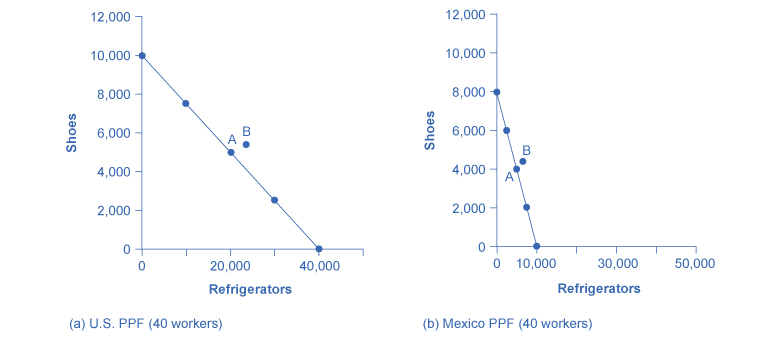

Figure 33.4図 33.4
(a) With 40 workers, the United States can produce either 10,000 shoes and zero refrigerators or 40,000 refrigerators and zero shoes. (b) With 40 workers, Mexico can produce a maximum of 8,000 shoes and zero refrigerators, or 10,000 refrigerators and zero shoes. All other points on the production possibility line are possible combinations of the two goods that can be produced given current resources. Point A on both graphs is where the countries start producing and consuming before trade. Point B is where they end up after trade.
英語のヒント
(a)40人の労働者がいるアメリカは、靴1万足と冷蔵庫ゼロ、または冷蔵庫4万台と靴ゼロを生産できる。(b)40人の労働者がいるメキシコは、最大で靴8,000足と冷蔵庫ゼロ、または冷蔵庫1万台と靴ゼロを生産できる。生産可能性の線上の他のすべての点は、現在の資源で生産できる二つの財の組合せである。両グラフの点Aは、貿易前に各国が生産・消費を始める点である。点Bは、貿易後の到達点である。
Let’s say that, in the situation before trade, each nation prefers to produce a combination of shoes and refrigerators that is shown at point A. Table 33.9 shows the output of each good for each country and the total output for the two countries.
英語のヒント
貿易前の状況では、各国が、点Aに示す靴と冷蔵庫の組合せを生産することを好むとしよう。表33.9は、各国の各財の生産量と、2か国の総生産量を示す。
Country 国 |
Current Shoe Production 現在の靴生産 |
Current Refrigerator Production 現在の冷蔵庫生産 |
|---|---|---|
United States アメリカ |
5,000 |
20,000 |
Mexico メキシコ |
4,000 |
5,000 |
Total 合計 |
9,000 |
25,000 |
Continuing with this scenario, suppose that each country transfers some amount of labor toward its area of comparative advantage. For example, the United States transfers six workers away from shoes and toward producing refrigerators. As a result, U.S. production of shoes decreases by 1,500 units (6/4 × 1,000), while its production of refrigerators increases by 6,000 (that is, 6/1 × 1,000). Mexico also moves production toward its area of comparative advantage, transferring 10 workers away from refrigerators and toward production of shoes. As a result, production of refrigerators in Mexico falls by 2,500 (10/4 × 1,000), but production of shoes increases by 2,000 pairs (10/5 × 1,000). Notice that when both countries shift production toward each of their comparative advantages (what they are relatively better at), their combined production of both goods rises, as shown in Table 33.10. The reduction of shoe production by 1,500 pairs in the United States is more than offset by the gain of 2,000 pairs of shoes in Mexico, while the reduction of 2,500 refrigerators in Mexico is more than offset by the additional 6,000 refrigerators produced in the United States.
英語のヒント
この筋書きを続け、各国が一定の労働を、比較優位のある分野へ移すと仮定しよう。たとえばアメリカは、6人の労働者を靴から冷蔵庫の生産へ移す。その結果、アメリカの靴生産は1,500足(6/4 × 1,000)減り、冷蔵庫生産は6,000台(6/1 × 1,000)増える。メキシコも、10人の労働者を冷蔵庫から靴の生産へ移し、比較優位のある分野へ生産を移す。その結果、メキシコの冷蔵庫生産は2,500台(10/4 × 1,000)減るが、靴生産は2,000足(10/5 × 1,000)増える。両国が、それぞれの比較優位(相対的に得意なこと)へ生産を移すと、表33.10に示すように、両方の財の合計生産量が増えることに注意しよう。アメリカでの靴1,500足の生産減は、メキシコでの靴2,000足の増加によって相殺されてなお余り、メキシコでの冷蔵庫2,500台の減少は、アメリカで生産される追加の冷蔵庫6,000台によって相殺されてなお余る。
Country 国 |
Shoe Production 靴生産 |
Refrigerator Production 冷蔵庫生産 |
|---|---|---|
United States アメリカ |
3,500 |
26,000 |
Mexico メキシコ |
6,000 |
2,500 |
Total 合計 |
9,500 |
28,500 |
This numerical example illustrates the remarkable insight of comparative advantage: even when one country has an absolute advantage in all goods and another country has an absolute disadvantage in all goods, both countries can still benefit from trade. Even though the United States has an absolute advantage in producing both refrigerators and shoes, it makes economic sense for it to specialize in the good for which it has a comparative advantage. The United States will export refrigerators and in return import shoes.
英語のヒント
この数値例は、比較優位の優れた洞察を示している。一国がすべての財に絶対優位を持ち、別の国がすべての財で絶対的に不利でも、両国とも貿易から利益を得られるのである。アメリカは冷蔵庫と靴の両方の生産に絶対優位を持つが、比較優位のある財に特化することには経済的な意味がある。アメリカは冷蔵庫を輸出し、その見返りに靴を輸入する。