第33章国際貿易
Gains from Trade貿易の利益
Consider the trading positions of the United States and Saudi Arabia after they have specialized and traded. Before trade, Saudi Arabia produces/consumes 60 barrels of oil and 10 bushels of corn. The United States produces/consumes 20 barrels of oil and 60 bushels of corn. Given their current production levels, if the United States can trade an amount of corn fewer than 60 bushels and receive in exchange an amount of oil greater than 20 barrels, it will gain from trade. With trade, the United States can consume more of both goods than it did without specialization and trade. (Recall that the chapter Welcome to Economics! defined specialization as it applies to workers and firms. Economists also use specialization to describe the occurrence when a country shifts resources to focus on producing a good that offers comparative advantage.) Similarly, if Saudi Arabia can trade an amount of oil less than 60 barrels and receive in exchange an amount of corn greater than 10 bushels, it will have more of both goods than it did before specialization and trade. Table 33.5 illustrates the range of trades that would benefit both sides.
英語のヒント
特化して貿易した後のアメリカとサウジアラビアの状況を考えよう。貿易前、サウジアラビアは石油60バレルとトウモロコシ10ブッシェルを生産・消費する。アメリカは石油20バレルとトウモロコシ60ブッシェルを生産・消費する。現在の生産水準を所与とすると、アメリカが60ブッシェル未満のトウモロコシを貿易に出し、引き換えに20バレルを超える石油を受け取れれば、貿易から利益を得る。貿易があれば、アメリカは、特化も貿易もしない場合よりも、両方の財を多く消費できる。(「経済学へようこそ!」で、労働者や企業に適用する特化を定義したことを思い出そう。経済学者は、国が資源を移して、比較優位を持つ財の生産に集中することも、特化と呼ぶ。)同様に、サウジアラビアが60バレル未満の石油を貿易に出し、引き換えに10ブッシェルを超えるトウモロコシを受け取れれば、特化と貿易の前より、両方の財を多く持つ。表33.5は、双方に利益をもたらす取引の範囲を示す。
The U.S. economy, after specialization, will benefit if it: 特化後、アメリカ経済は次の場合に利益を得る: |
The Saudi Arabian economy, after specialization, will benefit if it: 特化後、サウジアラビア経済は次の場合に利益を得る: |
|---|---|
Exports no more than 60 bushels of corn トウモロコシ60ブッシェル以下を輸出する |
Imports at least 10 bushels of corn トウモロコシを少なくとも10ブッシェル輸入する |
Imports at least 20 barrels of oil 石油を少なくとも20バレル輸入する |
Exports less than 60 barrels of oil 石油60バレル未満を輸出する |
The underlying reason why trade benefits both sides is rooted in the concept of opportunity cost, as the following Clear It Up feature explains. If Saudi Arabia wishes to expand domestic production of corn in a world without international trade, then based on its opportunity costs it must give up four barrels of oil for every one additional bushel of corn. If Saudi Arabia could find a way to give up less than four barrels of oil for an additional bushel of corn (or equivalently, to receive more than one bushel of corn for four barrels of oil), it would be better off.
英語のヒント
次の「疑問を解こう」が説明するように、貿易が双方に利益をもたらす根本的な理由は、機会費用の概念に根差す。国際貿易のない世界で、サウジアラビアが国内のトウモロコシ生産を増やしたいなら、その機会費用に基づき、トウモロコシを1ブッシェル増やすごとに、石油4バレルを諦めなければならない。追加のトウモロコシ1ブッシェルのために、石油4バレル未満を諦めればよい方法をサウジアラビアが見つけられれば(同じことだが、石油4バレルと引き換えにトウモロコシ1ブッシェル超を受け取れれば)、より豊かになる。
Recall that David Ricardo argued that if each country specializes in its comparative advantage, it will benefit from trade, and total global output will increase. How can we show gains from trade as a result of comparative advantage and specialization? Table 33.6 shows the output assuming that each country specializes in its comparative advantage and produces no other good. This is 100% specialization. Specialization leads to an increase in total world production. (Compare the total world production in Table 33.3 to that in Table 33.6.)
英語のヒント
Country 国 |
Quantity produced after 100% specialization — Oil (barrels) 100%特化後の生産量—石油(バレル) |
Quantity produced after 100% specialization — Corn (bushels) 100%特化後の生産量—トウモロコシ(ブッシェル) |
|---|---|---|
Saudi Arabia サウジアラビア |
100 |
0 |
United States アメリカ |
0 |
100 |
Total World Production 世界の総生産 |
100 |
100 |
What if we did not have complete specialization, as in Table 33.6? Would there still be gains from trade? Consider another example, such as when the United States and Saudi Arabia start at C and C', respectively, as Figure 33.2 shows. Consider what occurs when trade is allowed and the United States exports 20 bushels of corn to Saudi Arabia in exchange for 20 barrels of oil.
英語のヒント
Production Possibilities Frontier in Saudi Arabiaサウジアラビアの生産可能性フロンティア
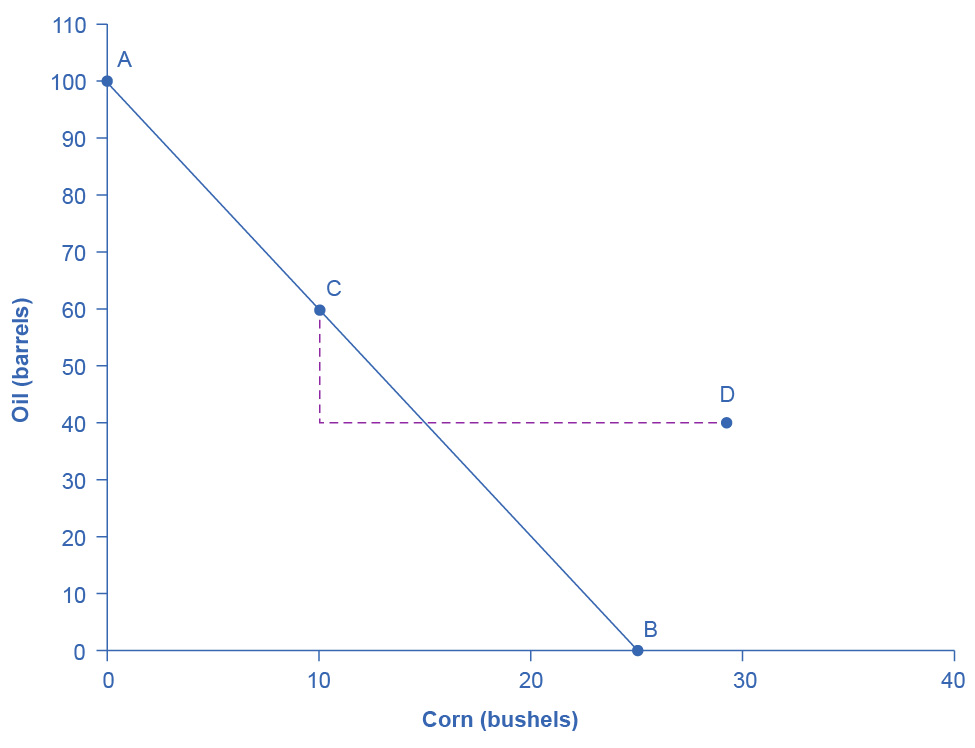

Figure 33.3図 33.3
Trade allows a country to go beyond its domestic production-possibility frontier
英語のヒント
貿易によって、国は国内の生産可能性フロンティアを超えられる
Starting at point C, which shows Saudi oil production of 60, reduce Saudi oil domestic oil consumption by 20, since 20 is exported to the United States and exchanged for 20 units of corn. This enables Saudi to reach point D, where oil consumption is now 40 barrels and corn consumption has increased to 30 (see Figure 33.3). Notice that even without 100% specialization, if the “trading price,” in this case 20 barrels of oil for 20 bushels of corn, is greater than the country’s opportunity cost, the Saudis will gain from trade. Since the post-trade consumption point D is beyond its production possibility frontier, Saudi Arabia has gained from trade.
英語のヒント
サウジアラビアの石油生産60を示す点Cから始めて、国内の石油消費を20減らす。20をアメリカへ輸出し、トウモロコシ20単位と交換するからである。これによってサウジアラビアは点Dに達し、石油消費は40バレル、トウモロコシ消費は30へ増える(図33.3を参照)。100%特化しなくても、「貿易価格」、この場合は石油20バレル対トウモロコシ20ブッシェルが、その国の機会費用を上回れば、サウジアラビアは貿易から利益を得ることに注意しよう。貿易後の消費点Dは生産可能性フロンティアの外側にあるため、サウジアラビアは貿易から利益を得たのである。