第33章国際貿易
A Numerical Example of Absolute and Comparative Advantage絶対優位と比較優位の数値例
Consider a hypothetical world with two countries, Saudi Arabia and the United States, and two products, oil and corn. Further assume that consumers in both countries desire both these goods. These goods are homogeneous, meaning that consumers/producers cannot differentiate between corn or oil from either country. There is only one resource available in both countries, labor hours. Saudi Arabia can produce oil with fewer resources, while the United States can produce corn with fewer resources. Table 33.1 illustrates the advantages of the two countries, expressed in terms of how many hours it takes to produce one unit of each good.
英語のヒント
サウジアラビアとアメリカという2か国、石油とトウモロコシという2製品からなる仮想の世界を考えよう。さらに、両国の消費者がこれら二つの財をともに欲しがると仮定する。これらの財は同質で、消費者や生産者は、どちらの国のトウモロコシや石油も区別できない。両国で利用できる資源は、労働時間の一つだけである。サウジアラビアは、より少ない資源で石油を生産でき、アメリカは、より少ない資源でトウモロコシを生産できる。表33.1は、各財1単位の生産に必要な時間で表した、両国の優位を示す。
Country 国 |
Oil (hours per barrel) 石油(1バレル当たり時間) |
Corn (hours per bushel) トウモロコシ(1ブッシェル当たり時間) |
|---|---|---|
Saudi Arabia サウジアラビア |
1 |
4 |
United States アメリカ |
2 |
1 |
In Table 33.1, Saudi Arabia has an absolute advantage in producing oil because it only takes an hour to produce a barrel of oil compared to two hours in the United States. The United States has an absolute advantage in producing corn.
英語のヒント
表33.1では、サウジアラビアは石油生産に絶対優位を持つ。石油1バレルの生産に必要なのが、アメリカの2時間に対して1時間だけだからである。アメリカはトウモロコシの生産に絶対優位を持つ。
To simplify, let’s say that Saudi Arabia and the United States each have 100 worker hours (see Table 33.2). Figure 33.2 illustrates what each country is capable of producing on its own using a production possibility frontier (PPF) graph. Recall from Choice in a World of Scarcity that the production possibilities frontier shows the maximum amount that each country can produce given its limited resources, in this case workers, and its level of technology.
英語のヒント
単純化のため、サウジアラビアとアメリカはそれぞれ100労働時間を持つとしよう(表33.2を参照)。図33.2は、生産可能性フロンティア(PPF)のグラフを使って、各国が自国だけで何を生産できるかを示す。「希少性の世界における選択」で学んだように、生産可能性フロンティアは、限られた資源、この場合は労働者と、技術水準を所与として、各国が生産できる最大量を示す。
Country 国 |
Oil Production using 100 worker hours (barrels) 100労働時間による石油生産(バレル) |
Corn Production using 100 worker hours (bushels) 100労働時間によるトウモロコシ生産(ブッシェル) |
|
|---|---|---|---|
Saudi Arabia サウジアラビア |
100 |
or または |
25 |
United States アメリカ |
50 |
or または |
100 |
Production Possibilities Frontiers生産可能性フロンティア
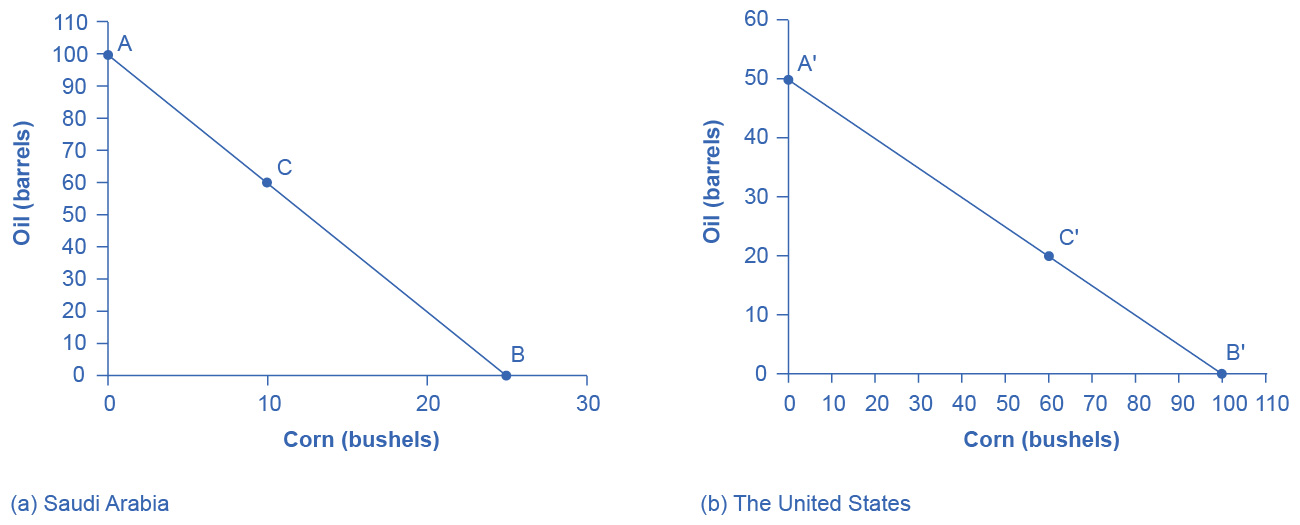

Figure 33.2図 33.2
(a) Saudi Arabia can produce 100 barrels of oil at maximum and zero corn (point A), or 25 bushels of corn and zero oil (point B). It can also produce other combinations of oil and corn if it wants to consume both goods, such as at point C. Here it chooses to produce/consume 60 barrels of oil, leaving 40 work hours that to allocate to produce 10 bushels of corn, using the data in Table 33.1. (b) If the United States produces only oil, it can produce, at maximum, 50 barrels and zero corn (point A'), or at the other extreme, it can produce a maximum of 100 bushels of corn and no oil (point B'). Other combinations of both oil and corn are possible, such as point C'. All points above the frontiers are impossible to produce given the current level of resources and technology.
英語のヒント
(a)サウジアラビアは、最大で石油100バレル、トウモロコシゼロを生産できる(点A)。あるいは、トウモロコシ25ブッシェル、石油ゼロを生産できる(点B)。両方の財を消費したければ、点Cのように石油とトウモロコシの他の組合せも生産できる。ここでは、表33.1のデータを使い、石油60バレルを生産・消費し、残る40労働時間をトウモロコシ10ブッシェルの生産に割り当てる選択をする。(b)アメリカが石油だけを生産するなら、最大で石油50バレル、トウモロコシゼロを生産できる(点A′)。もう一方の端では、最大でトウモロコシ100ブッシェルを生産し、石油は生産しない(点B′)。点C′のように、石油とトウモロコシ両方の他の組合せも可能である。フロンティアより上にあるすべての点は、現在の資源と技術の水準では生産不可能である。
Arguably Saudi and U.S. consumers desire both oil and corn to live. Let’s say that before trade occurs, both countries produce and consume at point C or C'. Thus, before trade, the Saudi Arabian economy will devote 60 worker hours to produce oil, as Table 33.3 shows. Given the information in Table 33.1, this choice implies that it produces/consumes 60 barrels of oil. With the remaining 40 worker hours, since it needs four hours to produce a bushel of corn, it can produce only 10 bushels. To be at point C', the U.S. economy devotes 40 worker hours to produce 20 barrels of oil and it can allocate the remaining worker hours to produce 60 bushels of corn.
英語のヒント
Country 国 |
Oil Production (barrels) 石油生産(バレル) |
Corn Production (bushels) トウモロコシ生産(ブッシェル) |
|---|---|---|
Saudi Arabia (C) サウジアラビア(C) |
60 |
10 |
United States (C') アメリカ(C′) |
20 |
60 |
Total World Production 世界の総生産 |
80 |
70 |
The slope of the production possibility frontier illustrates the opportunity cost of producing oil in terms of corn. Using all its resources, the United States can produce 50 barrels of oil or 100 bushels of corn; therefore, the opportunity cost of one barrel of oil is two bushels of corn—or the slope is 1/2. Thus, in the U.S. production possibility frontier graph, every increase in oil production of one barrel implies a decrease of two bushels of corn. Saudi Arabia can produce 100 barrels of oil or 25 bushels of corn. The opportunity cost of producing one barrel of oil is the loss of 1/4 of a bushel of corn that Saudi workers could otherwise have produced. In terms of corn, notice that Saudi Arabia gives up the least to produce a barrel of oil. Table 33.4 summarizes these calculations.
英語のヒント
生産可能性フロンティアの傾きは、トウモロコシで測った石油生産の機会費用を示す。すべての資源を使えば、アメリカは石油50バレル、またはトウモロコシ100ブッシェルを生産できる。したがって、石油1バレルの機会費用はトウモロコシ2ブッシェルであり、傾きは1/2である。つまり、アメリカの生産可能性フロンティアのグラフでは、石油生産が1バレル増えるたびに、トウモロコシが2ブッシェル減る。サウジアラビアは、石油100バレル、またはトウモロコシ25ブッシェルを生産できる。石油1バレルを生産する機会費用は、サウジアラビアの労働者が代わりに生産できたトウモロコシ1/4ブッシェルを失うことである。トウモロコシで測ると、石油1バレルを生産するために諦める量が最も少ないのは、サウジアラビアであることに注意しよう。表33.4は、これらの計算をまとめる。
Country 国 |
Opportunity cost of one unit — Oil (in terms of corn) 1単位の機会費用—石油(トウモロコシで測る) |
Opportunity cost of one unit — Corn (in terms of oil) 1単位の機会費用—トウモロコシ(石油で測る) |
|---|---|---|
Saudi Arabia サウジアラビア |
¼ |
4 |
United States アメリカ |
2 |
½ |
Again recall that we defined comparative advantage as the opportunity cost of producing goods. Since Saudi Arabia gives up the least to produce a barrel of oil, ( < in Table 33.4) it has a comparative advantage in oil production. The United States gives up the least to produce a bushel of corn, so it has a comparative advantage in corn production.
英語のヒント
比較優位を、財を生産する機会費用として定義したことを、もう一度思い出そう。サウジアラビアは石油1バレルを生産するために諦める量が最も少ないため(表33.4では < )、石油生産に比較優位を持つ。アメリカはトウモロコシ1ブッシェルを生産するために諦める量が最も少ないため、トウモロコシ生産に比較優位を持つ。
In this example, there is symmetry between absolute and comparative advantage. Saudi Arabia needs fewer worker hours to produce oil (absolute advantage, see Table 33.1), and also gives up the least in terms of other goods to produce oil (comparative advantage, see Table 33.4). Such symmetry is not always the case, as we will show after we have discussed gains from trade fully, but first, read the following Clear It Up feature to make sure you understand why the PPF line in the graphs is straight.