第19章マクロ経済の視点
19.2 Adjusting Nominal Values to Real Values19.2 名目値から実質値への調整
Learning Objectives学習目標
Learning Objectives学習目標
By the end of this section, you will be able to:
英語のヒント
この節を学ぶと、次のことができるようになる。
- Contrast nominal GDP and real GDP
英語のヒント
名目GDPと実質GDPを対比する。 - Explain GDP deflator
英語のヒント
GDPデフレーターを説明する。 - Calculate real GDP based on nominal GDP values
英語のヒント
名目GDPの値に基づいて実質GDPを計算する。
When examining economic statistics, there is a crucial distinction worth emphasizing. The distinction is between nominal and real measurements, which refer to whether or not inflation has distorted a given statistic. Looking at economic statistics without considering inflation is like looking through a pair of binoculars and trying to guess how close something is: unless you know how strong the lenses are, you cannot guess the distance very accurately. Similarly, if you do not know the inflation rate, it is difficult to figure out if a rise in GDP is due mainly to a rise in the overall level of prices or to a rise in quantities of goods produced. The nominal value of any economic statistic means that we measure the statistic in terms of actual prices that exist at the time. The real value refers to the same statistic after it has been adjusted for inflation. Generally, it is the real value that is more important.
英語のヒント
経済統計を調べるとき、特に強調しておくべき重要な区別がある。名目値と実質値の区別であり、インフレーションが統計の数値をゆがめているかどうかに関わる。インフレを考慮せずに経済統計を見るのは、双眼鏡をのぞきながら物までの距離を推測するようなものである。レンズの倍率を知らなければ、距離を正確には推測できない。同様に、インフレ率を知らなければ、GDPの増加が主に物価全体の上昇によるのか、生産された財の数量の増加によるのかを判断しにくい。経済統計の名目値とは、その時点で実際に存在する価格で測定した数値である。実質値とは、同じ統計をインフレについて調整した後の数値を指す。一般に、より重要なのは実質値である。
Converting Nominal to Real GDP名目GDPから実質GDPへの換算
Table 19.5 shows U.S. GDP at five-year intervals since 1960 in nominal dollars; that is, GDP measured using the actual market prices prevailing in each stated year. Figure 19.7 also reflects this data in a graph.
英語のヒント
Year 年 |
Nominal GDP (billions of dollars) 名目GDP(十億ドル) |
GDP Deflator (2012 = 100) GDPデフレーター(2012年 = 100) |
|---|---|---|
1960 |
542.4 |
16.6 |
1965 |
742.3 |
17.8 |
1970 |
1,073.3 |
21.7 |
1975 |
1,684.9 |
29.8 |
1980 |
2,857.3 |
42.2 |
1985 |
4,339.0 |
54.5 |
1990 |
5,963.1 |
63.6 |
1995 |
7,639.7 |
71.8 |
2000 |
10,251.0 |
78.0 |
2005 |
13,039.2 |
87.5 |
2010 |
15,049.0 |
96.2 |
2015 |
18,206.0 |
104.7 |
2020 |
20,893.7 |
113.6 |
U.S. Nominal GDP, 1960–2020米国の名目GDP、1960~2020年
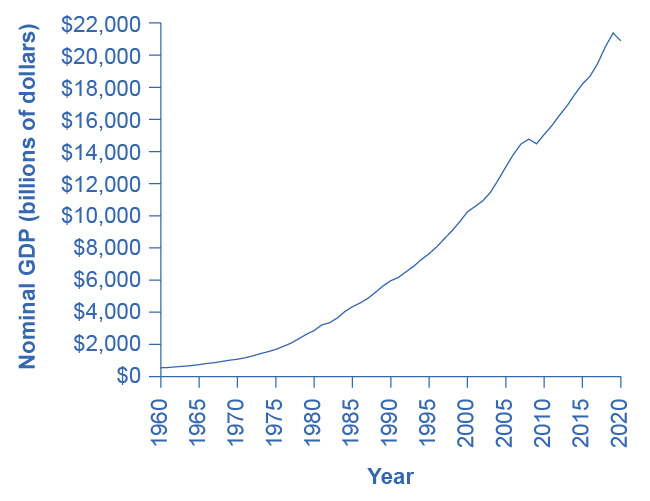
Figure 19.7図 19.7
Nominal GDP values have risen exponentially from 1960 through 2020, according to the BEA.
英語のヒント
BEAによると、名目GDPの値は1960年から2020年にかけて指数関数的に増加している。
If an unwary analyst compared nominal GDP in 1960 to nominal GDP in 2010, it might appear that national output had risen by a factor of more than 38 over this time (that is, GDP of $20.9 trillion in 2020 divided by GDP of $543 billion in 1960 = 38). This conclusion would be highly misleading. Recall that we define nominal GDP as the quantity of every final good or service produced multiplied by the price at which it was sold, summed up for all goods and services. In order to see how much production has actually increased, we need to extract the effects of higher prices on nominal GDP. We can easily accomplish this using the GDP deflator.
英語のヒント
注意を怠った分析者が1960年の名目GDPと2010年の名目GDPを比較すると、この間に国内の産出が38倍以上になったように見えるかもしれない。つまり、2020年のGDP20.9兆ドルを1960年のGDP5,430億ドルで割ると38となる。しかし、この結論は大いに誤解を招く。名目GDPは、生産されたすべての最終財・サービスの数量にそれぞれの販売価格を掛け、そのすべてを合計したものだと定義したことを思い出そう。生産が実際にどれだけ増えたかを見るには、名目GDPから価格上昇の影響を取り除く必要がある。GDPデフレーターを使えば、これは簡単にできる。
The GDP deflator is a price index measuring the average prices of all final goods and services included in the economy. We explore price indices in detail and how we compute them in Inflation, but this definition will do in the context of this chapter. Table 19.5 provides the GDP deflator data and Figure 19.8 shows it graphically.
英語のヒント
U.S. GDP Deflator, 1960–2020米国のGDPデフレーター、1960~2020年
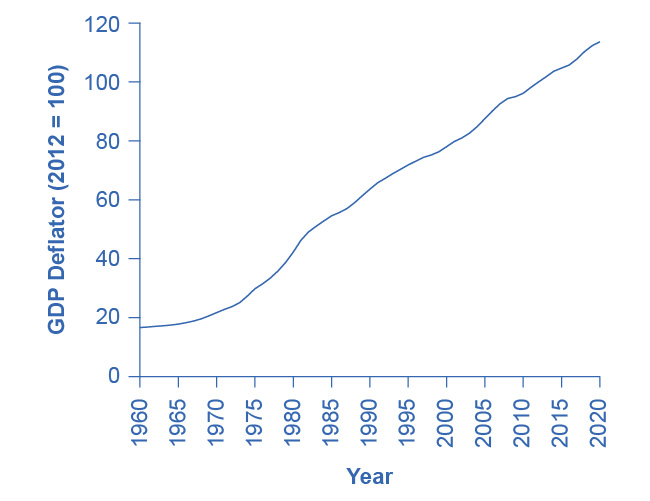


Figure 19.8図 19.8
Much like nominal GDP, the GDP deflator has risen exponentially from 1960 through 2010. (Source: BEA https://apps.bea.gov/itable/index.cfm, Table 1.1.9)
英語のヒント
名目GDPとよく似て、GDPデフレーターも1960年から2010年にかけて指数関数的に上昇している。(出典:BEA、https://apps.bea.gov/itable/index.cfm、表1.1.9)
Figure 19.8 shows that the price level has risen dramatically since 1960. The price level in 2020 was seven times higher than in 1960 (the deflator for 2020 was 113 versus a level of 17 in 1960). Clearly, much of the growth in nominal GDP was due to inflation, not an actual change in the quantity of goods and services produced, in other words, not in real GDP. Recall that nominal GDP can rise for two reasons: an increase in output, and/or an increase in prices. What is needed is to extract the increase in prices from nominal GDP so as to measure only changes in output. After all, the dollars used to measure nominal GDP in 1960 are worth more than the inflated dollars of 2020—and the price index tells exactly how much more. This adjustment is easy to do if you understand that nominal measurements are in value terms, where
英語のヒント
図19.8から、物価水準が1960年以来大幅に上昇してきたことが分かる。2020年の物価水準は1960年の7倍だった。デフレーターは1960年の17に対し、2020年は113だった。明らかに、名目GDPの成長の多くはインフレによるもので、生産された財・サービスの数量、言い換えれば実質GDPの実際の変化によるものではない。名目GDPは、産出の増加と価格の上昇という二つの理由、またはその両方によって増えうることを思い出そう。産出の変化だけを測るには、名目GDPから価格上昇の分を取り除かなければならない。そもそも、1960年に名目GDPの測定に使ったドルは、インフレの進んだ2020年のドルより価値が高い。その価値がどれほど高いかを物価指数が正確に示す。名目の測定は価値で表したものだと理解すれば、この調整は簡単に行える。すなわち、
Let’s look at an example at the micro level. Suppose the t-shirt company, Coolshirts, sells 10 t-shirts at a price of $9 each.
英語のヒント
ミクロの水準の例を見よう。Tシャツ会社のクールシャツが、Tシャツ10枚を1枚9ドルで販売するとする。
Then,
英語のヒント
すると、
In other words, when we compute “real” measurements we are trying to obtain actual quantities, in this case, 10 t-shirts.
英語のヒント
言い換えれば、「実質」の数値を計算するときには、実際の数量、ここではTシャツ10枚を求めようとしているのである。
With GDP, it is just a tiny bit more complicated. We start with the same formula as above:
英語のヒント
GDPの場合は、ほんの少しだけ複雑になる。まず上と同じ式から始める。
For reasons that we will explain in more detail below, mathematically, a price index is a two-digit decimal number like 1.00 or 0.85 or 1.25. Because some people have trouble working with decimals, when the price index is published, it has traditionally been multiplied by 100 to get integer numbers like 100, 85, or 125. What this means is that when we “deflate” nominal figures to get real figures (by dividing the nominal by the price index). We also need to remember to divide the published price index by 100 to make the math work. Thus, the formula becomes:
英語のヒント
後で詳しく説明する理由により、物価指数は数学的には1.00、0.85、1.25のような小数第2位までの数値である。小数の扱いを苦手とする人もいるため、物価指数は従来、公表時に100を掛け、100、85、125のような整数にしてきた。したがって、名目値を物価指数で割って実質値を求める「デフレート」を行う際には、計算を正しく行うため、公表されている物価指数を100で割ることも忘れてはならない。よって、式は次のようになる。
Now read the following Work It Out feature for more practice calculating real GDP.
英語のヒント
実質GDPを計算する練習をさらに行うため、次の「計算してみよう」を読もう。