第19章マクロ経済の視点
When thinking about the demand for domestically produced goods in a global economy, it is important to count spending on exports—domestically produced goods that a country sells abroad. Similarly, we must also subtract spending on imports—goods that a country produces in other countries that residents of this country purchase. The GDP net export component is equal to the dollar value of exports (X) minus the dollar value of imports (M), (X – M). We call the gap between exports and imports the trade balance. If a country’s exports are larger than its imports, then a country has a trade surplus. In the United States, exports typically exceeded imports in the 1960s and 1970s, as Figure 19.4(b) shows.
英語のヒント
グローバル経済の中で国内生産の財への需要を考えるときには、輸出、すなわち国内で生産して海外に売る財への支出を数えることが重要である。同様に、輸入、すなわち他国で生産され、自国の居住者が購入する財への支出は差し引かなければならない。GDPの純輸出の項目は、輸出のドル価値(X)から輸入のドル価値(M)を差し引いた額(X − M)に等しい。輸出と輸入の差を貿易収支という。輸出が輸入より大きければ、その国は貿易黒字である。図19.4(b)が示すように、1960年代と1970年代の米国では通常、輸出が輸入を上回っていた。
Since the early 1980s, imports have typically exceeded exports, and so the United States has experienced a trade deficit in most years. The trade deficit grew quite large in the late 1990s and in the mid-2000s. Figure 19.4 (b) also shows that imports and exports have both risen substantially in recent decades, even after the declines during the Great Recession between 2008 and 2009. As we noted before, if exports and imports are equal, foreign trade has no effect on total GDP. However, even if exports and imports are balanced overall, foreign trade might still have powerful effects on particular industries and workers by causing nations to shift workers and physical capital investment toward one industry rather than another.
英語のヒント
1980年代初頭以来、通常は輸入が輸出を上回り、米国はほとんどの年に貿易赤字を経験している。貿易赤字は1990年代後半と2000年代半ばにかなり大きくなった。図19.4(b)はまた、2008~2009年の大不況期の減少を経た後も、近年の数十年間に輸入と輸出がともに大きく増えたことを示している。前に述べたように、輸出と輸入が等しければ、外国貿易はGDP総額に影響しない。しかし、全体として輸出入が均衡していても、外国貿易によって各国が労働者と物的資本への投資をある産業から別の産業へ移せば、特定の産業や労働者に強い影響を及ぼす可能性がある。
Based on these four components of demand, we can measure GDP as:
英語のヒント
需要のこれら四つの構成要素に基づき、GDPは次のように測定できる。
Understanding how to measure GDP is important for analyzing connections in the macro economy and for thinking about macroeconomic policy tools.
英語のヒント
GDPの測定方法を理解することは、マクロ経済内のつながりを分析し、マクロ経済政策の手段を考えるうえで重要である。
GDP Measured by What is Produced生産されるものから測るGDP
Everything that we purchase somebody must first produce. Table 19.2 breaks down what a country produces into five categories: durable goods, nondurable goods, services, structures, and the change in inventories. Before going into detail about these categories, notice that total GDP measured according to what is produced is exactly the same as the GDP measured by looking at the five components of demand. Figure 19.5 provides a visual representation of this information.
英語のヒント
Components of GDP on the Supply Side (in trillions of dollars) 供給側から見たGDPの構成要素(兆ドル) |
Percentage of Total 全体に占める割合 |
|
|---|---|---|
Goods 財 |
||
Durable goods 耐久財 |
$3.5 |
16.7% |
Nondurable goods 非耐久財 |
$2.8 |
13.4% |
Services サービス |
$12.7 |
60.8% |
Structures 構築物 |
$1.9 |
9.1% |
Change in inventories 在庫の増減 |
$0.0 |
0.0% |
Total GDP GDP総額 |
$20.9 |
100% |
Percentage of Components of GDP on the Production Side生産側から見たGDPの構成比
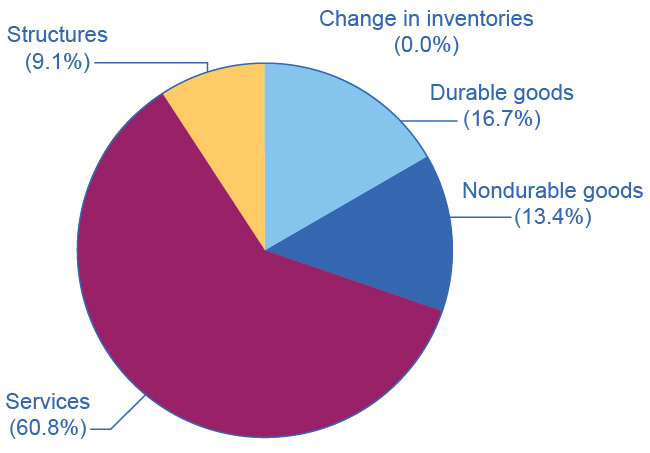
Figure 19.5図 19.5
Services make up over 60 percent of the production side components of GDP in the United States.
英語のヒント
米国のGDPを生産側から見ると、サービスが構成要素の60%以上を占める。
Since every market transaction must have both a buyer and a seller, GDP must be the same whether measured by what is demanded or by what is produced. Figure 19.6 shows these components of what is produced, expressed as a percentage of GDP, since 1950.
英語のヒント
どの市場取引にも買い手と売り手の双方がいるため、GDPは需要されるものから測っても、生産されるものから測っても同じでなければならない。図19.6は、生産されるもののこれらの構成要素を、1950年以降のGDP比で示している。
Types of Production生産の種類
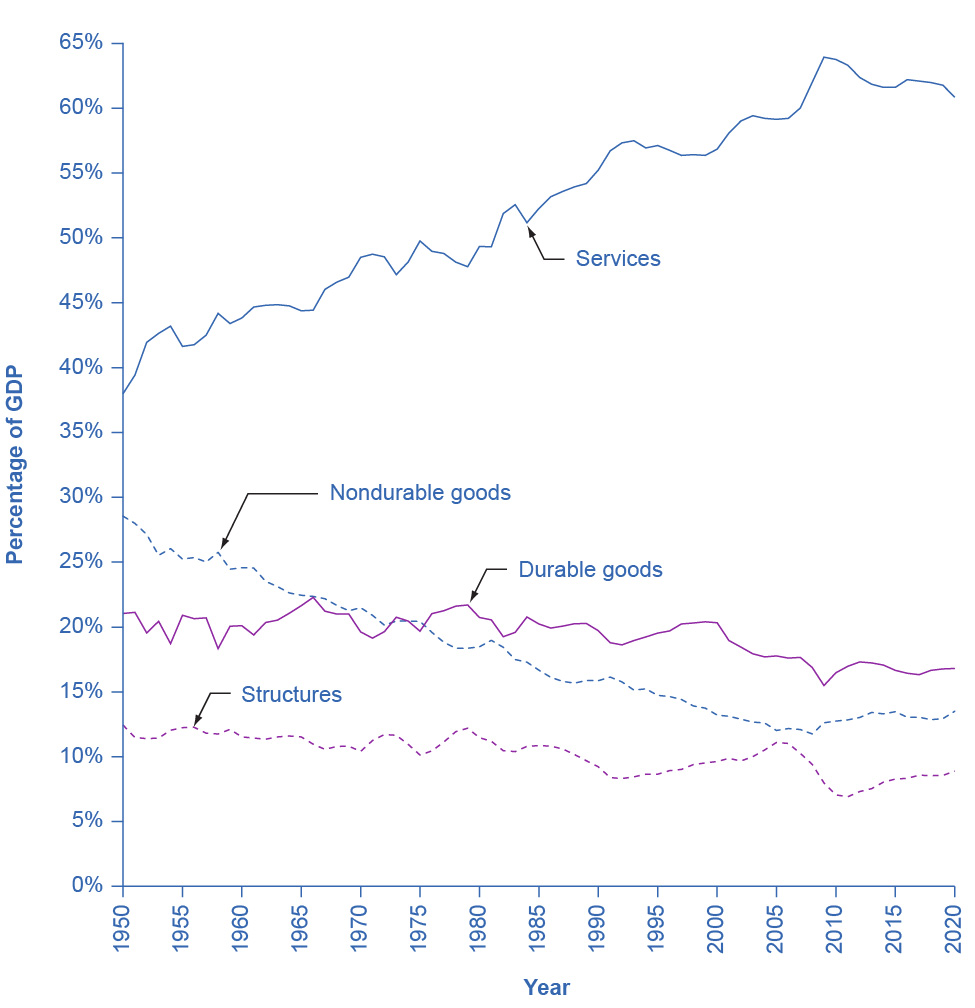


Figure 19.6図 19.6
Services are the largest single component of total supply, representing over 60 percent of GDP, up from about 45 percent in the early 1950s. Durable and nondurable goods constitute the manufacturing sector, and they have declined from 40 percent of GDP in 1950 to about 30 percent in 2016. Nondurable goods used to be larger than durable goods, but in recent years, nondurable goods have been dropping to below the share of durable goods, which is less than 20% of GDP. Structures hover around 10% of GDP. We do not show here the change in inventories, the final component of aggregate supply. It is typically less than 1% of GDP.
英語のヒント
サービスは総供給の中で最大の単一項目で、GDPの60%以上を占める。1950年代初頭の約45%から増えている。耐久財と非耐久財は製造業部門を構成し、その割合は1950年のGDP比40%から2016年の約30%へ低下した。かつては非耐久財の割合が耐久財より大きかったが、近年は低下して、GDPの20%未満である耐久財の割合を下回っている。構築物はGDPの10%前後で推移する。総供給の最後の項目である在庫の増減は、ここには示していない。通常はGDPの1%未満である。
In thinking about what is produced in the economy, many non-economists immediately focus on solid, long-lasting goods, like cars and computers. By far the largest part of GDP, however, is services. Moreover, services have been a growing share of GDP over time. A detailed breakdown of the leading service industries would include healthcare, education, and legal and financial services. It has been decades since most of the U.S. economy involved making solid objects. Instead, the most common jobs in a modern economy involve a worker looking at pieces of paper or a computer screen; meeting with co-workers, customers, or suppliers; or making phone calls.
英語のヒント
経済の中で何が生産されているかを考えるとき、経済学者でない人の多くは、自動車やコンピューターのような形があり長持ちする財にすぐ目を向ける。しかし、GDPの圧倒的に大きな部分を占めるのはサービスである。しかも、GDPに占めるサービスの割合は時間とともに増してきた。主要なサービス産業を詳しく分類すると、医療、教育、法律サービス、金融サービスなどが含まれる。米国経済の大部分が形ある物の製造に関わっていた時代から、すでに数十年がたっている。現代経済で最も一般的な仕事では、労働者は書類やコンピューター画面を見たり、同僚・顧客・仕入先と会ったり、電話をかけたりしている。
Even within the overall category of goods, long-lasting durable goods like cars and refrigerators are about the same share of the economy as short-lived nondurable goods like food and clothing. The category of structures includes everything from homes, to office buildings, shopping malls, and factories. Inventories is a small category that refers to the goods that one business has produced but has not yet sold to consumers, and are still sitting in warehouses and on shelves. The amount of inventories sitting on shelves tends to decline if business is better than expected, or to rise if business is worse than expected.
英語のヒント
財という大きな分類の中でも、自動車や冷蔵庫などの長持ちする耐久財と、食料や衣類などの短期間で使われる非耐久財は、経済に占める割合がほぼ同じである。構築物には、住宅からオフィスビル、ショッピングモール、工場までが含まれる。在庫は小さな項目で、企業が生産したものの、まだ消費者に売られず倉庫や棚に残っている財を指す。棚に残る在庫の量は、商売が予想より好調なら減り、予想より不調なら増える傾向がある。