第12章環境保護と負の外部性
12.6 The Tradeoff between Economic Output and Environmental Protection12.6 経済的生産と環境保護のトレードオフ
Learning Objectives学習目標
Learning Objectives学習目標
By the end of this section, you will be able to:
英語のヒント
この節を学ぶと、次のことができるようになる。
- Apply the production possibility frontier to evaluate the tradeoff between economic output and the environment
英語のヒント
生産可能性フロンティアを適用して、経済的生産と環境のトレードオフを評価する - Interpret a graphic representation of the tradeoff between economic output and environmental protection
英語のヒント
経済的生産と環境保護のトレードオフの図示を解釈する
We can analyze the tradeoff between economic output and the environment with a production possibility frontier (PPF) such as the one in Figure 12.5. At one extreme, at a choice like P, a country would be selecting a high level of economic output but very little environmental protection. At the other extreme, at a choice like T, a country would be selecting a high level of environmental protection but little economic output. According to the graph, an increase in environmental protection involves an opportunity cost of less economic output. No matter what their preferences, all societies should wish to avoid choices like M, which are productively inefficient. Efficiency requires that the choice should be on the production possibility frontier.
英語のヒント
経済的生産と環境のトレードオフは、図12.5のような生産可能性フロンティア(PPF)で分析できる。一方の極端な選択Pでは、国は高い経済的生産と、ごくわずかな環境保護を選ぶ。他方の極端な選択Tでは、高い環境保護と、わずかな経済的生産を選ぶ。グラフによれば、環境保護を増やすことには、経済的生産の減少という機会費用が伴う。どのような選好であっても、すべての社会は、生産の面で非効率的なMのような選択を避けたいはずである。効率性のためには、選択は生産可能性フロンティア上になければならない。
The Tradeoff between Economic Output and Environmental Protection経済的生産と環境保護のトレードオフ
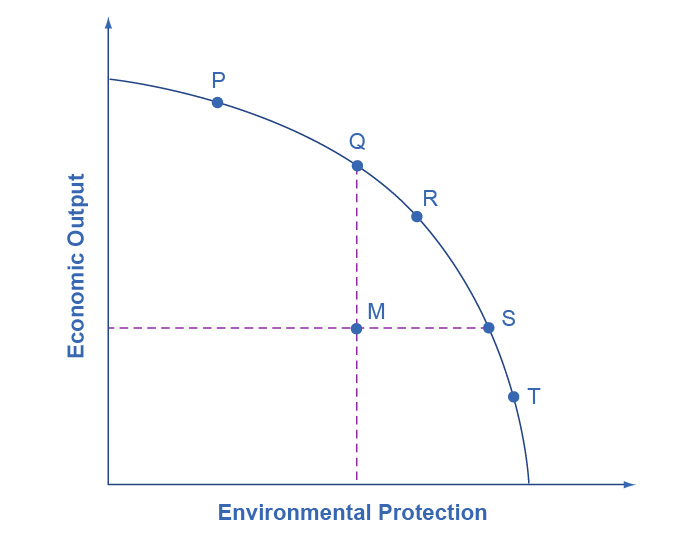

Figure 12.5図 12.5
Each society will have to weigh its own values and decide whether it prefers a choice like P with more economic output and less environmental protection, or a choice like T with more environmental protection and less economic output.
英語のヒント
各社会は自らの価値観を比較し、経済的生産が多く環境保護が少ないPのような選択を好むか、それとも環境保護が多く経済的生産が少ないTのような選択を好むかを決めなければならない。
Economists do not have a great deal to say about the choice between P, Q, R, S and T in Figure 12.5, all of which lie along the production possibility frontier. Countries with low per capita gross domestic product (GDP), such as India, place a greater emphasis on economic output—which in turn helps to produce nutrition, shelter, health, education, and desirable consumer goods. Countries with higher income levels, where a greater share of people have access to the basic necessities of life, may be willing to place a relatively greater emphasis on environmental protection.
英語のヒント
図12.5のP、Q、R、S、Tはいずれも生産可能性フロンティア上にあり、その間の選択について経済学者が言えることはそれほど多くない。インドのように1人当たり国内総生産(GDP)が低い国は、経済的生産をより重視する。それは栄養、住居、健康、教育、望ましい消費財を生み出す助けとなる。生活の基本的必需品を得られる人の割合が大きい高所得国では、環境保護を相対的により重視しようとするかもしれない。
However, economists are united in their belief that an inefficient choice such as M is undesirable. Rather than choosing M, a nation could achieve either greater economic output with the same environmental protection, as at point Q, or greater environmental protection with the same level of output, as at point S. The problem with command-and-control environmental laws is that they sometimes involve a choice like M. Market-oriented environmental tools offer a mechanism for providing either the same environmental protection at lower cost, or providing a greater degree of environmental protection for the same cost.
英語のヒント
しかし経済学者は、Mのような非効率的な選択は望ましくないという点で一致している。Mを選ぶよりも、点Qのように同じ環境保護でより多い経済的生産を達成するか、点Sのように同じ生産量でより大きな環境保護を達成できる。直接規制による環境法の問題は、時としてMのような選択を伴うことである。市場を活用する環境政策手段は、同じ環境保護をより低い費用で実現するか、同じ費用でより大きな環境保護を実現する仕組みを提供する。