第12章環境保護と負の外部性
12.1 The Economics of Pollution12.1 汚染の経済学
Learning Objectives学習目標
Learning Objectives学習目標
By the end of this section, you will be able to:
英語のヒント
この節を学ぶと、次のことができるようになる。
- Explain and give examples of positive and negative externalities
英語のヒント
正と負の外部性を説明し、例を挙げる - Identify equilibrium price and quantity
英語のヒント
均衡価格と均衡数量を求める - Evaluate how firms can contribute to market failure
英語のヒント
企業がどのように市場の失敗をもたらしうるかを評価する
From 1990 to 2023, the U.S. population increased by approximately 38 percent, and the size of the U.S. economy increased by more than 3.5-fold. Since the 1990s, however, the United States, using a variety of anti-pollution policies, has made genuine progress against a number of pollutants. Table 12.1 lists the change in industrial sector direct carbon dioxide emissions by fuel source according to the U.S. Energy Information Administration (EIA). The table shows that carbon dioxide emissions by coal declined substantially from 1990 to 2023, and carbon dioxide emissions by petroleum also declined. Over this time period, carbon dioxide emissions from coal dropped 171 million metric tons (MMT) a year—a 66% reduction. This seems to indicate that there has been progress made in the United States in reducing overall carbon dioxide emissions, which contribute to the greenhouse effect.
英語のヒント
1990年から2023年までに、米国の人口は約38パーセント増加し、経済規模は3.5倍以上になった。しかし1990年代以降、米国はさまざまな汚染対策政策を使い、多くの汚染物質について着実な進歩を遂げた。表12.1は、米国エネルギー情報局(EIA)による、産業部門の燃料別の直接的な二酸化炭素排出量の変化を示す。この表は、石炭による二酸化炭素排出量が1990年から2023年に大きく減り、石油による排出量も減ったことを示す。この期間に、石炭由来の二酸化炭素排出量は年間1億7100万メートルトン(MMT)減り、66%の削減となった。これは、温室効果に寄与する二酸化炭素の総排出量の削減について、米国で進歩があったことを示しているようである。
Year 年 |
Coal 石炭 |
Natural Gas 天然ガス |
Petroleum 石油 |
Total 合計 |
|---|---|---|---|---|
1990 |
259 |
435 |
369 |
1,063 |
2010 |
152 |
428 |
345 |
925 |
2023 |
88 |
554 |
327 |
969 |
Despite the gradual reduction in emissions from fossil fuels, many important environmental issues remain. Along with the still high levels of air and water pollution, other issues include hazardous waste disposal, destruction of wetlands and other wildlife habitats, and the impact on human health from pollution.
英語のヒント
化石燃料からの排出は徐々に減っているが、多くの重要な環境問題が残っている。依然として高水準の大気汚染や水質汚濁に加え、有害廃棄物の処理、湿地やその他の野生生物の生息地の破壊、汚染が人間の健康に及ぼす影響などがある。
Externalities外部性
Private markets, such as the cell phone industry, offer an efficient way to put buyers and sellers together and determine what goods they produce, how they produce them and who gets them. The principle that voluntary exchange benefits both buyers and sellers is a fundamental building block of the economic way of thinking. However, what happens when a voluntary exchange affects a third party who is neither the buyer nor the seller?
英語のヒント
携帯電話産業などの民間市場は、買い手と売り手を結びつけ、どの財を、どのように生産し、誰が得るかを決める効率的な方法を提供する。自発的な交換が買い手と売り手の双方に利益をもたらすという原理は、経済学的な考え方の基本要素である。しかし、自発的な交換が、買い手でも売り手でもない第三者に影響を与えると、何が起きるだろうか。
As an example, consider a concert producer who wants to build an outdoor arena that will host country music concerts a half-mile from your neighborhood. You will be able to hear these outdoor concerts while sitting on your back porch—or perhaps even in your dining room. In this case, the sellers and buyers of concert tickets may both be quite satisfied with their voluntary exchange, but you have no voice in their market transaction. The effect of a market exchange on a third party who is outside or “external” to the exchange is called an externality. Because externalities that occur in market transactions affect other parties beyond those involved, they are sometimes called spillovers.
英語のヒント
たとえば、あなたの住む地域から半マイル離れた場所に、カントリーミュージックのコンサートを開く野外会場を建てたいと考える興行主を想像しよう。あなたは家の裏のポーチに座って、あるいは食堂の中でさえ、その野外コンサートを聴ける。この場合、コンサートのチケットの売り手と買い手は、どちらも自発的な交換に十分満足しているかもしれないが、あなたにはその市場取引に口を出す権利がない。市場交換が、その交換の外側、すなわち「外部」にいる第三者に与える影響を、外部性と呼ぶ。市場取引の外部性は、取引の当事者以外にも影響を与えるため、スピルオーバーと呼ばれることもある。
Externalities can be negative or positive. If you hate country music, then having it waft into your house every night would be a negative externality. If you love country music, then what amounts to a series of free concerts would be a positive externality.
英語のヒント
外部性は負の場合も正の場合もある。カントリーミュージックが嫌いなら、それが毎晩家に流れ込んでくるのは負の外部性である。カントリーミュージックが大好きなら、事実上一連の無料コンサートとなるため、正の外部性である。
Pollution as a Negative Externality負の外部性としての汚染
Pollution is a negative externality. Economists illustrate the social costs of production with a demand and supply diagram. The social costs include the private costs of production that a company incurs and the external costs of pollution that pass on to society. Figure 12.2 shows the demand and supply for manufacturing refrigerators. The demand curve (D) shows the quantity demanded at each price. The supply curve (Sprivate) shows the quantity of refrigerators that all firms in the industry supply at each price assuming they are taking only their private costs into account and they are allowed to emit pollution at zero cost. The market equilibrium (E0), where quantity supplied equals quantity demanded, is at a price of $650 per refrigerator and a quantity of 45,000 refrigerators. Table 12.2 reflects this information in the first three columns.
英語のヒント
Taking Social Costs into Account: A Supply Shift社会的費用を考慮する:供給の移動
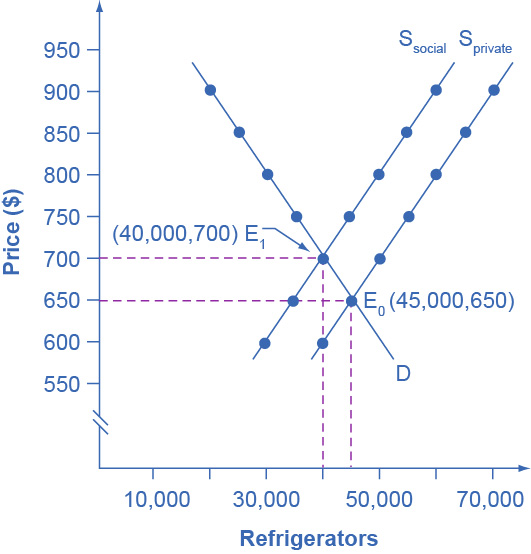

Figure 12.2図 12.2
If the firm takes only its own costs of production into account, then its supply curve will be Sprivate, and the market equilibrium will occur at E0. Accounting for additional external costs of $100 for every unit produced, the firm’s supply curve will be Ssocial. The new equilibrium will occur at E1.
英語のヒント
企業が自社の生産費用だけを考慮する場合、供給曲線はSprivateとなり、市場均衡はE0で生じる。生産1単位ごとの追加的な外部費用100ドルを考慮すると、供給曲線はSsocialとなる。新たな均衡はE1で生じる。
Price 価格 |
Quantity Demanded 需要量 |
Quantity Supplied before Considering Pollution Cost 汚染費用を考慮する前の供給量 |
Quantity Supplied after Considering Pollution Cost 汚染費用を考慮した後の供給量 |
|---|---|---|---|
$600 |
50,000 |
40,000 |
30,000 |
$650 |
45,000 |
45,000 |
35,000 |
$700 |
40,000 |
50,000 |
40,000 |
$750 |
35,000 |
55,000 |
45,000 |
$800 |
30,000 |
60,000 |
50,000 |
$850 |
25,000 |
65,000 |
55,000 |
$900 |
20,000 |
70,000 |
60,000 |
However, as a by-product of the metals, plastics, chemicals and energy that refrigerator manufacturers use, some pollution is created. Let’s say that, if these pollutants were emitted into the air and water, they would create costs of $100 per refrigerator produced. These costs might occur because of adverse effects on human health, property values, or wildlife habitat, reduction of recreation possibilities, or because of other negative impacts. In a market with no anti-pollution restrictions, firms can dispose of certain wastes absolutely free. Now imagine that firms which produce refrigerators must factor in these external costs of pollution—that is, the firms have to consider not only labor and material costs, but also the broader costs to society of harm to health and other costs caused by pollution. If the firm is required to pay $100 for the additional external costs of pollution each time it produces a refrigerator, production becomes more costly and the entire supply curve shifts up by $100.
英語のヒント
しかし、冷蔵庫メーカーが使う金属、プラスチック、化学物質、エネルギーの副産物として、いくらかの汚染が生じる。これらの汚染物質を大気や水中に排出すると、生産した冷蔵庫1台当たり100ドルの費用が生じるとしよう。この費用は、人間の健康、財産価値、野生生物の生息地への悪影響、余暇活動の機会の減少、あるいはその他の悪影響によって生じるかもしれない。汚染防止の制限がない市場では、企業は一部の廃棄物をまったく無料で処分できる。今度は、冷蔵庫を生産する企業が、この汚染の外部費用を考慮しなければならないとしよう。つまり、人件費や材料費だけでなく、汚染による健康被害やその他の費用という、より広い社会的費用も考慮するのである。冷蔵庫を1台生産するたびに、追加的な汚染の外部費用100ドルを支払うよう求められると、生産費用が上がり、供給曲線全体が100ドル上へ移動する。
As Table 12.2 and Figure 12.2 illustrate, the firm will need to receive a price of $700 per refrigerator and produce a quantity of 40,000—and the firm’s new supply curve will be Ssocial. The new equilibrium will occur at E1. In short, taking the additional external costs of pollution into account results in a higher price, a lower quantity of production, and a lower quantity of pollution. The following Work It Out feature will walk you through an example, this time with musical accompaniment.
英語のヒント
Remember that the supply curve is based on choices about production that firms make while looking at their marginal costs, while the demand curve is based on the benefits that individuals perceive while maximizing utility. If no externalities existed, private costs would be the same as the costs to society as a whole, and private benefits would be the same as the benefits to society as a whole. Thus, if no externalities existed, the interaction of demand and supply will coordinate social costs and benefits.
英語のヒント
供給曲線は企業が限界費用を見ながら行う生産の選択に基づき、需要曲線は個人が効用を最大化する際に認識する便益に基づくことを思い出そう。外部性がなければ、私的費用は社会全体の費用に等しく、私的便益は社会全体の便益に等しい。したがって外部性がなければ、需要と供給の相互作用が社会的費用と社会的便益を調整する。
However, when the externality of pollution exists, the supply curve no longer represents all social costs. Because externalities represent a case where markets no longer consider all social costs, but only some of them, economists commonly refer to externalities as an example of market failure. When there is market failure, the private market fails to achieve efficient output, because either firms do not account for all costs incurred in the production of output and/or consumers do not account for all benefits obtained (a positive externality). In the case of pollution, at the market output, social costs of production exceed social benefits to consumers, and the market produces too much of the product.
英語のヒント
しかし、汚染という外部性が存在すると、供給曲線はもはや社会的費用のすべてを表さない。外部性は、市場が社会的費用のすべてではなく一部しか考慮しない場合を表すため、経済学者は通常、外部性を市場の失敗の一例と呼ぶ。市場の失敗があると、企業が生産で生じる費用をすべて考慮しないか、消費者が得られる便益をすべて考慮しない(正の外部性)か、その両方により、民間市場は効率的な生産量を実現できない。汚染の場合、市場の生産量では生産の社会的費用が消費者への社会的便益を上回り、市場は製品を過剰に生産する。
We can see a general lesson here. If firms were required to pay the social costs of pollution, they would create less pollution but produce less of the product and charge a higher price. In the next module, we will explore how governments require firms to account for the social costs of pollution.
英語のヒント
ここから一般的な教訓が得られる。企業が汚染の社会的費用の支払を求められれば、汚染を減らす一方、製品の生産量を減らし、価格を引き上げるだろう。次の節では、政府が汚染の社会的費用を考慮するよう、企業にどのように求めるかを調べる。