第12章環境保護と負の外部性
Key Concepts and Summary重要概念とまとめ
Depending on their different income levels and political preferences, countries are likely to make different choices about allocative efficiency—that is, the choice between economic output and environmental protection along the production possibility frontier. However, all countries should prefer to make a choice that shows productive efficiency—that is, the choice is somewhere on the production possibility frontier rather than inside it. Revisit Choice in a World of Scarcity for more on these terms.
英語のヒント
所得水準や政治的選好の違いに応じて、各国は配分の効率性、すなわち生産可能性フロンティア上での経済的生産と環境保護の選択について、異なる選択をする可能性が高い。しかしすべての国は、生産の効率性を示す選択、つまり生産可能性フロンティアの内側ではなく、その上のどこかを選ぶことを好むはずである。これらの用語について詳しくは、「希少性の世界における選択」を再確認しよう。
Self-Check Questions理解度確認問題
Exercises 40練習問題 40
Exercise 40問題 40
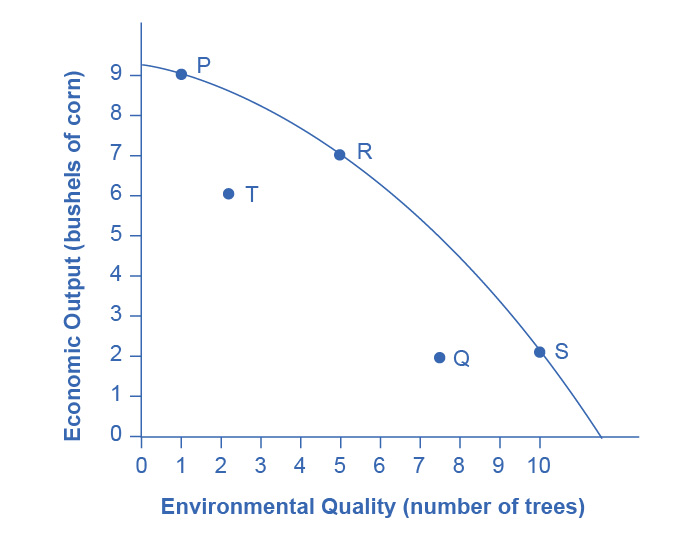
A country called Sherwood is very heavily covered with a forest of 50,000 trees. There are proposals to clear some of Sherwood’s forest and grow corn, but obtaining this additional economic output will have an environmental cost from reducing the number of trees. Table 12.13 shows possible combinations of economic output and environmental protection.
英語のヒント
シャーウッドという国は、5万本の木からなる森林に非常に広く覆われている。その一部を伐採してトウモロコシを栽培する計画があるが、この追加的な経済生産を得るには、木の本数の減少による環境費用が伴う。表12.13は、可能な経済的生産と環境保護の組合せを示す。
Combos 組合せ |
Corn Bushels (thousands) トウモロコシ(千ブッシェル) |
Number of Trees (thousands) 木の本数(千本) |
|---|---|---|
P |
9 |
1 |
Q |
2 |
7.5 |
R |
7 |
5 |
S |
2 |
1 |
T |
6 |
2 |
- Sketch a graph of a production possibility frontier with environmental quality on the horizontal axis, measured by the number of trees, and the quantity of economic output, measured in corn, on the vertical axis.
英語のヒント
横軸に木の本数で測る環境の質を、縦軸にトウモロコシで測る経済的生産量を取り、生産可能性フロンティアのグラフを描きなさい。 - Which choices display productive efficiency? How can you tell?
英語のヒント
どの選択が生産の効率性を示すか。どうすればわかるか。 - Which choices show allocative efficiency? How can you tell?
英語のヒント
どの選択が配分の効率性を示すか。どうすればわかるか。 - In the choice between T and R, decide which one is better. Why?
英語のヒント
TとRの選択では、どちらがよいかを決めなさい。それはなぜか。 - In the choice between T and S, can you say which one is better, and why?
英語のヒント
TとSの選択では、どちらがよいか、またその理由を言えるか。 - If you had to guess, which choice would you think is more likely to represent a command-and-control environmental policy and which choice is more likely to represent a market-oriented environmental policy, choice Q or S? Why?
英語のヒント
QとSのどちらが直接規制による環境政策を、どちらが市場を活用する環境政策を表す可能性が高いと推測するか。それはなぜか。
Solution解き方
- Of the choices provided, P, R, and S demonstrate productive efficiency. These are the choices on the production possibility frontier.
英語のヒント
示された選択肢では、P、R、Sが生産の効率性を示す。これらは生産可能性フロンティア上の選択である。 - Allocative efficiency is determined by the preferences—in this case by the preferences of society as expressed through government and other social institutions. Because you do not have information about these preferences, you really cannot say much about allocative efficiency.
英語のヒント
配分の効率性は選好によって決まる。この場合は、政府や他の社会制度を通じて表される社会の選好である。その選好の情報がないので、配分の効率性についてはほとんど何も言えない。 - In the choice between T and R, R should clearly be preferred, because it has both more corn and more trees. This answer illustrates why productive efficiency is beneficial. Compared with choices inside the PPF, it means more of one or both goods.
英語のヒント
TとRなら、トウモロコシも木も多いRが明らかに望ましい。この解答は、生産の効率性が有益な理由を示す。PPFの内側の選択に比べ、一方または両方の財をより多く得られるからである。 - In the choice between T and S, it is not possible to say which choice is better. True, S is on the PPF and T is not—but that only addresses the issue of productive efficiency. If a society has a strong preference for economic output and places a lower value on trees, then allocative efficiency may lead to a choice of T over S. Of course, the reverse could also be true, leading to a choice of S. Without information on society’s preferences to judge allocative efficiency, this question cannot be answered.
英語のヒント
TとSの選択では、どちらがよいとは言えない。確かにSはPPF上にあり、Tはないが、それは生産の効率性だけの問題である。社会が経済的生産を強く好み、木の価値を低く評価するなら、配分の効率性からはSよりTを選ぶことがありうる。もちろん逆もあり、Sが選ばれる場合もある。配分の効率性を判断するための社会の選好の情報がなければ、この問いには答えられない。 - Compared with command-and-control policies, market-oriented policies allow either more output with the same environmental protection or more environmental protection with the same level of output—or more of both environmental protection and output. Thus, a choice like Q inside the PPF is more likely to represent a command-and-control policy demand than a choice like S on the frontier of the PPF.
英語のヒント
直接規制に比べ、市場を活用する政策は、同じ環境保護でより多い生産、同じ生産量でより多い環境保護、または環境保護と生産の両方の増加を可能にする。したがって、PPFの内側のQのような選択は、PPF上のSのような選択より、直接規制による政策の要求を表す可能性が高い。

Review Questions復習問題
Exercises 41–42練習問題 41–42
Exercise 41問題 41
In the tradeoff between economic output and environmental protection, what do the combinations on the protection possibility curve represent?
英語のヒント
経済的生産と環境保護のトレードオフにおいて、保護可能性曲線上の組合せは何を表すか。
Exercise 42問題 42
What does a point inside the production possibility frontier represent?
英語のヒント
生産可能性フロンティアの内側の点は何を表すか。
Critical Thinking Questions考察問題
Exercises 43練習問題 43
Exercise 43問題 43
Technological innovations shift the production possibility curve. Look at graph you sketched for Exercise 40. Which types of technologies should a country promote? Should “clean” technologies be promoted over other technologies? Why or why not?
英語のヒント
技術革新は生産可能性曲線を移動させる。演習40で描いたグラフを見なさい。国はどの種類の技術を促進すべきか。他の技術より「クリーン」な技術を促進すべきか。それはなぜか。
Problems問題
Exercises 44練習問題 44
Exercise 44問題 44
In the Land of Purity, there is only one form of pollution, called “gunk.” Table 12.14 shows possible combinations of economic output and reduction of gunk, depending on what kinds of environmental regulations you choose.
英語のヒント
純潔の国には、「汚れ」と呼ばれる1種類の汚染しかない。表12.14は、選ぶ環境規制の種類に応じた、経済的生産と汚れの削減の可能な組合せを示す。
Combos 組合せ |
Eco Output 経済的生産 |
Gunk Cleaned Up 除去した汚れ |
|---|---|---|
J |
800 |
10% |
K |
500 |
30% |
L |
600 |
40% |
M |
400 |
40% |
N |
100 |
90% |
- Sketch a graph of a production possibility frontier with environmental quality on the horizontal axis, measured by the percentage reduction of gunk, and with the quantity of economic output on the vertical axis.
英語のヒント
横軸に汚れの削減率で測る環境の質を、縦軸に経済的生産量を取り、生産可能性フロンティアのグラフを描きなさい。 - Which choices display productive efficiency? How can you tell?
英語のヒント
どの選択が生産の効率性を示すか。どうすればわかるか。 - Which choices show allocative efficiency? How can you tell?
英語のヒント
どの選択が配分の効率性を示すか。どうすればわかるか。 - In the choice between K and L, can you say which one is better and why?
英語のヒント
KとLの選択では、どちらがよいか、またその理由を言えるか。 - In the choice between K and N, can you say which one is better, and why?
英語のヒント
KとNの選択では、どちらがよいか、またその理由を言えるか。 - If you had to guess, which choice would you think is more likely to represent a command-and-control environmental policy and which choice is more likely to represent a market-oriented environmental policy, choice L or M? Why?
英語のヒント
LとMのどちらが直接規制による環境政策を、どちらが市場を活用する環境政策を表す可能性が高いと推測するか。それはなぜか。