第12章環境保護と負の外部性
Marginal Benefits and Marginal Costs限界便益と限界費用
We can use the tools of marginal analysis to illustrate the marginal costs and the marginal benefits of reducing pollution. Figure 12.4 illustrates a theoretical model of this situation. When the quantity of environmental protection is low so that pollution is extensive—for example, at quantity Qa—there are usually numerous relatively cheap and easy ways to reduce pollution, and the marginal benefits of doing so are quite high. At Qa, it makes sense to allocate more resources to fight pollution. However, as the extent of environmental protection increases, the cheap and easy ways of reducing pollution begin to decrease, and one must use more costly methods. The marginal cost curve rises. Also, as environmental protection increases, one achieves the largest marginal benefits first, followed by reduced marginal benefits. As the quantity of environmental protection increases to, say, Qb, the gap between marginal benefits and marginal costs narrows. At point Qc the marginal costs will exceed the marginal benefits. At this level of environmental protection, society is not allocating resources efficiently, because it is forfeiting too many resources to reduce pollution.
英語のヒント
限界分析の道具を使い、汚染削減の限界費用と限界便益を示せる。図12.4は、この状況の理論モデルを示す。環境保護の量が少なく、汚染が広範囲に及ぶ場合、たとえば数量Qaでは、通常、比較的安く容易に汚染を減らせる方法が数多くあり、その限界便益はかなり高い。Qaでは、汚染対策により多くの資源を配分するのが理にかなう。しかし環境保護が進むにつれ、安く容易な削減方法は減り始め、より高い費用の方法を使わなければならなくなる。限界費用曲線は上昇する。また環境保護を増やすと、最も大きな限界便益が最初に得られ、その後は限界便益が小さくなる。環境保護の量が、たとえばQbまで増えると、限界便益と限界費用の差は縮まる。点Qcでは限界費用が限界便益を上回る。この水準では、汚染削減のためにあまりに多くの資源を犠牲にしており、社会は資源を効率的に配分していない。
Marginal Costs and Marginal Benefits of Environmental Protection環境保護の限界費用と限界便益
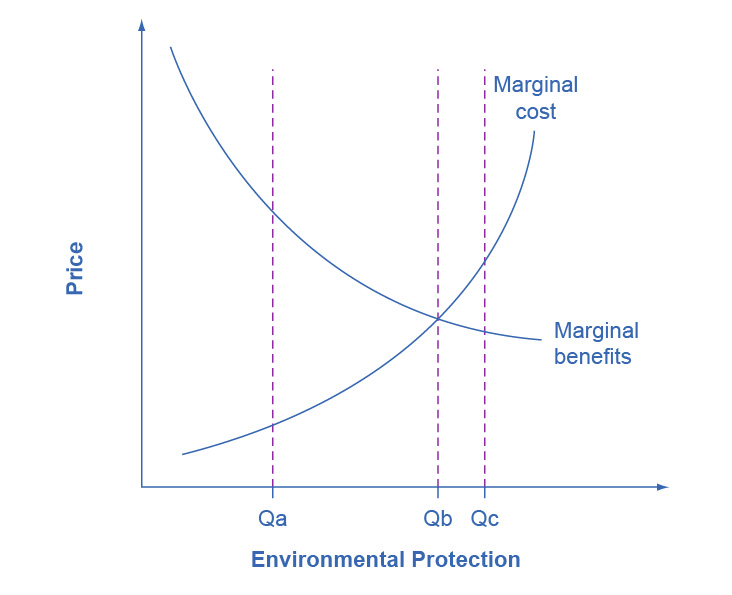

Figure 12.4図 12.4
Reducing pollution is costly—one must sacrifice resources. The marginal costs of reducing pollution are generally increasing, because one can first make the least expensive and easiest reductions, leaving the more expensive methods for later. The marginal benefits of reducing pollution are generally declining, because one can take the steps that provide the greatest benefit first, and steps that provide less benefit can wait until later.
英語のヒント
汚染削減には費用がかかり、資源を犠牲にしなければならない。最も安く容易な削減を先に行い、高い費用の方法を後に残せるため、汚染削減の限界費用は一般に増加する。最も便益の大きい措置を先に行い、便益の小さい措置を後回しにできるため、汚染削減の限界便益は一般に減少する。
As society draws closer to Qb, some might argue that it becomes more important to use market-oriented environmental tools to hold down the costs of reducing pollution. Their objective would be to avoid environmental rules that would provide the quantity of environmental protection at Qc, where marginal costs exceed marginal benefits. The following Clear It Up feature delves into how the EPA measures its policies – and the monetary value of our lives.
英語のヒント
社会がQbに近づくにつれ、汚染削減費用を抑えるために市場を活用する環境政策手段を使う重要性が増す、と主張する人もいる。その目的は、限界費用が限界便益を上回るQcの環境保護量をもたらすような環境規則を避けることである。次の「疑問を解こう」では、EPAが政策をどう測るか、そして私たちの生命の金銭価値を詳しく扱う。
Key Concepts and Summary重要概念とまとめ
We can make a strong case, taken as a whole, that the benefits of U.S. environmental regulation have outweighed the costs. As the extent of environment regulation increases, additional expenditures on environmental protection will probably have increasing marginal costs and decreasing marginal benefits. This pattern suggests that the flexibility and cost savings of market-oriented environmental policies will become more important.
英語のヒント
全体として見ると、米国の環境規制の便益は費用を上回ってきたという強い主張ができる。環境規制が進むにつれ、環境保護への追加支出は、おそらく限界費用が増加し、限界便益が減少する。このパターンは、市場を活用する環境政策の柔軟性と費用節約が、さらに重要になることを示唆する。