第7章生産・費用・産業構造
Fixed and Variable Costs固定費用と可変費用
We can decompose costs into fixed and variable costs. Fixed costs are the costs of the fixed inputs (e.g., capital). Because fixed inputs do not change in the short run, fixed costs are expenditures that do not change regardless of the level of production. Whether you produce a great deal or a little, the fixed costs are the same. One example is the rent on a factory or a retail space. Once you sign the lease, the rent is the same regardless of how much you produce, at least until the lease expires. Fixed costs can take many other forms: for example, the cost of machinery or equipment to produce the product, research and development costs to develop new products, even an expense like advertising to popularize a brand name. The amount of fixed costs varies according to the specific line of business: for instance, manufacturing computer chips requires an expensive factory, but a local moving and hauling business can get by with almost no fixed costs at all if it rents trucks by the day when needed.
英語のヒント
費用は固定費用と可変費用に分けられる。固定費用は、資本などの固定投入物の費用だ。固定投入物は短期には変わらないため、固定費用は生産水準によらず変わらない支出である。大量に生産しても、少量でも同じだ。工場や店舗の賃料が一例である。賃貸契約を結べば、少なくとも契約が切れるまでは、生産量によらず賃料は変わらない。生産用の機械や設備、新製品の研究開発、ブランドを広める広告など、固定費用にはほかにも多くの形がある。固定費用の額は業種で異なる。コンピューターチップの製造には高額な工場が必要だが、地域の引っ越し・運送業者なら、必要な日にトラックを借りれば、固定費用はほとんどなくても営業できる。
Variable costs are the costs of the variable inputs (e.g., labor). The only way to increase or decrease output is by increasing or decreasing the variable inputs. Therefore, variable costs increase or decrease with output. We treat labor as a variable cost, since producing a greater quantity of a good or service typically requires more workers or more work hours. Variable costs would also include raw materials.
英語のヒント
可変費用は、労働などの可変投入物の費用だ。産出量を増減するには、可変投入物を増減するしかない。そのため、可変費用は産出量とともに増減する。財やサービスの生産を増やすには、通常、労働者数や労働時間を増やす必要があるので、労働は可変費用として扱う。原材料も含まれる。
Total costs are the sum of fixed plus variable costs. Let's look at another example. Consider the barber shop called “The Clip Joint” in Figure 7.7. The data for output and costs are in Table 7.9. The fixed costs of operating the barber shop, including the space and equipment, are $160 per day. The variable costs are the costs of hiring barbers, which in our example is $80 per barber each day. The first two columns of the table show the quantity of haircuts the barbershop can produce as it hires additional barbers. The third column shows the fixed costs, which do not change regardless of the level of production. The fourth column shows the variable costs at each level of output. We calculate these by taking the amount of labor hired and multiplying by the wage. For example, two barbers cost: 2 × $80 = $160. Adding together the fixed costs in the third column and the variable costs in the fourth column produces the total costs in the fifth column. For example, with two barbers the total cost is: $160 + $160 = $320.
英語のヒント
Labor 労働 |
Quantity 数量 |
Fixed Cost 固定費用 |
Variable Cost 可変費用 |
Total Cost 総費用 |
|---|---|---|---|---|
1 |
16 |
$160 |
$80 |
$240 |
2 |
40 |
$160 |
$160 |
$320 |
3 |
60 |
$160 |
$240 |
$400 |
4 |
72 |
$160 |
$320 |
$480 |
5 |
80 |
$160 |
$400 |
$560 |
6 |
84 |
$160 |
$480 |
$640 |
7 |
82 |
$160 |
$560 |
$720 |
How Output Affects Total Costs産出量が総費用に与える影響
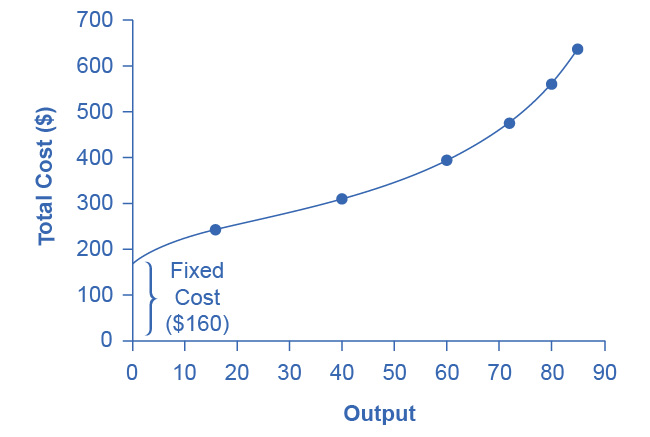

Figure 7.7図 7.7
At zero production, the fixed costs of $160 are still present. As production increases, variable costs are added to fixed costs, and the total cost is the sum of the two.
英語のヒント
生産がゼロでも固定費用160ドルは発生する。生産が増えると、固定費用に可変費用が加わる。総費用は両者の合計だ。
At zero production, the fixed costs of $160 are still present. As production increases, we add variable costs to fixed costs, and the total cost is the sum of the two. Figure 7.7 graphically shows the relationship between the quantity of output produced and the cost of producing that output. We always show the fixed costs as the vertical intercept of the total cost curve; that is, they are the costs incurred when output is zero so there are no variable costs.
英語のヒント
生産がゼロでも固定費用160ドルは発生する。生産が増えると、固定費用に可変費用を加える。総費用は両者の合計だ。図7.7は、産出量とその生産費用の関係をグラフにしている。固定費用は常に総費用曲線の縦軸切片で示す。産出量がゼロで可変費用が発生しないときにも、かかる費用だからだ。
You can see from the graph that once production starts, total costs and variable costs rise. While variable costs may initially increase at a decreasing rate, at some point they begin increasing at an increasing rate. This is caused by diminishing marginal productivity which we discussed earlier in the Production in the Short Run section of this chapter, which is easiest to see with an example. As the number of barbers increases from zero to one in the table, output increases from 0 to 16 for a marginal gain (or marginal product) of 16. As the number rises from one to two barbers, output increases from 16 to 40, a marginal gain of 24. From that point on, though, the marginal product diminishes as we add each additional barber. For example, as the number of barbers rises from two to three, the marginal product is only 20; and as the number rises from three to four, the marginal product is only 12.
英語のヒント
グラフから、生産を始めると総費用と可変費用が増えることが分かる。可変費用は、最初は増加の速さが下がることがあるが、ある段階から増加の速さが上がる。これは、前の「短期の生産」で述べた限界生産性の逓減による。例で見ると分かりやすい。表で理髪師が0人から1人になると、産出量は0件から16件へ増え、限界的な増加、すなわち限界生産物は16件だ。1人から2人なら16件から40件へ増え、限界生産物は24件になる。しかし、それ以降は追加するたびに限界生産物が減る。2人から3人なら20件、3人から4人なら12件にすぎない。
To understand the reason behind this pattern, consider that a one-man barber shop is a very busy operation. The single barber needs to do everything: say hello to people entering, answer the phone, cut hair, sweep, and run the cash register. A second barber reduces the level of disruption from jumping back and forth between these tasks, and allows a greater division of labor and specialization. The result can be increasing marginal productivity. However, as the shop adds other barbers, the advantage of each additional barber is less, since the specialization of labor can only go so far. The addition of a sixth or seventh or eighth barber just to greet people at the door will have less impact than the second one did. This is the pattern of diminishing marginal productivity. As a result, the total costs of production will begin to rise more rapidly as output increases. At some point, you may even see negative returns as the additional barbers begin bumping elbows and getting in each other’s way. In this case, the addition of still more barbers would actually cause output to decrease, as the last row of Table 7.9 shows.
英語のヒント
この形になる理由を理解するため、1人で営む理髪店の忙しさを考えよう。客への挨拶、電話、散髪、掃除、会計をすべて1人で行う必要がある。2人目が加わると、作業を行き来する中断が減り、分業と専門化が進む。その結果、限界生産性が上昇することがある。しかし、さらに人を増やしても、労働の専門化には限界があるので、1人を追加する利点は小さくなる。入口で客を迎えるためだけに6人目、7人目、8人目を加えても、2人目ほどの効果はない。これが限界生産性の逓減である。結果として、産出量が増えると総費用は次第に速く増える。ある段階では、増えた理髪師が互いにぶつかって邪魔になり、収穫がマイナスになることさえある。この場合、表7.9の最後の行のように、さらに理髪師を増やすと、実際には産出量が減る。
This pattern of diminishing marginal productivity is common in production. As another example, consider the problem of irrigating a crop on a farmer’s field. The plot of land is the fixed factor of production, while the water that the farmer can add to the land is the key variable cost. As the farmer adds water to the land, output increases. However, adding increasingly more water brings smaller increases in output, until at some point the water floods the field and actually reduces output. Diminishing marginal productivity occurs because, with fixed inputs (land in this example), each additional unit of input (e.g., water) contributes less to overall production.
英語のヒント
限界生産性の逓減は生産で一般的に見られる。別の例として、農地の作物への灌漑を考えよう。土地は固定された生産要素で、水が主な可変費用だ。水を増やすと収穫量は増える。しかし、水をさらに増やすほど収穫量の増加は小さくなり、やがて畑が水浸しになると、収穫量は実際に減る。限界生産性が逓減するのは、固定投入物(ここでは土地)の下で、投入物(水など)の追加1単位が全体の生産に寄与する量が小さくなるためである。