第7章生産・費用・産業構造
7.2 Production in the Short Run7.2 短期の生産
Learning Objectives学習目標
Learning Objectives学習目標
By the end of this section, you will be able to:
英語のヒント
この節を学ぶと、次のことができるようになる。
- Understand the concept of a production function
英語のヒント
生産関数の概念を理解する - Differentiate between the different types of inputs or factors in a production function
英語のヒント
生産関数の投入物・生産要素の種類を区別する - Differentiate between fixed and variable inputs
英語のヒント
固定投入物と可変投入物を区別する - Differentiate between production in the short run and in the long run
英語のヒント
短期の生産と長期の生産を区別する - Differentiate between total and marginal product
英語のヒント
総生産物と限界生産物を区別する - Understand the concept of diminishing marginal productivity
英語のヒント
限界生産性の逓減を理解する
In this chapter, we want to explore the relationship between the quantity of output a firm produces, and the cost of producing that output. We mentioned that the cost of the product depends on how many inputs are required to produce the product and what those inputs cost. We can answer the former question by looking at the firm’s production function.
英語のヒント
この章では、企業の生産量と、その生産にかかる費用の関係を調べたい。製品の費用は、生産に必要な投入物の量と、その投入物にかかる費用によると述べた。前者は、企業の生産関数を見ることで分かる。
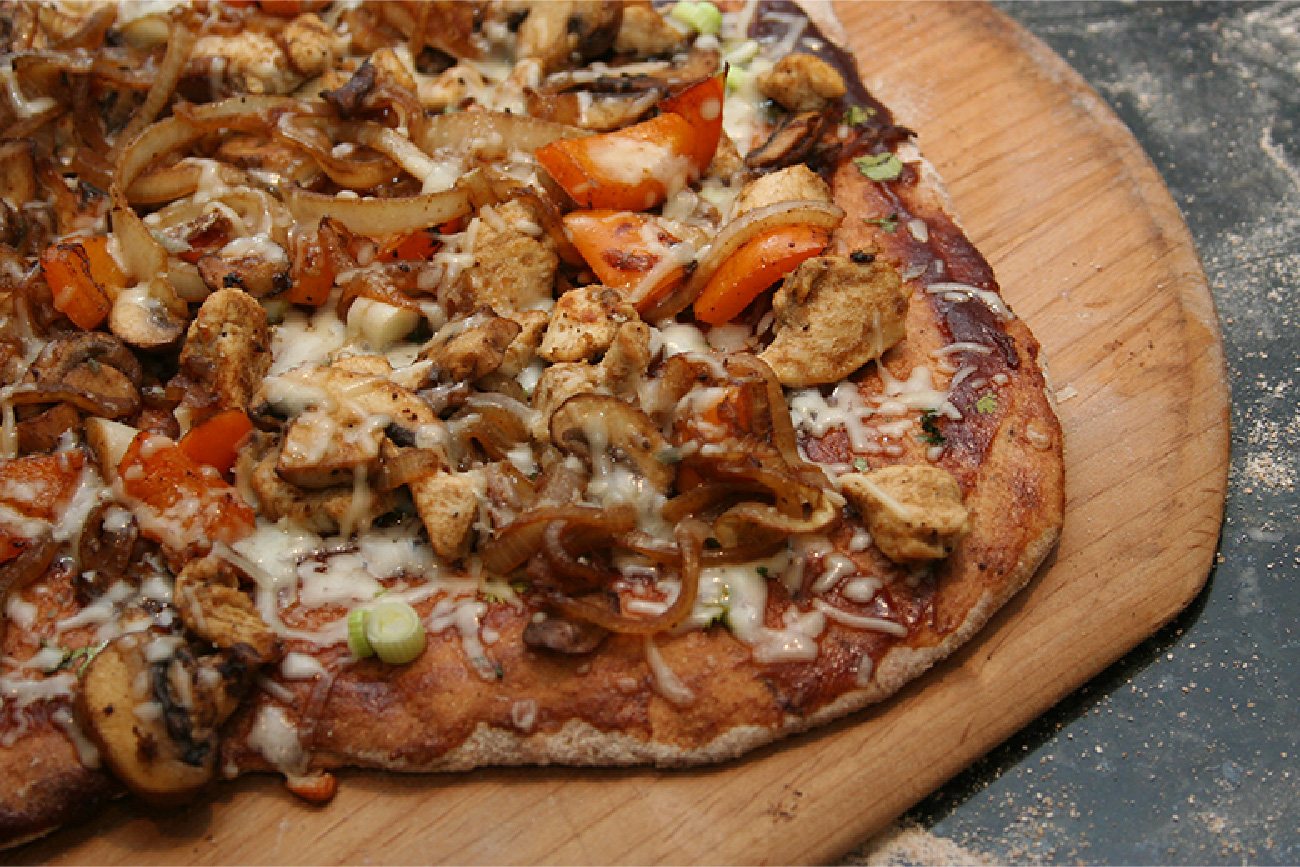
The production process for pizza includes inputs such as ingredients, the efforts of the pizza maker, and tools and materials for cooking and serving. (Credit: “Grilled gluten-free BBQ chicken pizza” by Keith McDuffee/Flickr, CC BY 2.0) · CC BY 2.0 · Source出典
Figure 7.3図 7.3
The production process for pizza includes inputs such as ingredients, the efforts of the pizza maker, and tools and materials for cooking and serving. (Credit: “Grilled gluten-free BBQ chicken pizza” by Keith McDuffee/Flickr, CC BY 2.0)
英語のヒント
ピザの生産過程には、食材、ピザ職人の労力、調理や提供に使う道具と材料などの投入物がある。(出典:Keith McDuffee/Flickr「Grilled gluten-free BBQ chicken pizza」、CC BY 2.0)
Production is the process (or processes) a firm uses to transform inputs (e.g., labor, capital, raw materials) into outputs, i.e. the goods or services the firm wishes to sell. Consider pizza making. The pizzaiolo (pizza maker) takes flour, water, and yeast to make dough. Similarly, the pizzaiolo may take tomatoes, spices, and water to make pizza sauce. The cook rolls out the dough, brushes on the pizza sauce, and adds cheese and other toppings. The pizzaiolo uses a peel—the shovel-like wooden tool—to put the pizza into the oven to cook. Once baked, the pizza goes into a box (if it’s for takeout) and the customer pays for the good. What are the inputs (or factors of production) in the production process for this pizza?
英語のヒント
生産とは、企業が投入物(労働、資本、原材料など)を産出物、すなわち販売したい財やサービスへ変える過程である。ピザ作りを考えよう。ピッツァイオーロ(ピザ職人)は小麦粉、水、酵母から生地を作る。同様に、トマト、香辛料、水からピザソースを作ることもある。生地を伸ばし、ソースを塗り、チーズなどの具を載せる。ピザ職人はピールというシャベルに似た木の道具で、ピザをオーブンに入れて焼く。焼き上がると、持ち帰りなら箱に入れ、客が代金を払う。このピザの生産過程では、何が投入物(生産要素)に当たるだろうか。
Economists divide factors of production into several categories:
英語のヒント
経済学者は、生産要素をいくつかの種類に分ける。
- Natural Resources (Land and Raw Materials) - The ingredients for the pizza are raw materials. These include the flour, yeast, and water for the dough, the tomatoes, herbs, and water for the sauce, the cheese, and the toppings. If the pizza place uses a wood-burning oven, we would include the wood as a raw material. If the establishment heats the oven with natural gas, we would count this as a raw material. Don’t forget electricity for lights. If, instead of pizza, we were looking at an agricultural product, like wheat, we would include the land the farmer used for crops here.
英語のヒント
天然資源(土地と原材料)―ピザの食材は原材料である。生地の小麦粉、酵母、水、ソースのトマト、ハーブ、水、チーズ、その他の具が含まれる。薪のオーブンを使う店なら、薪も原材料に含む。天然ガスでオーブンを加熱するなら、これも原材料に数える。照明の電気も忘れてはならない。ピザではなく小麦などの農産物なら、作物の栽培に使う土地もここに含む。 - Labor – When we talk about production, labor means human effort, both physical and mental. The pizzaiolo was the primary example of labor here. They need to be strong enough to roll out the dough and to insert and retrieve the pizza from the oven, but they also must know how to make the pizza, how long it cooks in the oven and a myriad of other aspects of pizza-making. The business may also have one or more people to work the counter, take orders, and receive payment.
英語のヒント
労働―生産についていう労働は、身体的・精神的な人間の努力を指す。ここではピザ職人が主な例だ。生地を伸ばし、ピザをオーブンに入れて取り出せる力だけでなく、作り方、焼き時間、そのほかピザ作りの数多くの事柄を知っている必要がある。店には、カウンターで注文や支払いを受ける人が1人以上いるかもしれない。 - Capital – When economists uses the term capital, they do not mean financial capital (money); rather, they mean physical capital, the machines, equipment, and buildings that one uses to produce the product. In the case of pizza, the capital includes the peel, the oven, the building, and any other necessary equipment (for example, tables and chairs).
英語のヒント
資本―経済学者がいう資本は、金融資本(お金)ではなく、生産に使う機械、設備、建物という物的資本である。ピザの場合、ピール、オーブン、建物、その他の必要な設備(テーブルや椅子など)が資本に含まれる。 - Technology – Technology refers to the process or processes for producing the product. How does the pizzaiolo combine ingredients to make pizza? How hot should the oven be? How long should the pizza cook? What is the best oven to use? Gas or wood burning? Should the restaurant make its own dough, sauce, cheese, toppings, or should it buy them?
英語のヒント
技術―技術は、製品を生産する過程を指す。ピザ職人は食材をどう組み合わせるのか。オーブンの温度は何度にすべきか。どれだけ焼くべきか。どのオーブンが最適か。ガスか薪か。生地、ソース、チーズ、具を店で作るべきか、それとも買うべきか。 - Entrepreneurship – Production involves many decisions and much knowledge, even for something as simple as pizza. Who makes those decisions? Ultimately, it is the entrepreneur, the person who creates the business, whose idea it is to combine the inputs to produce the outputs.
英語のヒント
企業家活動―ピザのように単純なものでも、生産には多くの判断と知識が必要だ。その判断をするのは誰か。最終的には、企業を作る企業家である。投入物を組み合わせて産出物を生み出そうという考えを持った人だ。
The cost of producing pizza (or any output) depends on the amount of labor capital, raw materials, and other inputs required and the price of each input to the entrepreneur. Let’s explore these ideas in more detail.
英語のヒント
ピザに限らず、生産費用は、必要な労働、資本、原材料などの投入量と、企業家が払う各投入物の価格による。この考えを詳しく見ていこう。
We can summarize the ideas so far in terms of a production function, a mathematical expression or equation that explains the engineering relationship between inputs and outputs:
英語のヒント
ここまでの考えを、生産関数でまとめられる。これは、投入物と産出物の工学的な関係を表す数式や方程式である。
The production function gives the answer to the question, how much output can the firm produce given different amounts of inputs? Production functions are specific to the product. Different products have different production functions. The amount of labor a farmer uses to produce a bushel of wheat is likely different than that required to produce an automobile. Firms in the same industry may have somewhat different production functions, since each firm may produce a little differently. One pizza restaurant may make its own dough and sauce, while another may buy those pre-made. A sit-down pizza restaurant probably uses more labor (to handle table service) than a purely take-out restaurant.
英語のヒント
生産関数は、投入量が異なると企業がどれだけ生産できるかを示す。生産関数は製品ごとに異なる。小麦1ブッシェルの生産に農家が使う労働量は、自動車1台の生産に必要な量と異なるだろう。同じ産業でも、生産方法が少しずつ違うため、生産関数は企業によって多少異なることがある。あるピザ店は生地とソースを自作し、別の店は既製品を買うかもしれない。店内で食事を提供するピザ店は、テーブルへの給仕が必要なため、持ち帰り専門店より多くの労働を使うだろう。
We can describe inputs as either fixed or variable.
英語のヒント
投入物は固定的なものと可変的なものに分けられる。
Fixed inputs are those that can’t easily be increased or decreased in a short period of time. In the pizza example, the building is a fixed input. The restaurant owner signs a lease and is stuck in the building until the lease expires. Fixed inputs define the firm’s maximum output capacity. This is analogous to the potential real GDP shown by society’s production possibilities curve, i.e., the maximum quantities of outputs a society can produce at a given time with its available resources.
英語のヒント
固定投入物は、短期間では容易に増減できない投入物だ。ピザの例では建物が当たる。店主が賃貸契約を結ぶと、契約が切れるまでその建物を使うことになる。固定投入物は企業の最大生産能力を決める。これは、社会の生産可能性曲線が示す潜在実質GDP、すなわち、ある時点で利用できる資源を使って社会が生産できる最大の産出量に似ている。
Variable inputs are those that can easily be increased or decreased in a short period of time. The pizzaiolo can order more ingredients with a phone call, so ingredients would be variable inputs. The owner could hire a new person to work the counter pretty quickly as well.
英語のヒント
可変投入物は、短期間で容易に増減できる投入物だ。ピザ職人は電話1本で食材を追加注文できるので、食材は可変投入物になる。店主はカウンターを担当する人も比較的すぐ雇える。
Economists often use a short-hand form for the production function:
英語のヒント
経済学者は、生産関数を次のように略記することが多い。
where L represents all the variable inputs, and K represents all the fixed inputs.
英語のヒント
ここで、Lはすべての可変投入物を、Kはすべての固定投入物を表す。
Economists differentiate between short and long run production.
英語のヒント
経済学者は、短期の生産と長期の生産を区別する。
The short run is the period of time during which at least some factors of production are fixed. During the period of the pizza restaurant lease, the pizza restaurant is operating in the short run, because it is limited to using the current building—the owner can’t choose a larger or smaller building.
英語のヒント
短期とは、少なくとも一部の生産要素が固定されている期間だ。ピザ店の賃貸契約期間中は、今の建物しか使えず、店主はより大きい建物や小さい建物を選べないため、店は短期の条件で営業している。
The long run is the period of time during which all factors are variable. Once the lease expires for the pizza restaurant, the shop owner can move to a larger or smaller place.
英語のヒント
長期とは、すべての生産要素が可変となる期間だ。ピザ店の賃貸契約が切れれば、店主はより大きい場所や小さい場所へ移れる。
Let’s explore production in the short run using a specific example: tree cutting (for lumber) with a two-person crosscut saw.
英語のヒント
具体例として、2人用の横挽きのこぎりで木材用の木を切る作業を使い、短期の生産を調べよう。

Production in the short run may be explored through the example of lumberjacks using a two-person saw. (Credit: “DO - Apple Day Civilian Conservation Corps Demonstration Crosscut Saw (Gladden)” by Virginia State Parks/Flickr, CC BY 2.0) · CC BY 2.0 · Source出典
Figure 7.4図 7.4
Production in the short run may be explored through the example of lumberjacks using a two-person saw. (Credit: “DO - Apple Day Civilian Conservation Corps Demonstration Crosscut Saw (Gladden)” by Virginia State Parks/Flickr, CC BY 2.0)
英語のヒント
2人用ののこぎりを使う木こりの例で、短期の生産を調べられる。(出典:Virginia State Parks/Flickr「DO - Apple Day Civilian Conservation Corps Demonstration Crosscut Saw (Gladden)」、CC BY 2.0)
Since by definition capital is fixed in the short run, our production function becomes
英語のヒント
定義上、短期には資本が固定されるため、生産関数は次のようになる。
This equation simply indicates that since capital is fixed, the amount of output (e.g., trees cut down per day) depends only on the amount of labor employed (e.g., number of lumberjacks working). We can express this production function numerically as Table 7.2 below shows.
英語のヒント
この式は、資本が固定されているので、産出量(1日に切り倒す木の本数など)が、雇う労働量(働く木こりの人数など)だけで決まることを示す。この生産関数は、表7.2のように数値でも表せる。
# Lumberjacks 木こりの人数 |
1 |
2 |
3 |
4 |
5 |
# Trees (TP) 木の本数(TP) |
4 |
10 |
12 |
13 |
13 |
MP |
4 |
6 |
2 |
1 |
0 |
Note that we have introduced some new language. We also call Output (Q) Total Product (TP), which means the amount of output produced with a given amount of labor and a fixed amount of capital. In this example, one lumberjack using a two-person saw can cut down four trees in an hour. Two lumberjacks using a two-person saw can cut down ten trees in an hour.
英語のヒント
新しい用語を導入したことに注意しよう。産出量Qは総生産物TPとも呼ぶ。これは、一定の労働量と固定された資本量で生産される量である。この例では、木こり1人が2人用ののこぎりを使うと1時間に4本、2人で使うと1時間に10本の木を切り倒せる。
We should also introduce a critical concept: marginal product. Marginal product is the additional output of one more worker. Mathematically, Marginal Product is the change in total product divided by the change in labor: . In the table above, since 0 workers produce 0 trees, the marginal product of the first worker is four trees per day, but the marginal product of the second worker is six trees per day. Why might that be the case? It’s because of the nature of the capital the workers are using. A two-person saw works much better with two persons than with one. Suppose we add a third lumberjack to the story. What will that person’s marginal product be? What will that person contribute to the team? Perhaps they can oil the saw's teeth to keep it sawing smoothly or they could bring water to the two people sawing. What you see in the table is a critically important conclusion about production in the short run: It may be that as we add workers, the marginal product increases at first, but sooner or later additional workers will have decreasing marginal product. In fact, there may eventually be no effect or a negative effect on output. This is called the Law of Diminishing Marginal Product and it’s a characteristic of production in the short run. Diminishing marginal productivity is very similar to the concept of diminishing marginal utility that we learned about in the chapter on consumer choice. Both concepts are examples of the more general concept of diminishing marginal returns. Why does diminishing marginal productivity occur? It’s because of fixed capital. We will see this more clearly when we discuss production in the long run.
英語のヒント
もう一つ、重要な概念である限界生産物を導入しよう。限界生産物は、労働者を1人増やしたときの追加の産出量だ。数式では、総生産物の変化を労働量の変化で割る。。上の表では、労働者0人なら伐採量は0本なので、最初の労働者の限界生産物は1日4本、2人目は1日6本になる。なぜそうなるのだろうか。使う資本の性質が理由だ。2人用ののこぎりは、1人より2人で使う方がはるかによく働く。3人目を加えたら、その人の限界生産物はどうなるだろう。チームに何を貢献できるか。のこぎりの歯に油を差して滑らかに切れるようにしたり、切っている2人に水を運んだりできるかもしれない。表から、短期の生産について極めて重要な結論が分かる。労働者を増やすと、最初は限界生産物が増えるかもしれないが、遅かれ早かれ、追加の労働者の限界生産物は減少する。最終的には産出量への効果がゼロ、あるいはマイナスになることさえある。これを限界生産物逓減の法則といい、短期生産の特徴である。限界生産性の逓減は、消費者の選択の章で学んだ限界効用の逓減によく似ている。どちらも、より一般的な限界収穫逓減という概念の例だ。限界生産性の逓減はなぜ起こるのか。資本が固定されているためである。長期の生産を論じると、より明確になる。
We can show these concepts graphically as Figure 7.5 and Figure 7.6 illustrate. Figure 7.5 graphically shows the data from Table 7.2. Figure 7.6 shows the more general cases of total product and marginal product curves.
英語のヒント
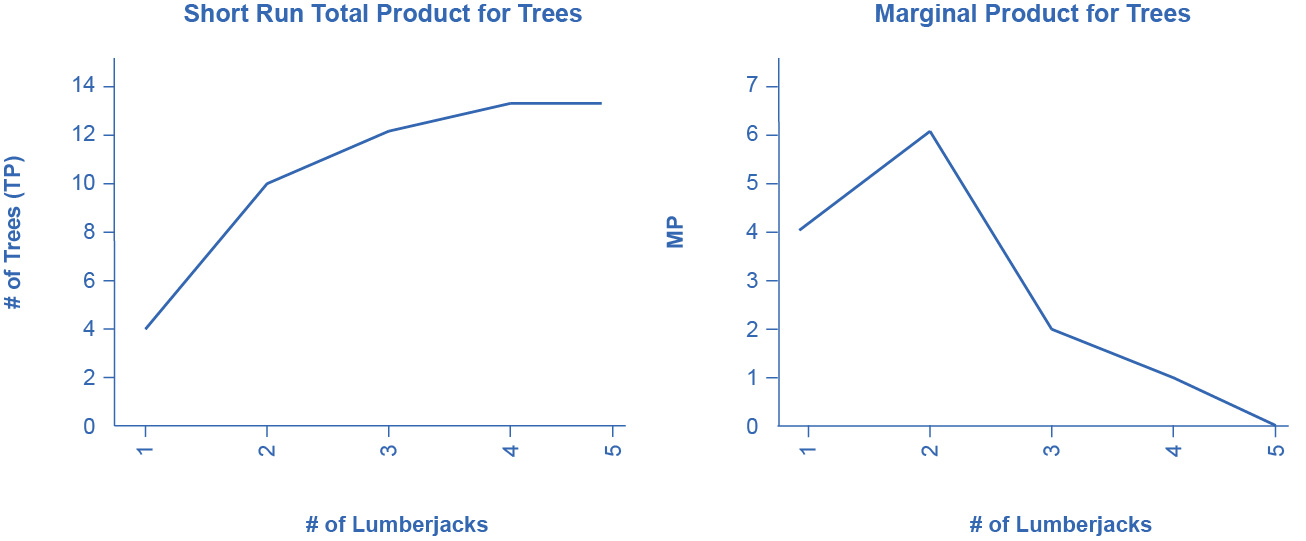
Figure 7.5図 7.5
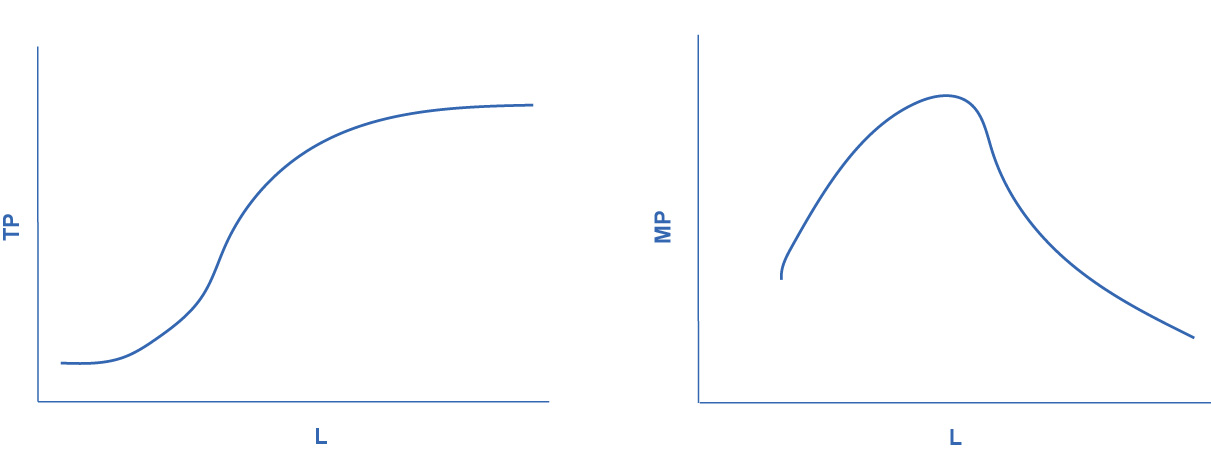


Figure 7.6図 7.6